Wednesday, January 22, 2014

Persuade the Bystanders

This post has to do with social justice – you know, topics like privilege, racism, sexism, classism, ablism, and all the other ignorant and/or hatey "isms" worth railing against. I'll get to those in a second.

In the early 90s, while arguing politics on BBS message boards, I realized an important truth that I've carried with me always:

When people argue in public, they will almost never convince one another. But they do influence the lurkers. 

WWIV message boards
My view of the world when I
learned this important life lesson 
Sometimes the persuasion is instant. Now and then a lurker will timidly post and reveal that their minds have been changed. But most keep this fact to themselves. More often, the change is slow. These lurkers continue to follow similar arguments, until eventually, they are swayed by whichever side has collectively made the best case. I myself have drastically changed my mind on deeply held beliefs in this way, both by debating and merely watching debates. I've also seen it happen to other people. But it's rarely instant.

It's hard to know that these neutral and persuadable lurkers exist. They are, by their nature, quiet. Very often, though not always, the more vocal a person is, the less likely they are to be convinced. So we tend to think everyone who doesn't use a megaphone is just like everyone who does. This is not true.

I think about the topic of persuasion alot. I'm a writer. It's my job to persuade. I also love debate, a casual pastime since childhood. Roland makes a wonderful and challenging debate partner to help me better understand what works and what doesn't. On top of all that, I've studied mind control, otherwise known as "coercive persuasion" – the ability of manipulators to convince people against their will.

I've learned about why people believe things, and what factors make people change their minds, and why people sometimes never will, even in the face of overwhelming evidence. Cognitive Dissonance is the mechanism we all employ to either accept or reject new ideas. It can be a very powerful barrier to persuading others that our position is correct. Cognitive dissonance is the source of all closed minds. There are ways around it – both ethical and unethical. I am more concerned with ethical persuasion.

I consider myself an activist. Anyone who publicly advocates for social justice, is, in my opinion, an activist. I am a woman and I have what some might call an invisible disability. In all other areas, I am privileged, but I consider myself an ally against racism and other hateful thought systems. I firmly believe that everyone has a different life experience, and it is generally best to never dismiss anyone's position out of hand until I've done my utmost to understand – even if I don't agree.

Social media has opened a new door for activists. It allows the voices of oppressed individuals and classes be heard by all kinds of people who were previously isolated. The internet democratizes the population by giving everyone a printing press and a megaphone. It's a beautiful thing. And every activist, whether they know it or not, is in a position to persuade.
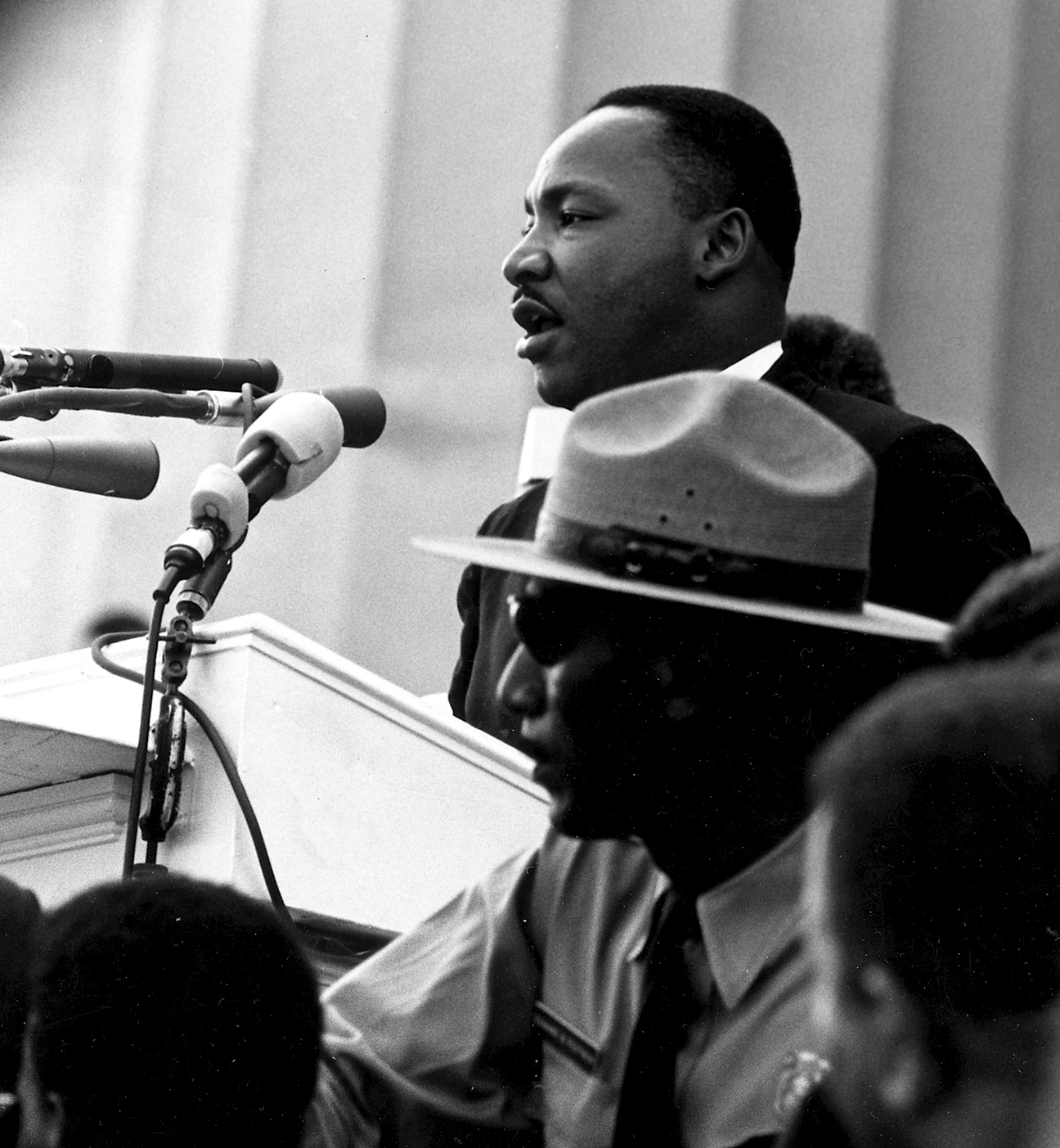
This guy is just like you. Everyone is listening.
Choose well what you will say.
Presumably, our goal is to make society better. To reduce hate. To eliminate ignorance. To eliminate unfairness. To prevent harm and prosecute those who hurt others. To pass laws that create the most equal playing fields for all people. Everyone should have the same opportunities for success, regardless of outward differences that so many in our society tend to get hung up on. I want everyone to be treated with respect, even if they're a different color, or gender, or disabled, or attracted to the same gender, or all the other things I've failed to list here.

In a democracy, the best way to accomplish all of those goals is to be persuasive. Activism, when done right, is persuasive. Anything else is just preaching to the choir – it feels good, but nothing gets done.

Given that, there are certain trends I see among activists that disturb me for two reasons:

  1. I don't consider these methods ethical. 
  2. These methods are not persuasive.

The Outrage Machine is constantly producing new horrors to raise outrage. Sometimes I believe this machine is persuasive, and other times I don't. Sometimes I think it is counter-persuasive. And that concerns me. Because I'd like to see society improve. I'd like to employ the best tactics.

So when I apply my mind to social justice activism, the question often is, "How could this message be more convincing? How can it reach more people and change minds?" Sometimes, I speak up about tactics. And when I do, my views are controversial, often because they're mistaken for taking up the other side's position, or being an apologetic, or dismissing someone's views, or perhaps not being enough of a cheerleader for our side, nor supportive enough of the cheerleaders we have.

None of those are my goals. I'm not dismissing anyone. I am not being an apologist for the other side. I am not defending horrible behavior. I am merely goal-oriented and thinking about the best ways to achieve the goals that all online social justice activists share – more fairness and equality and tolerance for all.

So here's my controversial statement of the day, and I hope you'll hear me out. Allow me to persuade you before immediately dismissing my argument. Please know I understand the counter-arguments and have given this alot of thought.

I've seen a certain sentiment echoed via Twitter and the blogosphere, usually coming from an underprivileged person directed at a privileged person (i.e. woman or POC or disabled or trans* directed at a man or white person or cis), and it goes something like: "It's not my job to educate you!" It is often delivered in an angry or dismissive or antagonistic tone.

In terms of accomplishing the above goals, it is entirely counterproductive.

Yes, I do understand where this sentiment comes from. Especially when, say, a feminist of color has been asked 50,000 times by hostile racist misogynists to explain why she's so upset, and she's given the answer 49,999 times, and she's being asked to speak for her entire race and sex to flaming assholes who aren't listening anyway. Her anger is entirely justified. As is her weariness in the face of this seemingly Sisyphean task. It is true, in fact, that Google is just a fingertip away, and all ignorance about any topic can be quickly dissolved like salt in water.

The endless questions themselves can be a rhetoric tool used to dismiss, belittle, and aggravate. So why waste even two seconds talking to those jerks?

I get all that, I really do. 

And I understand the double-bind. As a woman, I can choose to be labeled a bitch, or let people walk all over me. I am not allowed a middle ground. Similar thought-terminating cliches are employed to double-bind people of all other oppressed classes. I am not suggesting the answer is passivity and eternal politeness, bowing and scraping. Far from it.

And most especially, I understand that most oppressed people have no interest in activism and just want to live their lives without being bothered. They just want to be accepted as average and normal and don't want to go around thinking about their orientation, disability, or skin color. They just want to live. In this latter case, I think the "It's not my job" answer is most appropriate – it isn't your job.

But as activists and advocates, you actually have taken on the job. Maybe you only want it to be part time, but it's your job. By speaking up, you volunteered. It's a tough job, but worth doing.

No, it's not your job to educate the hostile instigator of controversy or the timeline troll who is just trying to raise everyone's hackles. That guy will never be convinced by anything you have to say. It's true. He is so enmired in his beliefs and has made public declarations of it, so his cognitive dissonance is nearly impenetrable. It is likely that when the world changes completely into a social utopia dreamworld, he will go to his grave willfully ignorant and hating.

Alas, educational and persuasive words are not meant for him. Your efforts are meant for the bystanders, the dozens, or hundreds, or even thousands of quiet lurkers. They're out there, neutral, or ignorant, or perhaps a bit racist or a bit sexist or any other *ist, but they don't feel too strongly about it. Not enough to join the argument. But they're curious, and they're watching each player make a case.

Pretend today the Outrage Machine has identified a new controversy and brought it to the rapt attention of the information-obsessed internet. Someone gets wrongly fired from a job, or groped at a con, or catcalled, or outed, or harassed, or murdered. Some person in power says something stupid, and advocates reply, and anti-advocates reply back and everyone's in an uproar for a few days. This is the chance to convince that silent neutral ignorant majority. They are all near the fence. They think sexism is over, or transwomen are just confused, or bisexuals don't exist, or Muslims are more protected than Christians, or any black kid has it coming because no one gets shot unless they deserve it, or whatever ignorant thing they believe. This is the chance of advocates to convince those bystanders.

I believed many of those things once. And over time, effective arguments finally got to me. Advocates finally educated me. And not usually because I sought the information out on my own. Usually because people kept pointing me in the right direction.

That's the point of publicity. You hold a megaphone, just for a few minutes. You've gotten someone's attention. In this age of the information firehose, that's the hard part. Now how are you going to most effectively use it?

Even the small-time advocate who doesn't have a big platform, who rarely says much of anything, has a huge opportunity to convince these silent types, because their followers are their friends and family. We are much more influential to those who know us and like us personally. Yes, those Facebook debates are frustrating, because no one seems to listen, but the silent readers are paying attention.

This is how the most recent victories in marriage equality were won. A majority of the mainstream public was swayed, not through anger and righteous indignation, but through family members who came out of the closet and stood gentle yet firm on their rights to be gay and to love and commit to who they wanted. Eventually, few loving family members could imagine a world where government would bar their happy union.

Injustices happen every moment of every day. Outrage can spark quite an inflagration of justifiable anger that sadly, too often, turns to hostility, or ostracism, or shaming, or personal attacks, or blatant logical fallacies. And when this happens, you've lost the moral high-ground. You have ceased being persuasive to that silent, neutral, convincible audience. And then it doesn't matter how right you are. Because anyone who might have been listening will turn against your position. The opponent wins an easy victory. Score one for the trolls.

Even more tragic and destructive is when misdirected anger scares away fellow advocates and allies – even those in the same category as you (fellow women, POCs, LGBTs, etc). These are people who are already convinced of your position and want to help. They observe this open hostility and feel judged or lumped in with the haters because of a slight variance in opinion. They may already be marginalized by being themselves in the oppressed class, and now they feel marginalized further by activists who claim to be advocating on their behalf. They may become terrified to say anything, lest it be the wrong thing, lest your irate gaze turn instead on them. Intersectional individuals are even more at risk for this type of dismissal and marginalization.

I myself have been in this position amongst my fellow feminists, sometimes for defending intersectional classes (like advocating trans rights to rad fems), and sometimes because my opinion on tactics differed. (I'm generally against boycotts, for instance.) I'm fine with people disagreeing with me, but I've also been actively shamed for holding these and other stances. Shaming, threatened ostracization, and personal attacks go too far.

This type of hostility makes it frightening for fellow advocates to contribute to the discussion. For instance, it made me hesitant to write this post. Thankfully, I'm the type of person who doesn't like to be silenced in the face of fear. Others are understandably more timid.

We need more diversity among our voices, not less. And more tolerance. Don't we believe that both diversity and tolerance lead to a better world? We need all the allies and advocates we can get, waving the banner, even if some choose to wave it differently than you. Punch upward, at the system, at the oppressors, at the powerful, at the bad guys. Don't punch sideways at the ally standing next to you just because she's easier to hit.

Oppressed people have much to be angry about, and I would never rob them of their anger. Anger is a valuable emotion. It motivates and feeds energy into individuals and groups and causes. I am not advocating for less anger – I am suggesting that those energies be channeled persuasively to produce the most positive outcomes.

(And in the moment of offense, especially when there is no audience, untamed anger very much has its place in defending individuals against in-progress assault or insult. I am not suggesting passivity or politeness when rights need to be asserted to a hostile *ist who insults and then demands to know why it was insulting. Since you likely will never convince him, that's the time to growl and spit, to say it's not your job, and to gently or not-so-gently direct him to Google. Or not. Depends on you and the situation.)

Updated to add: Sally Kohn puts it another way in her TED talk, "Let's Try Emotional Correctness".


And Mattie Brice recently wrote about anger in protesting the video games industry, suggesting we put behind us the demeaning hostility in 2013.

It's true that maintaining the moral high-ground can be exhausting. We can't do it all the time. Sometimes I tweet or blog my opinions. Sometimes I advocate. Sometimes I give the long answer.

And other times, I'm busy, I just direct people to others who have written more eloquently than I. Think about it: If, instead of saying, "Correcting your ignorance is not my responsibility," you suggest a well-known educational website or blog post on the topic, like Unpacking the Invisible Knapsack. You not only give that hostile person a chance at graceful, face-saving redemption, but more importantly, it's another opportunity to distribute that content to every single one of your other followers, many whom may have missed that particular blog post, or have never been exposed to content that you think is obvious because you read it a decade ago.

There is much to be said for "brand awareness", a tactic commercial marketers understand well. Every chance you have to retweet the same link to yet another person asking the same questions, your other followers will begin to see that content as legitimate and worth consuming. Maybe they meant to read it last month, and have forgotten. You're making it easy for them to educate themselves and maybe even join the cause.

Other times, the good fight becomes overwhelming. It's exhausting to be outraged all the time. That's when I take a break and let others pick up the banner. Sometimes I do this because I am far too emotional to think clearly. I'd rather sit out the Outrage Machine's churning than say something that loses points for my side. Because I want my team to win. It is possible to communicate "It's not my job" in a way that doesn't detract from the overall argument or your future ability to be persuasive. Like, "I don't have time to answer that right now. Could you please google 'cis privilege' on your own?" Or just remain silent. That gives the hostile troll the last word, but most likely, it will reflect worse on him than you.

It's true that my white, cis, thin, mostly-abled, * privilege gives me the luxury to sit alot of these out, a privilege not everyone may have. I realize that I live relatively free from various kinds of hostility that lets me take these breaks. It's a little easier for me, perhaps, to go on an anger diet, to step away from the keyboard when emotions run too high. In many ways, this might be "easy for me to say". I still think these suggestions are tactically the most effective, and worth employing whenever possible.

In the end, we all have our own journey and our own idea of what's right and wrong. It's your social media platform, so please, do with it what you will. But hopefully, I've been just a bit persuasive here.

Let's go out and change the world.

Labels: , , , , , , , , , , , , , ,

Wednesday, July 18, 2012

Claws and Fangs - An Allegory Of Privilege

A few years ago, a comedy movie called Swingers told the story of a group of men who went to bars and picked up chicks.  This clip is SFW, though with some use of the F-bomb:


Please set aside all nuances of sexism that may or may not be in this scene or in my extrapolation.  Do not be distracted by my overuse of the term "bunny".  Because that's not the point.  As Dr. Horrible said, "It's not a perfect analogy."

All men are money.  All men are big bears with claws and fangs.  Some of them are batting bunnies around not knowing how to kill them, or even if they should.  Some are gently frolicking alongside the bunnies, having a great time.  Some are working with the bunnies, finding common causes, building upon each other's strengths and weaknesses to accomplish big-forest-things. (Stay with me here.)

A few bad bears know perfectly well that they have those claws and they go for the kill every time.

Bears have strengths that bunnies clearly do not.  Bunnies are small and weak and their claws are more like long toenails and their teeth are good for eating vegetables.  

The bear is privileged.  The bunny is not.  Whether the bear knows it or not does not change the fact that the bear is massive and strong and has claws and fangs.  Even nice bears still have those claws and fangs, and no matter how nice they are, they will not turn into a bunny.  If the bunny says to the bear, "My, what big fangs you have," she is not actually saying, "You're a stupid jerk evil bear who wants to kill me."  She is merely pointing out something the bear has that she does not.

In real life, most bears are actually more interested in eating berries than bunnies.  (The Black Bear here in Washington State is 85% vegetarian.)  So let's lie with statistics, and assume in this corny analogy that 85% of bears aren't at all interested in bunny-flesh.  15% of the bears will, like Mikey the Swinger in the above clip, learn to use those claws and fangs to intentionally kill every bunny they see.  
Mr. McNiceBear is representative of the majority of bears.  He is so money, and he doesn't even know it.  One day, he is rummaging around in the woods, minding his own business, looking for tasty roots.  

And then it happens -- he steps on a bunny.

And the bunny is squealing like a banshee and in pain and bleeding from huge claw marks all down her side.

Mr. McNiceBear says, "What's the matter?  I didn't do anything.  You should have gotten out of my way.  That doesn't hurt.  Stop whining."  

The bear is so money, and he doesn't even know it.

It's not the bear's fault that he has claws and fangs.  It's just how things are.  Only the most Radical Anti-Bear Bunnies blame the bear for being who he is.  Nevertheless, it is dangerous to be a bunny in a bear world, so the bunnies keep trying to explain.  They would really appreciate it if the nice bears would try to be more careful.  They only want the nice bears to realize just how money they really are.  

When Mr. McNiceBear accidentally steps on a bunny, instead of blaming the bunny, she wants him to apologize and ask if she's okay.  If the bear is confused, which is understandable, she wants him to ask, politely, for details.  She wants a chance to explain why the trampling hurt and where he should avoid stepping next time.  

And when the bunny points out she is tiny and has no claws and fangs, she would really love it if the nice bear would just believe her.

Sometimes the mean bears come.  They're the ones who know they're money.  They're going for the kill...   Sometimes they're not quite even mean... they're potentially-nice bears who are poking at the bunny.  

This is Mr. McNiceBear's time to shine.  If he's been paying attention to the bear-bunny dynamic, he can step in and tell the mean bears to lay off.  He can tell the potentially-nice-batting-bunnies-around-bears to lay off.  He could explain to the other bears, whether nice or mean or in-between, that the bunnies don't have claws and fangs.  

But all too often, Mr. McNiceBear doesn't know what's going on, because he hasn't been listening to the bunnies.  He doesn't see all the claws and fangs swinging about, like the bunny does.  And all too often, Mr. McNiceBear wants to impress the other bears.

So he stays silent.

Some of the bunnies are sick of it, and they talk amongst themselves and try to make changes, and all the bears, even the nice ones, fight them tooth and nail.  Yet in spite of this, over time, the bunnies finally manage to make a few things better.  They got some rules passed a while back to force bears to be more careful while walking on trails, and they bring about some awareness of non-consensual bunny killings.  

And the bears say to the bunnies, even the nice bears, say, "You got what you wanted.  You should have claws and fangs now.  You can finally stop complaining." 

And the bunnies look at their paws and think, "No... no, these are still just glorified toenails."  Things have changed, but they have only changed a little bit.

If it's not clear, the bears represent men, and the bunnies are women.

Privilege is naturally ignorant of itself.  It's only human, to take for granted all the cool things we have.  We take it so for granted, that we assume everyone has the same things we have.  And if they don't have it, it must be their fault.  Or they must be lying.  Or overreacting.  We fear that to accept our own privilege is to accept some kind of guilt.  No one wants to be a bad person.

Privileged people aren't evil.  I have plenty of privileges as a woman that, say, a black man does not.  It doesn't make me a bad person.  I was born this way, into a system I did not consent to.  No amount of guilt or gnashing of my teeth will change that.  But I do have power over one thing in this screwed up world:  I do not have to remain ignorant of that privilege.  I do not have to deny it.  To do so means I continue to unintentionally harm to fellow human beings.

There are certainly men who know they are privileged over women and they use it as a weapon.  But most men do not know they are privileged.  They are nice men, good people.  Or they try to be.  But now and then, they accidentally hurt women without knowing why.  

A nice man in this position may get defensive.  It is understandable, if he can't see the privilege he has.  It feels to him as if he is being attacked for no reason.  He doesn't think he's a bad person, but suddenly, here is someone who seems to be saying he is a bad person.

But really, the woman isn't saying he's bad.  Just that he needs to notice some of the advantages she doesn't have, and that he needs to be more careful.  His continual missteps are very painful, and his denial of the female experience is even worse.  

Like most men, he doesn't mean to harm women.  But he does.  He is so money, and he doesn't even know it.

There is a third kind of man.  A rare kind of man that I appreciate so much.  He is aware of his privilege and is willing to pay real attention to the experiences of women and acknowledge that it is quite different from that of men.  He realizes that women are experts on women, and that if he really wants to what women are so upset about, maybe he can go to the experts and learn.

He's learned many of the ways that women get trampled, oppressed, abused, bullied, belittled, gaslit, demeaned, paid unfairly, harassed, and ignored.  He has empathized.  He's on our side, not just in intention, but in action.  

These men sometimes still make mistakes.  And the women around them appreciate that they acknowledge their mistakes rather than deny them.  We appreciate that they defend us to other men who are ignorant, and especially to the men who are just plain mean.

That's what most feminists really want.  We want the well-intentioned men to stop getting so defensive.  We will think more highly of you if you learn how to stop trampling on bunnies by accident.  And when you do misstep, to just say, "I'm sorry," and "Please help me understand why that was painful."

You're like a big bear, man.  We know you're a nice bear.  Just watch how you're using those claws.

Labels: ,

Monday, June 4, 2012

Gender Politics on Game Night: "Apples to Apples" vs "Blokus"

I love games.  I love games of every type: LARP, PC, console, board, card, RPG, strategy, and puzzle games.  I like games that are difficult, that make me think.  And I love games where I can sit back and relax and do something mindless for hours.  I love meaningless social games where everyone wins.  And hardcore competitive games where the loud shout of "Headshot!" booms bass from my speakers in a crowded room of a LAN party.

I'm really good at many games, and pretty good at most games.  I used to avoid games I totally suck at, but lately I can play them without caring too much about winning.

For many years, off and on, I've hosted game nights where random friends show up bearing games and snacks.  A card or board game is selected by democratic process, and fun is had by all.

A few years ago, I attended a large game night with twenty or thirty attendees in a large house.  Some of the people I knew pretty well, and others were new to me.  We had enough people for two or three simultaneous games.  At some point, Apples to Apples was starting up in the living room, and Blokus was coming out the dining room.

In case you're not familiar, let me describe these games.  Apples to Apples is a party game that large groups can play.  The rules and strategy are very simple.

A very girly card played during a very girly game.

The judge draws a card.  In this example, he reads, "Touchy-Feely! Affectionate; Tactile, Huggy!"  Players then select from their hands cards they think the judge will find most touchy-feely...  They throw them into the pile upside down, and the judge reads off all the red cards in a dramatic or amusing fashion, explaining the rejects before settling on the winner.  In my case, here I would choose "spiders", because I freaking love adorable cuddly spiders.

In this example, "Risky", I'd choose "Cocaine"... because when I use a wood chipper, I know exactly who I'm putting in there and why.
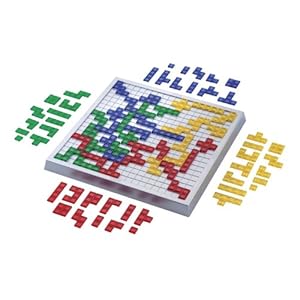
Blokus is a very different game.  There are a fixed number of players, up to four, and four works best.  You are given a pile of brightly colored geometric shapes and a series of specific rules on how to place them on the board.  Your goal is to lay down as many of the pieces as possible while blocking your opponents' ability to do the same.  It is a highly competitive game requiring feats of logic.
The only 8-bit board game.
These two games could not be any more different from each other.  And I love both equally.  Depending on who I'm playing with, I'm usually more likely to win Blokus than Apples to Apples... and as I said, everyone wins Apples to Apples.

So we're at this party, where an Apples to Apples game is forming.  I'm standing in the dining room with two other guys, and we're trying to talk another guy into being the fourth player in Blokus.  One of the guys, someone I've not met before, says something like, "It's better than that girl-game they've got going in there."

Errrrt.  Time to bust out my newly-formed infant inner-feminist.

There was a time when I'd let this comment slide.  After all, who wants to be the rude angry bra-burner, when he's perfectly innocent just ignorant and we're all just trying to have a little fun?  The fear bubbles up -- how am I going to put this complicated concept into words he'll understand?

I turned on him and opened my mouth in spite of my fears.  I said, "What?"

He repeats what he'd said, then makes some excuse.  "You know, it's a girl-game.  What's wrong with that?"

"And I suppose Blokus is a boy's game?"

He nods, a little sheepishly, but only a little.  "It's no big deal," he says.  "You know what I mean."

"It is a big deal," I say.  Then I explain to him, exactly and persuasively, what I mean.  I ask him, "Do you work in the IT field?"  Most guys at these Seattle game nights are.  He nods.

At this point in my life, I had worked in IT for ten years.  Ask any woman who has worked in IT for long.  I had experienced what most of us have:
  • A former boss spent most of our conversations staring at my breasts.
  • I'd been denied promotions, only to have outside male-hires fill those positions.
  • When answering the tech line on the phone, I'd heard the words, "I'm sorry, I was trying to reach tech support... can you transfer me?" more than once.
  • I'd had persuasive arguments for decisions ignored until my male underlings said the same things to the same people, and then the decisions were made.
  • I was repeatedly honored for being an awesome "webmistress", then a "guru", then a "rockstar", yet continually made 40% of the market average for my position. 
  • If you had any kind of computer problem, I could solve it, but had a hard time convincing a lot of men that my opinions were worth anything.
  • I went years thinking I was the only women this ever happened to.
I also had won almost every Blokus game I'd played up to that point.

So I say to him, "Most likely you are or will be in a position to hire."

He nods.

"And you think that women are good at social word-association touchy-feeling games, and uninterested in logic games.  Which means you may generally think women are bad at logic."

At this point he says something about thinking not all women were bad at logic.  Obviously some women are good at logic.

"That's a problem," I said.  "Because the IT field requires logic as a primary skill.  Someday, you will interview two applicants of equal experience and skills.  One will be a woman, and the other a man.  And the woman will have to somehow prove to you that she logical enough to get the job.  The man won't.  That is why it's a big deal."

He looked abashed.  He looked convinced.  We went on to play Blokus, and I won.  I pwned three guys in a competitive game of logic and strategy, and I hope at least one will someday interview a woman and remember that night.  And that she will get the job.  And that she will be treated well at that job, and that her opinion will matter, and that she will have equal opportunities for advancement.

This personal story is important on this week when a sexual harassment lawsuit is beginning in Silicon Valley.  Liberal geeks on the West Coast, in the IT field, consider themselves open minded, advanced, pushing the envelope not just in the tech fields, but in culture and social interaction as well.  The geek men in Seattle have long hair and wear kilts and T-Shirts with swear words and they are sex-positive and tolerant and they're well-read on advanced concepts of political theory and history and .. well, they're aware, and they're smart.

Geeks should know better.  Yet according to employment statistics, they don't.  According to that one guy, at that one game night, they don't.  Women are less likely to enter the computer field, less likely to climb the ladder to management and executive levels, less likely to make as much as men in the same positions, and more likely to leave the computer field for a new career.  (I did.)

There are a lot of reasons for these stats, and I'm willing to acknowledge there are many factors, including pregnancy, women's difficulty with knowing how to negotiate, and women's tendency to try to be "nice".

Yet I cannot overstate how men's attitudes towards women play a direct role in keeping women discouraged.  I was strongly motivated in my career, not only to make more money, but to influence my company.  No matter where I worked, I always wanted to help my company succeed.  I wanted to make operations more efficient, I wanted to make our systems run as smoothly as possible.  I wanted our products to be better.  And I invested a lot of thought and energy at each company towards these goals.  I didn't see myself as any different than my male co-workers.  But they did.

Being shot down repeatedly is demoralizing enough.  To know that at least some of those times I was dismissed because of my gender is intolerable.  At one company, early in my career, I'd been shot down so many times, I remember finally giving in and giving up.  (Especially when they kept hiring men for the IT Manager role that I was basically doing, without the title or pay.)  I decided to stop rocking the boat and just settle into the shoes they wanted me to fill... just fix the computers and make everything run, without a budget or the authority to make decisions that no one was making.  I literally kept the network together with duct tape.

What they needed:  A smart, driven person to make decisions and keep the network running.
What they had:  A smart, driven person to make decisions and keep the network running who happened to be female.

The Silicon Valley lawsuit story combines with another new story.  Global labor statistics reveal the jobs most difficult to fill.  Even with unemployment at 8.2%, STEM (Science, Technology, Engineering, Math) jobs continue to go unfilled at crippling rates, especially in hard-logic roles like Infosec and Network Architecture (two fields which were options on my career path).  Of the top five hardest positions to fill, STEM fields make up four of them, including IT jobs.  49% of companies in the US have difficulty filling jobs.

These numbers will have a huge impact on our country's role as a technology innovator.  It will have a huge impact on our GDP.

Is it just a coincidence that fewer women are entering these fields during the same period that these fields are starving for employees?  Women make up half of our population -- shouldn't we be represented 50/50 in STEM jobs at IT firms?  And shouldn't women help run these companies?  I worked for five tech companies in my career, and with one exception where a small consulting firm was started and owned by a woman, the only women in C-level positions were in HR and Marketing.

Gender stereotypes might be funny to joke about at parties.  They might not seem like a "big deal".  It's all good.  It's just game night.  But real women are being hired and fired based on that stereotype.  Women who could contribute.  Women who might help your bottom line.  Women who probably would take your company to the next level against your competitors, if only you'd listen to them, if only you'd give them credit, and if only you'd pay them what they're worth.  Women who could help keep this economy afloat if society would only stop barring and discouraging them from positions that are desperately needed.

One thing I can say for sure.  This woman will gladly challenge you to a game of Blokus, because there's a strong chance I'll win.

Labels: , , , , , , ,

Tuesday, May 15, 2012

What's So Wrong with Being the Healer?

Today an interesting conversation came up in my Twitter feed.  It echoed a conversation I had with one of my daughters yesterday, about the role of gender and the celebration of fighting over more peaceful activities.  With my daughter, we discussed girl cartoons vs boy cartoons.

Specifically, Jem, who uses science and technology to create music, vs. the Transformers, who use science and technology to cause devastating explosions.  Even though my daughter is female, she thought the girl-shows were lame.  Shooting things was much, much better.

The Twitter conversation was about gaming, specifically related to today's release of Diablo III.
Oestrus is a woman.  For those who might not automatically guess, this statement is potentially controversial in a gender-politics kind of way.  Why?  Because stereotypically, women are healers in games.  Moreover, this reflects real life, in which women are healers, nurturers, and in general, sissies.  (The word "sissy" was invented to describe what weak little girls women can be.  Men can be unflatteringly accused of being in this state.)

One could easily imagine a man mocking a female gamer by making the above statement in a highpiched voice.  "And then my girlfriend was all like, 'Are there healer thingies?  Can I follow you around and heal all the things?  PLEASE?' and I was all line, no ho, get back in the kitchen!" (Cue bass laughter.)

I didn't see the original post first.  I saw the reaction:
This is an understandable response.  i.e. stop acting the stereotype, because you're going to prove what men have been saying about us all along!

This kind of thinking makes a few assumptions that bother me.  It assumes that being a healer is undesirable.

There are simulations of living things flying around on the screen and the healer is not helping them to die.  You're just going around making injured people feel better, and that is not very respectable.

There is a kernel of fundamental sexism rooted in this assumption, so deeply, that most people, even women, miss it.  It is such a basic part of our mental reality that we take it for granted.  The male paradigm of what is important, and what is not, is so accepted as truth that we will not question it.

The question should be: What's so bad about healing?

We assume it's weak.  We assume it is not very hard.  We assume it requires no skill.  We assume it doesn't help anyone win the game.

Yet none of this is true.  In most serious MMORPGs, there are basically three roles (sometimes broken into sub-roles):
  • Tank: Takes damage and keeps mobs (monsters) from attacking other players.
  • DPS: Deals massive damage.  Can be ranged or melee.
  • Healer.  Heals people and buffs them (makes them stronger).
Anyone who has seriously played an MMORPG actually knows, deep down inside, that healing is essential.  It is a difficult skill to master.  A poor healer will cause a party to wipe far more often than a poor damage class or tanking class.  The tank's primary job, actually, is to keep the healer alive.

A good healer can often make up for poor performance on the part of any other class.  Our team is not doing enough damage?  That's okay.  I will keep you alive long enough to kill it.  It just means the fight takes longer, but we will live through it.

A healer in PvP (Player vs. Player, considered some of the most hardcore gaming on MMOs) is golden.  A team with good healers will beat a team with no healers or bad healers any day.

I rarely play a healer.  I rarely feel up to muster.  I know that the tank (who usually leads parties) will chew my hide if I fail as a healer.  Healers get yelled at.  Healers hold the life of the party in their hands.

My lovely girlfriend?  She is happy to take on this enormous responsibility, and I respect her for that.  And she is good at it.  And every time there are open calls for raid parties or in PvP queues, she is first in line.  All healers are.  Because there aren't enough of them to go around.

Maybe there aren't enough of them because the role is downplayed.  Because it's sissy.  That's a character only girls play.  Or the larger picture: The role of healing in our entire society is downplayed.  Who cares about healing when we can build stuff, or better yet, kill things?

So a lot of men don't want to play healers.  And a lot of women trying very hard not to seem like women don't want to play healers.  (I didn't want to give this video airplay by linking, but it is appropriate.)  What we end up with is a shortage of healers.  It should be obvious to everyone how necessary they are, when a party can't even do a raid without them.

Another gaming analogy went around today.  John Scalzi wrote about how being a white male is like playing an MMO on easy, while everyone else has to play on hard.  Games simulate life, and so it only makes sense to bring the metaphors back to reality.  What can we learn about real life from looking at how healers are perceived?

Think about our healing classes in real life: Teachers, nurses, mothers, day care providers, HR managers, psychologists, massage therapists, social workers.

Unless you're lying to yourself, or an alien, your idea of these careers evokes a reaction in you: One Big Giant "Meh!"  Who wants to do any of these things?  Compared to rocket scientist or police officer or lawyer or airline pilot, no one does.  They are weak roles, anyone can do them.  They are boring, at best necessary evils - the kids must be taught, and someone has to clean up after sick people.  Only janitors show up lower on the totem pole, in terms of respected careers.

(Doctors are an exception, a respected healing class.  Perhaps that is because it is still not a female-dominated career.  Many of the above listed careers more respected back when they were male-dominated.)

Is the problem that women act in nurturing ways?  Take nurturing jobs?  Are we too eager to be healers?

Or is the problem that we accept the sexist undervaluing of these roles?

Rearing children is amazingly cool.  It is difficult.  It requires skill, and it helps society win the game.

Psychology is awesome.  It fixes people's brains.  It makes people happy.  It is difficult.  It takes a lot of skill, and helps society win.

Social workers help lift people up, keep people going through hard times.  It is difficult.  It helps society win.

Admin assistants (aka secretaries) are awesome.  Like healers in MMOs, they juggle a thousand different things, run all over the place, get it all done in time, and get yelled at if they let anyone fall down.  It is difficult.  They help a company win.

We could "stop acting the stereotype", but that won't lift the oppression.  If we are reacting against the gender roles by stepping into male shoes, we validate the existence of those roles.  We continue to perpetuate them and allow them to oppress us.

If women are avoiding acting the stereotype so we can be "free" of oppression, then we're no more free than we were barefoot and pregnant.  Sure, it will lift oppression for women who would rather work in male-dominated fields (as I once did in IT, and arguably, still do as a writer).  It will help women who want to be successful tanks and damage-dealers.  And that's great.

But it won't help those people, both women and men, who want to be healers.

What we need to do is not question the stereotype, but question the value placed on the stereotype.  What's so wrong with choosing to be a mother, if that choice is available to you?  What is so wrong with being a nurse or an HR manager?  What is wrong with being a healer?

Women should be able to play whatever character we want.

This goes past gender politics.  This goes to the bedrock of some of the ills of society.  This world is in need of good healers.  Humanity needs more people (men and women) competently doing very difficult and valuable jobs.  If we respected the results of good healing as much or more than we respect skillful damage-dealing, perhaps we'd have fewer lawsuits and wars, and more happy, healthy, functional people.

Gaming shows us it's possible to heal and be competitive.  It is possible to heal and help everyone else win.  It is possible to cooperate and win in a competitive way.  Let's learn from that.

We've been programmed to dis peaceniks (hippies and sissies, the lot of them), just as we laugh at healers.  In the long run, shifting our values could make for a better society, one in which it is valuable to heal and be healed.

If you are a healer, you are awesome.

Labels: , , , , , , , ,

Saturday, March 26, 2011

Analysis of Sucker Punch - A Feminist Perspective

Sucker Punch was released this weekend to extremely negative reviews, with a score of 36% on Metacritic, and an abysmal 20% on Rotten Tomatoes. You can't set expectations much lower than that, yet I enjoyed every minute of this film.  I am still thinking about it this morning, and all its implications, hence this blog post.

I will start with a non-spoilery review, and then launch into a detailed analysis of Sucker Punch from a feminist perspective. 

I know why critics did not like this film.  And so in this review, I will tell you what you need to bring with you, so you can enjoy the film as much as I did.

First, watch this trailer.  It is the best of the trailers, and gives you a good setup to help you understand what is going on.  It is a deeply-psychological movie, in the tradition of David Lynch (Twin Peaks, Blue Velvet) and Charlie Kaufman (Eternal Sunshine of a Spotless Mind, Being John Malkovich).  Additionally, it is a "layer" film, like Inception or The Matrix -- there are multiple versions of reality.  Armed with that knowledge, you should be able to suspend disbelief, sit back, and go with it.  No part of you should be screaming "That would never happen!", because when you're inside someone's mind, anything can happen.

That said, the fantasy action sequences should not be considered gratuitous.  This movie illustrates how the human mind deals with severe trauma in order to survive.  If you have a basic understanding of dissociation -- the idea that the mind can detach from reality in order to not experience pain -- the entire premise is not only plausible, but meaningful.

You are joining a girl's fantasy, created to protect her mind from the terrors she will experience in a mental institution in the early 20th century.  Unlike Lynch's Mulholland Drive, (Salon.com analysis here), the narrative is well-portrayed in a chronological, clear storyline.  It is easy to follow if you understand the premise at the outset.

In other words, be prepared to take certain parts of the film unseriously.  Enjoy the ride.  Take other parts very seriously.

It helps to have seen a number of darker comic book movies like 300 and Sin City, as well as a few over-the-top kung-fu movies like Kill Bill, Crouching Tiger Hidden Dragon, House of Flying Daggers.  Being familiar with Japanese animation will also help.  Snyder very much captures the feel of all three genres.

A basic understanding of feminist issues will also contribute greatly to your enjoyment of this film.  When the credits rolled, I said: "This film is a summary of the experience of women throughout the 20th century."  My hope is that women will have a better time of things in the 21st.  In the meantime, this film has much to teach the ignorant about the plight of women.  It is a primer.  If you think feminists are a bunch of angry women who whine for no reason, or bra-burning dykes seeking revenge against males, go see Sucker Punch, and then come back and read my analysis.

Lastly, be prepared for a very dark story.  It crosses some barriers of what's "ok" to do in a movie plot.  Be prepared to let go of your notions, because much like another Zack Snyder flick, The Watchmen, this film is unafraid of revealing harsh reality in a fictional guise.

If you are a writer or connoisseur of storytelling, and have not seen the film, refresh your memory of the Hero's Journey before viewing.  It follows the steps very closely, and it was a joy to watch this unfold.  There is perhaps, arguably, even a meta-Hero's Journey, which I mention with a bit more detail in the spoilery section.

Many critics slammed the acting, but I enjoyed the actors.  Somehow Emily Browning (Baby Doll) captures the essence and spirit of an Japanese anime schoolgirl, even though nothing about her looks Japanese.  She manages to pull it off in spite of her Scandinavian eyes and too-blond hair.  She fills the rest of the film with soulfull looks that seem to tap the heart and the "ethereal beauty" centers of the brain.

Those reviewers who did not understand the psychological premise, or those who were unfamiliar with or do not like the genres listed above, may have thought the film incomprehensible or over-the-top.  But mostly, critics hated it because they did not have the feminist context through which to interpret this film.  It breaks certain rules and exagerates certain norms, the combination of which I believe many people would find disturbing or nonsensical.

If good stories examine the human condition, then this is one of the best.

Now, go see it, and then read my analysis.

Warning: Here There Be Dragons Spoilers

This movie tells the tale of a girl placed in a mental institution in the 1950's.  Really, it could be set at any time from 1890-1970, which is why the fashions and sets contain so many anachronisms.  The essential structure of the plot actually happened to tens of thousands of people, particularly women, through that time (and before).  All it took was an accusation of insanity by a significant male (father, husband, brother, doctor), which would typically go unquestioned, and a woman could find herself in Baby Doll's place: Committed to an institution rife with mental, physical, and sexual abuse.  Not only that, she is on schedule to receive a lobotomy.

If you accept that this tragic premise is so true, so incredibly real -- if you understand the history of these women, who were entirely powerless and could do nothing but try to cope -- then you can understand the rest of the film.  It also helps to note that while the psychiatry field has been "cleaned up" in recent decades, and rarely perpetuates these abuses, this reality of powerless women still exists in many other areas of life, even here in America.

Then we are faced with two layers of Baby Doll's fantasy world.  In one, she is being placed not in an institution, but in a 1930's bordello.  In fact, some part of me wondered if that was her "true" reality, since this is the layer we are most frequently return to.  The rape subtext implied in the institution is replaced with ownership-prostitution, and we see that there aren't many differences.  In both they are powerless, in both they are used, in both they are treated like objects. 

And in both, with no other tools (or "weapons" as the film euphamistically calls them), they are forced to use their sexuality to attempt escape.

This is a shocking fact that many movie-goers do not wish to face.  Women should not have to use their sexuality to get what they want, but the sad reality is, women with no other options must and will use their bodies.  And for doing what they must, they are later harshly criticized, and sometimes further victimized, for doing so.  It is the last choice available for Baby Doll and her friends, and so they take it.

When Baby Doll dances to distract her captors, we never get to see her moves.  She dissociates from a distasteful, unpleasant use of her body, the way many victims of sexual assault do to survive the physical and emotional pain.  (And I wonder if "dancing" in the bordello layer is an escape from sex on the institution layer.)  Her form of dissociation plunges her into a third layer of fantasy, wherein she is a powerful warrior equipped with a katana and pistol.  Here she is capable of destroying dragons and twenty-foot demon samurai.  Her sexual power transforms into real power.  The other girls are likewise equipped with symbols of male power: machine guns, shotguns, knives, swords, and perhaps most threatening of all (to the male hierarchy), technical expertise with helicopters and airplanes.

Yet the women are still sexualized in their scanty outfits, which one reviewer called an unzipped geek-boy fantasy.  Even here, Baby Doll cannot shake the sexual roots of the power she is using in the "real world".  She may be defeating steam-zombies and high-tech robots with impossible slow-mo battle moves, but in reality she is just shaking her booty to distract the men so the other girls can gather the tools of escape.

Reviewers can blame the writer and director for the situation these girls are in, but Zack Snyder merely holds a mirror up to our own society.  (I believe the The Social Network intended the same thing, when every single woman in that film (with one exception) was brutally objectified.)  Many don't like what they see, and even fewer understand, and so they are left squirming, vaguely aware that something is not right.  But when one in four women in America are sexually assaulted, many before the age of 18, we need to make films, (and yes, even PG-13 films with glossed-over details), to expose the seriousness of these crimes towards women.  (More rape statistics here.)

Perhaps, like Baby Doll, society itself likes to dissociate, fantasizing of a world in which women are happy with their lot, where females are really powerful, and where rape doesn't exist or doesn't hurt anyone.  We want our movies to support these fantasies, and when they do not, like in Sucker Punch, we fail to comprehend it and criticize it as done by a "filmmaker who has absolutely nothing original or even coherent to say." (New York Post review)  And yet this is one of the most original and thought-provoking movies I've seen all year.  I would expect those ignorant of white male privilege to be blind to its merits.

Even at the end of the film, when Sweet Pea boards the bus to freedom, it is only by the grace of a male that she gets away.  After all that work, she must still pass a male gatekeeper, who knows nothing about her, yet through the kindness of his heart, lies to the police and lets her get on the bus without paying for a ticket. 

Like The Social Network, there is but one powerful woman in this movie.  And she is the psychiatrist, Dr. Gorsky.  Yet even her power is subjugated through the "good old boys network" run by an evil orderly, who falsifies signatures and takes money from men to get rid of troublesome girls.  Once she learns of this racket, she has the ultimate authority and has Blue arrested.  Yet she is incapable of saving Baby Doll or any of the other girls from their tragic fates.  Her powerlessness is reflected on the bordello level of reality... There she plays a harsh Madam supposedly in control of the girls, but we soon learn that she is just as owned by the club-owner as they are.

Even in their fantasy world, they are aided through the missions by a male "commander", Wise Man, who takes not only a mentor role, but also that of an officer, a superior.  Even equipped with weapons and fighting skills, they cannot escape their roles in a male-dominated society.

The only "real" male who shows any sympathy for Baby Doll is the lobotomist, who displays a spark of regret for what he has done and calls attention (too late) to the falsified signature.  In a deleted scene, he also plays the High-Roller with whom Baby Doll has a loving sex scene -- but oddly, this was cut in order to give the film its PG-13 rating.  The one time Baby Doll has control of her sexuality, using it willingly and for her own pleasure, it is cut to make the movie more palatable for modern society.

By the end, Baby Doll must sacrifice herself to save one of her fellow women.  This further punctuates the story of American women throughout the last century -- lacking any other power, many women found themselves sacrificing their own comfort, freedom, or lives, for the sake of their sisters and children.  Or even for the sake of their men.  I'm talking about sacrifice of body, career, education, life choices; choices of who to marry, when to start a family, where to live, what political views to hold, what talents to pursue, whether to own property, when and who to have sex with, and so on.  In fact, Baby Doll's sacrifice is a sexual one: By revealing herself to the men on the bordello-level, she is sentenced to have sex with the High Roller.  (She defends herself ineffectively by kicking a man in the groin, a stark contrast to the fantasy world in which she kills a dragon with a sword.)  In reality, it means her mind will be destroyed through the act of lobotomy... She will be turned into a passive, submissive woman, so she can play her rightful role in society.

Many of the reviewers criticized Sucker Punch as a feminist revenge film.  But I simply cannot agree.  In the battle fantasies, not a single male human is killed.  Read that again.  Yes, they kill steam-powered German zombies.  Yes, they kill Orcs.  Yes, they kill robots.  Yes, they kill dragons.  Yes, they kill demons.  But it is no accident that the one chance Baby Doll has of killing a living human male (the map-courier in the German trenches), she refrains.  Instead of lancing him, she uses her sword to lift the map from his shoulders.

Even when Blue tries to rape Baby Doll, she stabs him, but not fatally.  He is still alive enough to attempt the rape again, this time post-lobotomy, when her last remaining defenses have been ripped away.  These women, even when they become ultimately powerful, do not use their powers for revenge. 

Many critics disparaged this film's PG-13 rating.  Michael Medved thought it should be NC-17.  Yet what was so challenging in this movie?  No sex.  No nudity.  Very little, if any, bad language.  Cartoon violence.  Very minimal use of blood (blood on her fingers when her sister dies, blood seeping through fabric from Blue's and Rocket's stab wounds).  NC-17, for that?

I will tell you what was so challenging in this movie, and these are not things the MPAA bases ratings on:

1. Women die.  Lots of women die.
2. Women have power.  Even if imaginary power, they have lots of it.
3. There is a subtext of rape.  Lots of rape.  It is never shown, in fact not even explicitly implied.  If you know what to look for, it is merely hinted at.
4. This movie displays the harsh realities of being a woman in this world.

While the MPAA couldn't find this offensive based on objective standards, many subjective reviewers did.  And that fact points not only to the ignorance society holds for these issues, but also to why movies like this are so desperately needed.

[A few side notes about the Hero's Journey and alternate interpretations of the ending: There is some guesswork as to whose reality we are viewing in the movie.  Roland suggested that we are actually seeing two hero's journeys, of both Baby Doll and Sweet Pea.  I began to argue, to point out that since the camera does not follow Sweet Pea, her journey, if she has one, is not being told.  He counter-pointed that Baby Doll is Sweat Pea's mentor/guru (Supernatural Aid); that the main character is actually Sweet Pea, telling her own story through Baby Doll's lens.  After all, Baby Doll does say "This is your story."  It is interesting to think about.

Alternately, the ending where we get to see Sweet Pea's final escape may in fact be Baby Doll's fantasy.  Perhaps Sweet Pea escapes, but from Baby Doll's point of view, she can only hope she makes it to the bus stop.  The lobotomized Baby Doll must now live entirely inside her head, and she chooses Sweet Pea's escape for her own "paradise".  This idea is supported by the fact that Wise Man is also the bus driver, someone none of them have ever seen before in the real world.]

This film stands at a historical cusp.  Whereas many films today reflect a girl-power can-do attitude of third-wave feminism, I think this is more of a wish than a reflection of how things are.  This film says, "This is how things were, and maybe how things still are, but the fantasy is the way things can be."  With its mix of female powerlessness and female power, it fits the zeitgeist of the confusion many women now feel about what role they should play.  Should I be like my mother or grandmother, exerting subtle manipulation as my only manifestation of action?  Or should I be a male-in-girl-clothes, sporting guns and killing toy soldiers like the generations of second- and third-wave feminists before me?

Perhaps the tragedy of this film shows us that both roles are dangerous and lead to an equally futile conclusion.  Perhaps we should throw away both the male and female "weapons" of the past, and forge new impliments of power.  Fourth-wave feminism, now in its fetal stage, seems to suggest that.

UPDATE: Zack Snyder gave an interview yesterday that adds more interesting insights.  It is worth reading in its entirety, but here are a couple of callouts:
Would you say the film is a critique on geek culture’s sexism?
It is, absolutely. I find it interesting, in a lot of ways, that this movie – of all the movies I’ve made – has been universally hated by fanboys. It’s like a fanboy indictment, in some ways. They can’t have fun with the geek culture sexual hang ups.

I thought it was basically you commenting on those attendants at Comic-Con who shout, “You’re hot!” at beautiful cast members.

Yeah! 100%. They don’t know how to be around it. It’s funny because someone one asked me about why I dressed the girls like that, and I said, “Do you not get the metaphor there? The girls are in a brothel performing for men in the dark. In the fantasy sequences, the men in the dark are us. The men in the dark are basically me; dorky sci-fi kids.”
There has been a gender divide on whether people like this film.  This goes along with what I said about society not wanting to pull down the curtain that protects their ignorant bliss.  Likewise, geek boys are faced with the reality that they may not be much different than the Mayor, watching Baby Doll dance on the stage.  They came to see a film about fighting girls with tits and asses, and while they're getting that, they're not allowed to be comfortable with their feelings.

It's a cruel bit of sadism on Snyder's part, and in a way, I almost feel bad for the geekboys... almost.  And in this sense, maybe it is a revenge film.  Revenge on the male audience.  (And saying so makes me feel uncomfortable, because I don't like to think of myself as a vengeful sort of woman.)
Is it wrong to enjoy seeing Babydoll in that school girl outfit, though?
I have no problem with this dichotomy as to why she is in the outfit. You can say what you want about the movie, but I did not shoot the girls in an exploitative way. They might be dressed sexually, but I didn’t shoot the movie to exploit their sexuality. There’s no close-ups of cleavage, or stuff like that. I really wanted it to be up to the viewer to feel those feelings or not. Does that make sense?
And the big reveal: Snyder didn't do anything to evoke that sense of sexuality other than dress the women in school girl outfits.  No intentional shots of the sort directors often make to add sex to the movie.  In other words, any turn-on felt by viewers is their own damn fault... or... maybe they can think, "she shouldn't have dressed that way".

As to how a man could capture the feel of the experience of being a woman so well... The truth is simple.  He stayed humble and gave the actresses their own voices:
Most female action heroines are generally very interchangeable with men. Can you talk about the process of finding that specific female voice?
As a man, you can only do what you can do as far as understanding the female psyche. I just tried to write as honestly as I could, so then the female actors would fill in the emotional blanks I left for them. I feel like the girls were really up to that and into that. I thought it was an interesting approach. A good example is when we did the scene where the girls were going to break out and they’re all saying “They’re in!” and they’re crying at the end of the scene. That’s not in the script, and that was just them. If I had written that, I probably would have thought it was cheesy and no one would cry at the end of the sequence.
This is a lesson that could be learned from self-described male feminists everywhere, one which some male feminists do well (like by boyfriend) -- but other well-meaning, condescending, protective men just manage to piss women off more.  If you want to truly understand why so many women are <insert "unreasonable" opinion or emotion here>, then listen to them.  Ask them.  Stop making assumptions to protect your own vulnerable status, and trust their perspective.

It is interesting then, that so many reviewers complained about the "poor acting", when I thought the acting was brilliant.  Maybe, like the film itself, the actresses were too honest.

Update 1/3/2012: Be sure to read on into the comments, as many of my readers continue to have fascinating insights and theories of their own.

Labels: , , , , ,