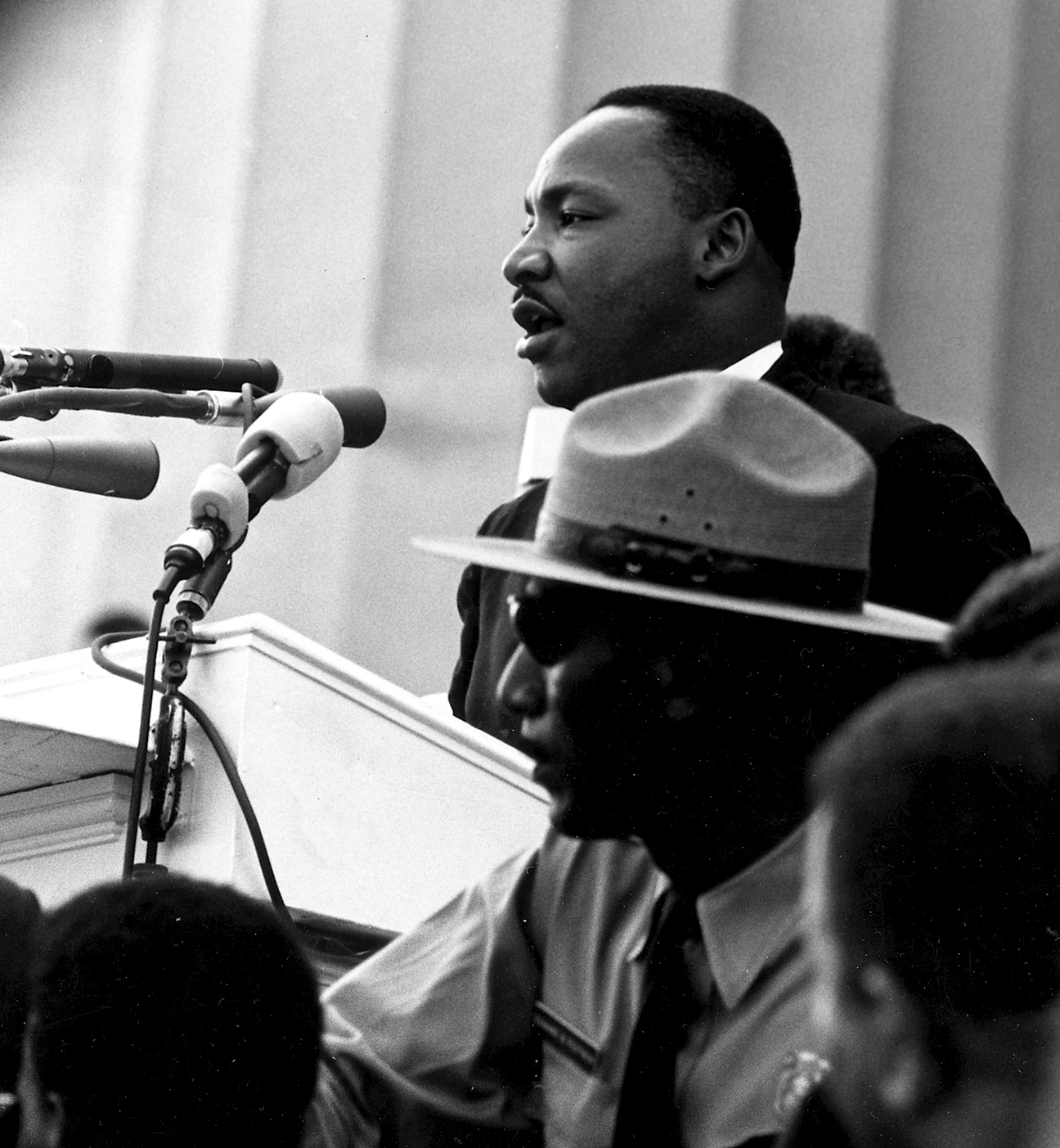
Monday, February 24, 2014

Reflected in Ice: An Aspergers Review of Frozen

The following movie review contains mild spoilers. I try to tread lightly, but can't avoid addressing a few in-movie moments or thematic elements.


There are two measures of good art.

The first is anything that can make me feel strongly. The other is that which holds up a mirror to the viewers, in which, each sees herself.

Frozen accomplished both of these goals with resounding success.

Secret Wish - Tami Vaughn
I had this printed on a mousepad I used for years.
Good mirrors are composed of metaphors and character traits and plot in the right combination of vague and specific to reflect a broad range of life situations and personalities. Many types of people see themselves in Frozen: girls who are raised to be perfect, sisters who struggle in their relationships, women who are deceived by those they trust, those who have secrets, neurodiverse people, anyone who is misunderstood, and anyone who is rejected for all the wrong reasons. And like the second trial in The NeverEnding Story, a mirror which reveals the viewers "true self", Frozen's mirror can reflect the ugly parts of some people, like the blogger, "Well-Behaved Mormon Woman", who calls Frozen part of the "gay agenda to normalize homosexuality" and who says it's terrible we're letting kids get the message that rebellion is better than obedience.

Can you hold it down, please?
I'm trying to make history over here.
Whatever, lady. I have an entirely different view when I look at myself in art.


Frozen reflected many visions for me. Most strongly, it portrayed my autism in a very accurate way. It also reflected my relationship with my sister, and my struggles to leave the religious culture of my birth (incidentally, Mormonism), and my struggles relating to my family members who still belong to that culture. I will cover my thoughts on all these points.

Social equality activists argue for more representation of minorities in fiction. There are many good reasons to do this, but for any creator, the biggest reason should be "to make better art". When the same old characters are dancing to the same old plots choreographed with the same old tropes and the same old twists, only the same old segment of society is allowed to see themselves reflected in art. And even that segment is only allowed to get the same messages they always have about themselves. The mirror is cracked and the reflective backing is faded. It ceases to be useful even for the intended audience.

What's fun is a funhouse with only one twisted mirror?


Frozen is the first movie I can remember that explores the relationship between two sisters. I'm sure there are other examples, but they are few and far between. Often, to find them, you have to leave the mainstream film scene, into the art houses and foreign films.

Because of this dearth, Frozen had it easy. Its subject and plot is low hanging fruit. Disney made the only mainstream movie about sisters in recent history, so of course anyone who is a sister and has a sister is going to see herself in it. Finally, someone is showing her herself.

Because women are so rarely represented in movies, outside certain highly limiting tropes, we latch on to anything we're given. And it benefits us all greatly. Frozen allowed my sister and I to have a conversation we were unable to have before, because we lacked any kind of context to have it. Frozen helped her and I understand one another more.

Any filmmaker following in Frozen's footsteps will face a steeper challenge. The next attempt will require a little more thought and nuance in order to be good art and not simply derivative.

This is a good thing. I hope many attempts will be made to best Frozen's "sisters" mirror. And while we're at it, let's take a look at other female-female relationships. Mother-daughter? (Brave got us started there.) Business partners? Partners in crime? Buddies? (More Thelma and Loiuse, please.)

And God forbid.. Perhaps we could see female-female romantic partners? In spite of the success of the big gay agenda, I currently only have one small part of one song that describes what it feels like to be snuggled up with my lovely girlfriend. That ought to give well-behaved blogger up there a real example of homosexuality portrayed in the media.

Anyway, there's plenty more low-hanging-good-art fruit for the picking. Half the movie-viewing audience are women who really want, crave, and need more mirrors.

Now, I'm not implying Frozen's creators were amateurs and that it only succeeded because they entered unexplored territory. They tread some other ground which is extremely well-trod and managed to find a fresh mirror there, too.

The "be your own unique self no matter what people say" theme has been done to death. It's part of American culture, and we love it every single time. Where this theme gets stale is, again, where we endlessly see the same take on it. The underdog nonconformists who win in the end, they all start to blur together after awhile, until we forget that this is the theme of pretty much every single movie, ever. We don't even notice it anymore. The individualist rebel has become the new conformity, the ideal that we all strive for equally, to the point where we shun anyone who fails.

Repeat after me...
For Frozen to pull this old trick out of the bag, dust it off, and make it seem like they were the first to ever think of it, is a pretty tremendous feat. A mirror is pointless if we keep seeing the same image. It's the one that reveals a different side, or that pimple hiding under the chin, is the one that wins the "Good Art" award from me.

The song "Let It Go" is good art for the same reasons. It speaks to these common themes and others, of social rejection, of turning ostracization into chosen isolation, of the damage caused by suppressing feelings, of finding self-acceptance, and of having uncontrollable emotions or an inner power which is misunderstood.

This scene made me cry the first time I saw it. Which leads us to autism.

Others have written about this topic. But I shall write more about it. Because when you meet one person with autism, you've only met that one person with autism, so there's no one definitive autistic perspective.

[Mild spoilers incoming!]

Elsa is born with her power, and she is taught to hate and suppress it. She learns from her well-meaning parents that she is dangerous and likely to hurt others, especially her sister Anna, who she loves. She has to hide away in her locked room, stuff her feelings, and resist using her powers because of these inaccurate beliefs about herself.

Her powers are a double-edged sword. They started as a force for good, which she used to make her sister happy and strengthen their sisterly bonds. But after one mistake, her talent turns into a dark and ugly thing, not because of Elsa herself, but because of how the people around her view it.

Ironically, it isn't her magic that hurts Anna. It's Elsa's self-imposed isolation because she believes herself to be dangerous. All Anna wants is the same love they once shared. The door that separates them wounds more sharply than the ice which was easily healed.

In a perfect case study of unintended consequences, Elsa's suppression of her power is what keeps her from controlling it. It all comes out sideways at the worst time, and she ends up in mutually-agreed upon exile, but with disastrous results for both her and her people. Again, it isn't her powers that are dangerous, it is how she and everyone else is handling them.

Olga Bogdishina's book, "Communication Issues in Autism and Asperger's Syndrome", talks about the ways autists process sensory information differently from neurotypicals (NTs). Among other issues, autists deal with being either hypo- or hyper-sensitive to stimuli. "Their senses seem to be too acute…or not working at all…"

Excellent book.
So read it.
Every autistic individual has a mashup of different conditions under which their senses are either ramped up or remote and blocked off. For some, sounds will always be too loud (auditory hypersensitivity) but they have no idea what they're feeling (alexithymia). For others, they do fine with sound... until they get overstimulated. Then they can hear a pin drop on the other side of the house.

Emotions should be counted among the "five" senses. Emotions are a sense, giving us information about our internal reactions to outside events, and are subject to hypo- or hyper- sensitivity effects. For autists, emotions can be remote and incomprehensible, or very loud like a blaring siren. While I've had periods in my life where I was more hyposensitive to my feelings (my teen years), these days, I tend to be more hypersensitive. I usually know what I'm feeling, and why, and even what I need to do to change those feelings. The downside is that strong emotions are very, very strong. Overwhelmingly so. Uncontrollably so.

And that's where meltdowns come in. 

Add to the complication, I was raised in a passive-aggressive environment, where showing certain emotions was never allowed. I quickly learned that crying would invoke an angry response, or accusations, or that I could hurt the people I loved. I became very good at repressing my tears if anyone else was around. When I became an adult, I had to teach myself to cry. It's a lesson I've never fully learned, and I have lots of triggers and shaky boundaries around that. All stuff I continue to work on.

When I feel cornered and triggered, I can meltdown. My emotions become so overwhelming that they shut down my thinking brain, with symptoms very similar to panic attack. I feel anxiety like fire, in my whole body, even my skin. I can't breathe, I can't think straight, I can't act in the best ways to protect myself. Everything becomes all-or-nothing. I may lash out and say hurtful things.

I'd put something funny here but it isn't really funny.
Cue Elsa. Here she has this double-edged power. She can build magnificent complicated fractal-based buildings using only her mental powers, but when she loses control, she shoots icicles from her hands.

Elsa's big triggers are related to emotions. When her parents die, her room turns frosty. And just like me, she becomes most dangerous during conflicts. She always risks hurting someone when she feels powerful things. And most of all, no one understands her. She's hurting and afraid, but everyone thinks she's a monster.

Her powers are just like my overwhelming emotions. As a child, I dealt with them by never feeling anything. As an adult, I still try to stuff them sometimes, but it totally backfires, especially when it reminds me of being a helpless child and I get triggered.

Power over ice is the best metaphor here. Aspies are often thought of as being emotionally cold, yet like Elsa's power, our emotions are often very active and passionate. Emotional repression is like trying to freeze feelings. And when I get upset, words come more difficult to me, as if my thoughts are freezing up. When the panic sets it, it's hard to breath, like my chest is frozen with fear.

It's not an icebeam, no that's all Jonny Snow!
(And Elsa the Snow Queen)
Anna tries to reason with Elsa, so together they can solve the endless winter problem. I related to Anna here, as well. My solutions are so simple, yet sometimes so hard to convey.

This is when Elsa whirls around in frustration, erecting a defensive ice barrier all around herself. Unknowingly, she hits Ana in the heart with an icy ray.

How often have I whirled about in my own pain and frustration said something that wounded someone I love? The closer to meltdown I am, the worse it is. I'm not trying to hurt anyone, though people accuse me of doing so. I'm as surprised as Elsa is, when she hears Ana's little cry of pain.

The metaphor continues through Anna's reaction. She seems fine for awhile. She knows she's got a problem, but she runs around for awhile and even has a comedic musical number with the trolls, before the ice starts to take over and incapacitates her. That's how painful words work. We stand up and shake them off and move along in life, but if the words were painful enough, they cause traumas that are hidden but still slowly freezing us to death.

Elsa finds her answer, and it's the answer I found. By stuffing her emotions, by trying to deny who she really is, by allowing social shame to consume her, she becomes explosive. It's only when she "lets it go" and accepts who she is in spite of what others tell her, that her talent becomes a controllable force for good. A unique power no one else has.

The message here, for anyone with autism or Aspergers, is to be true to your autistic self. NTs are going to set up alot of incomprehensible social standards for you to follow, but maybe you don't have to. At least not all of them, not all the time. Maybe there are ways around them, or maybe you can just do what you're going to do anyway, without shame. Maybe some of those social standards are lame and need to be questioned and rejected.

Art by FabUUlousGear.
Because you can get this as a mousepad.
By accepting and being open about all facets of your personality, you learn to control your powers. You can avoid those pesky painful meltdowns altogether, and forgive yourself when you can't. You can create your own environment, a palace on a hill, free from overstimulation and ridiculous social rules. And when you get really good at that, maybe you can come down off the hill and be a leader for others.

Or not, and that's okay, too.

One of the emotional elements of Frozen, for me, was Elsa's entire story arc. I had a rotten 2013. I was diagnosed in April. Conflicts between me and Roland were increasing in intensity and frequency. For many reasons, my anxiety continued to increase, until it pained me every single day. I was melting down every couple of weeks, every month at a minimum. I had multiple scary suicidal moments which recurred for months.

My diagnosis was helpful, but it also spun me into turmoil. I had my own self-rejection/self-acceptance narrative arc. I had to learn about my traits, my powers, and my limits, and then learn to articulate them to others.

As I watched Elsa struggle on screen, trying on various options to deal with her power/curse, I watched myself. I felt her pain and confusion. I understood her loneliness. But I also triumphed with her. I danced with her as she sang of how she no longer cared what anyone else thought, she no longer wanted to hide her true self, she would no longer try to be the perfect girl everyone expected her to be.

It's making me tear up as I write about it.

By the end of the year, I'd found my balance, an equilibrium, of how to live with autism and accept myself. The hardest part was learning how to be around others. Living in an ice castle is one thing, but I have family. I learned to set boundaries to keep other people from hurting me, which also resulted in me hurting them less. Like Elsa, I am now able to step out on the stage, confident, knowing I am loved.

That's not to say I won't continue to struggle. Every story arc repeats itself. On screen, it's just a sliver, a slice, of the cyclic life-themes we continue to deal with. Frozen gives us a common language to think about it and discuss it.

The story also reflects isolation, of being around others and yet effectively alone because true communication is impossible. This is the story of autism.

When I first started researching autism, I wondered what non-verbal autists could possibly have in common with me and other aspies. Yet I still had this deeply empathetic response to any non-verbal autist I read about or saw on video.

In the documentary Wretches & Jabberers, two men with classical autism travel the world to meet other autists and advocates. I found myself almost in tears through the whole film. Even though their experience of life is, in so many ways, very different from mine, I felt some common, mysterious tie.
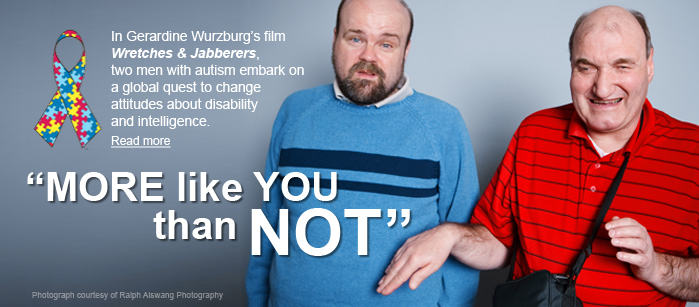
Wretches and Jaberers
There's a moment in the film where Larry expresses how painful it is when people thinks he's stupid because he can't talk. I related so hard to this moment, not because people think I'm stupid. The opposite, I'm normally perceived as being above-average. It took me awhile to figure out what I had in common with Larry in this moment.

Then it occurred to me – the key thread is being misunderstood.

I know myself really well. I know my capabilities and feelings and outlooks. Yet often NTs think they know these better than me. They make assumptions about my motives, and then they argue with me, trying to convince me their outside perceptions are more real than my own experience.

All autists are deeply misunderstood. NTs often think we're stupid, or out of control, or crazy, or drama, or unfeeling, or unempathetic, or dangerous. They think we're emotionally unintelligent. We are painted in broad strokes with wide brushes that assume intentions and ascribe meanings which aren't true.

It's even harder, for those of us who are skilled in the use of language, when what normally works for us suddenly stops working. We sometimes can't find words, or the words we use are suddenly incomprehensible to NTs because of their assumptions or because autistic thought patterns are so different and difficult to communicate across the divide. Other skills, like sensory processing or executive function and abruptly fail, and we blow through expectations set by past behavior.

For this and many other reasons, I've known instinctively, since I was a small child, that I could expect to be misunderstood on a regular basis.

To see Elsa fleeing her own kingdom really struck a chord. She tried so hard to be like everyone else and to avoid hurting anyone, and yet she still failed and had her motives misascribed. This is something many autists can relate to.

The misunderstanding is even more acute because Elsa looks normal. Her "disability" (diversability) is invisible, so when it suddenly appears, it is all the more shocking and horrible and more difficult to understand. Aspie behavior is much the same. Because no one can see a reason for strange behavior, NTs can hurtfully ascribe motives that make sense to them, but not to us.

"You just need to try harder..."
Helpful advice, but only a little
It's easy to see why someone in a wheelchair isn't running in a marathon, but when a well-dressed, intelligent, and verbal aspie with sensory processing disfunction fails to reciprocate a friendly greeting, it must be out of rudeness or meanness or a lack of empathy, not out of severe social anxiety, or an inability to assemble the words into meaning, or the inability to instinctively understand what the appropriate response is.

Likewise, when Elsa's power first escapes in public, she is accused of being a sorceress, a monster. The people are not only afraid of her, some of them hate her and want her dead.

This reflects the quick switch of being admired by everyone, then abruptly alienating them, and not knowing why. That's the life of an aspie who passes as neurotypical, builds up expectations, then shocks everyone when we reach a limit and breakdown, or fail at some seemingly simple task (like shaking someone's hand). People don't realize the capricious nature of Aspergers, that sometimes those little things are impossible for us, even if it was possible just a minute ago.

Just like it became impossible for Elsa to contain her powers.

Though Elsa is a secondary character, she upstages Anna, the protagonist, who may also be a relatable character for aspie viewers. She is clumsy, socially awkward, blunt, practical, lonely, and unorthodox. She also expresses an impulsiveness and devil-may-care attitude which is not only endearing, but common to the Asperger's experience.

I related very strongly to Anna's confusion and pain when Elsa shuts her out the way my sister did me. Elsa's reasons for the rejection seemed to be good, but it caused more harm than it prevented. As in their case, my own relationship with my sister seems to be improving the more time we spend talking to one another, not less.
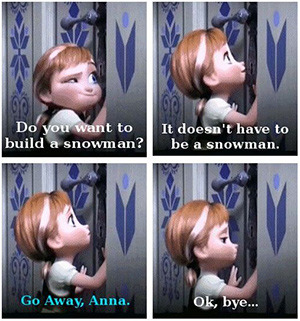

My sister's reasons for shutting me out are rooted partially in long-running misunderstandings about my behavior vs. her interpretation of my behavior. Once I told her I am as aspie, she could understand me more. (No everyone reacts this way, however. I have heard that revealing an Asperger's diagnosis sometimes causes increased misunderstanding in families.)

My sister's reasons are also partially rooted in religion, which leads me to the last mirror that Frozen held up to my life.

When I chose to leave the religion of my birth, I felt a mix of conflicting emotions. I still do. On the one hand, I can celebrate my freedom from expectations and rules which never quite fit me, as Elsa does. There is much joy to be had in that. My new beliefs and new way of living is very me. I've lived this way for thirteen years, and the more time that passes, the more I know this path is totally right for me, and I won't let anyone take it from me.

Yet like all good stories, there are tradeoffs and conflicts. This isn't a Mary Sue story, and the price I paid is steep. I left most of my family behind. I left my cultural homeland behind. I could no longer fit in there, so I exited. By isolating myself from them (and that isolation is a two-way street), they can no longer hurt me, and likewise, I no longer hurt them by being myself in their presence. But my leaving had unknowable destructive effects back home. My family misses me, and though their desire for me to fit their mold is unrealistic, it is also real.

Though we now live in very different worlds, we are still family. This story arc has not ended for me yet. I'm still the Elsa dancing in her ice palace, singing "Let It Go", trying to forget the people I left behind, trying hard to pretend they're better off without me as I am better off without them.

Our issues seem insurmountable, but maybe they aren't. The trolls sing a song about fixer-uppers which is about marriage and romance, but it also addresses blood-family. "Everyone’s a bit of a fixer-upper, that’s what it’s all about! Father! Sister! Brother! We need each other to raise us up and round us out." 

Getting to the point of acceptance is the hardest part. Unconditional love isn't loving in spite of differences; it's loving because of the differences. Unconditional love has no room inside it for wishing the other person were different. We can wish they'd treat us better, and set boundaries towards that end, but when we want them to act a certain way so we can pretend they are a fantasy version of themselves? That is very selfish indeed. That's alot of strings attached, enough to turn our loved-one into a puppet.
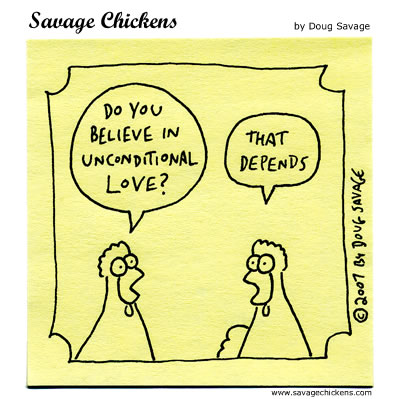
I love you...
I just don't approve of your choice to be a chicken.
The way I choose to live is a very spiritual path for me, uplifting, deep. Like Elsa, I feel ostracized for being who I am. In "Let It Go", when she sings the words, "No right or wrong, no rules for me", it's because those rules don't fit her the same way fit the others. She's decided "the perfect girl is gone" because she has a new standard of perfection all her own. This feeling is reflected in the lyrics of the radio version by Demi Lovato, "Up here in the cold thin air I finally can breathe; I know I left a life behind but I'm too relieved to grieve".

Having gone through that, it really is a weight thrown off. 

It's sad that by creating her own standard and cutting those strings, Elsa has to isolate herself: "Standing frozen in the life I've chosen, you won't find me, the past is so behind me, buried in the snow."

Elsa does eventually find acceptance among her people, but the movie fails to explain how this happens. The implication is that it magically happens once she comes to accept herself. In real life, it's kind of that simple, but not really. The reality is that some people will accept you. Others will reject you even more. Still others will reject you at first, and then slowly decide that love is more important–and more effective–than trying to form everyone else into a standard of false perfection.

In my case, whether talking about autism or religion, self-acceptance is my priority. If I have to reject myself to be accepted by others, their love isn't worth it. I would rather live my life in the best way I know how, and let them come around to me, if they want. In many ways, this is my "kingdom of ice-olation", but it's a price I am willing to pay.

Labels: , , , , , , , , , , , , , , , , , , ,

Wednesday, January 22, 2014

Persuade the Bystanders

This post has to do with social justice – you know, topics like privilege, racism, sexism, classism, ablism, and all the other ignorant and/or hatey "isms" worth railing against. I'll get to those in a second.

In the early 90s, while arguing politics on BBS message boards, I realized an important truth that I've carried with me always:

When people argue in public, they will almost never convince one another. But they do influence the lurkers. 

WWIV message boards
My view of the world when I
learned this important life lesson 
Sometimes the persuasion is instant. Now and then a lurker will timidly post and reveal that their minds have been changed. But most keep this fact to themselves. More often, the change is slow. These lurkers continue to follow similar arguments, until eventually, they are swayed by whichever side has collectively made the best case. I myself have drastically changed my mind on deeply held beliefs in this way, both by debating and merely watching debates. I've also seen it happen to other people. But it's rarely instant.

It's hard to know that these neutral and persuadable lurkers exist. They are, by their nature, quiet. Very often, though not always, the more vocal a person is, the less likely they are to be convinced. So we tend to think everyone who doesn't use a megaphone is just like everyone who does. This is not true.

I think about the topic of persuasion alot. I'm a writer. It's my job to persuade. I also love debate, a casual pastime since childhood. Roland makes a wonderful and challenging debate partner to help me better understand what works and what doesn't. On top of all that, I've studied mind control, otherwise known as "coercive persuasion" – the ability of manipulators to convince people against their will.

I've learned about why people believe things, and what factors make people change their minds, and why people sometimes never will, even in the face of overwhelming evidence. Cognitive Dissonance is the mechanism we all employ to either accept or reject new ideas. It can be a very powerful barrier to persuading others that our position is correct. Cognitive dissonance is the source of all closed minds. There are ways around it – both ethical and unethical. I am more concerned with ethical persuasion.

I consider myself an activist. Anyone who publicly advocates for social justice, is, in my opinion, an activist. I am a woman and I have what some might call an invisible disability. In all other areas, I am privileged, but I consider myself an ally against racism and other hateful thought systems. I firmly believe that everyone has a different life experience, and it is generally best to never dismiss anyone's position out of hand until I've done my utmost to understand – even if I don't agree.

Social media has opened a new door for activists. It allows the voices of oppressed individuals and classes be heard by all kinds of people who were previously isolated. The internet democratizes the population by giving everyone a printing press and a megaphone. It's a beautiful thing. And every activist, whether they know it or not, is in a position to persuade.

This guy is just like you. Everyone is listening.
Choose well what you will say.
Presumably, our goal is to make society better. To reduce hate. To eliminate ignorance. To eliminate unfairness. To prevent harm and prosecute those who hurt others. To pass laws that create the most equal playing fields for all people. Everyone should have the same opportunities for success, regardless of outward differences that so many in our society tend to get hung up on. I want everyone to be treated with respect, even if they're a different color, or gender, or disabled, or attracted to the same gender, or all the other things I've failed to list here.

In a democracy, the best way to accomplish all of those goals is to be persuasive. Activism, when done right, is persuasive. Anything else is just preaching to the choir – it feels good, but nothing gets done.

Given that, there are certain trends I see among activists that disturb me for two reasons:

  1. I don't consider these methods ethical. 
  2. These methods are not persuasive.

The Outrage Machine is constantly producing new horrors to raise outrage. Sometimes I believe this machine is persuasive, and other times I don't. Sometimes I think it is counter-persuasive. And that concerns me. Because I'd like to see society improve. I'd like to employ the best tactics.

So when I apply my mind to social justice activism, the question often is, "How could this message be more convincing? How can it reach more people and change minds?" Sometimes, I speak up about tactics. And when I do, my views are controversial, often because they're mistaken for taking up the other side's position, or being an apologetic, or dismissing someone's views, or perhaps not being enough of a cheerleader for our side, nor supportive enough of the cheerleaders we have.

None of those are my goals. I'm not dismissing anyone. I am not being an apologist for the other side. I am not defending horrible behavior. I am merely goal-oriented and thinking about the best ways to achieve the goals that all online social justice activists share – more fairness and equality and tolerance for all.

So here's my controversial statement of the day, and I hope you'll hear me out. Allow me to persuade you before immediately dismissing my argument. Please know I understand the counter-arguments and have given this alot of thought.

I've seen a certain sentiment echoed via Twitter and the blogosphere, usually coming from an underprivileged person directed at a privileged person (i.e. woman or POC or disabled or trans* directed at a man or white person or cis), and it goes something like: "It's not my job to educate you!" It is often delivered in an angry or dismissive or antagonistic tone.

In terms of accomplishing the above goals, it is entirely counterproductive.

Yes, I do understand where this sentiment comes from. Especially when, say, a feminist of color has been asked 50,000 times by hostile racist misogynists to explain why she's so upset, and she's given the answer 49,999 times, and she's being asked to speak for her entire race and sex to flaming assholes who aren't listening anyway. Her anger is entirely justified. As is her weariness in the face of this seemingly Sisyphean task. It is true, in fact, that Google is just a fingertip away, and all ignorance about any topic can be quickly dissolved like salt in water.

The endless questions themselves can be a rhetoric tool used to dismiss, belittle, and aggravate. So why waste even two seconds talking to those jerks?

I get all that, I really do. 

And I understand the double-bind. As a woman, I can choose to be labeled a bitch, or let people walk all over me. I am not allowed a middle ground. Similar thought-terminating cliches are employed to double-bind people of all other oppressed classes. I am not suggesting the answer is passivity and eternal politeness, bowing and scraping. Far from it.

And most especially, I understand that most oppressed people have no interest in activism and just want to live their lives without being bothered. They just want to be accepted as average and normal and don't want to go around thinking about their orientation, disability, or skin color. They just want to live. In this latter case, I think the "It's not my job" answer is most appropriate – it isn't your job.

But as activists and advocates, you actually have taken on the job. Maybe you only want it to be part time, but it's your job. By speaking up, you volunteered. It's a tough job, but worth doing.

No, it's not your job to educate the hostile instigator of controversy or the timeline troll who is just trying to raise everyone's hackles. That guy will never be convinced by anything you have to say. It's true. He is so enmired in his beliefs and has made public declarations of it, so his cognitive dissonance is nearly impenetrable. It is likely that when the world changes completely into a social utopia dreamworld, he will go to his grave willfully ignorant and hating.

Alas, educational and persuasive words are not meant for him. Your efforts are meant for the bystanders, the dozens, or hundreds, or even thousands of quiet lurkers. They're out there, neutral, or ignorant, or perhaps a bit racist or a bit sexist or any other *ist, but they don't feel too strongly about it. Not enough to join the argument. But they're curious, and they're watching each player make a case.

Pretend today the Outrage Machine has identified a new controversy and brought it to the rapt attention of the information-obsessed internet. Someone gets wrongly fired from a job, or groped at a con, or catcalled, or outed, or harassed, or murdered. Some person in power says something stupid, and advocates reply, and anti-advocates reply back and everyone's in an uproar for a few days. This is the chance to convince that silent neutral ignorant majority. They are all near the fence. They think sexism is over, or transwomen are just confused, or bisexuals don't exist, or Muslims are more protected than Christians, or any black kid has it coming because no one gets shot unless they deserve it, or whatever ignorant thing they believe. This is the chance of advocates to convince those bystanders.

I believed many of those things once. And over time, effective arguments finally got to me. Advocates finally educated me. And not usually because I sought the information out on my own. Usually because people kept pointing me in the right direction.

That's the point of publicity. You hold a megaphone, just for a few minutes. You've gotten someone's attention. In this age of the information firehose, that's the hard part. Now how are you going to most effectively use it?

Even the small-time advocate who doesn't have a big platform, who rarely says much of anything, has a huge opportunity to convince these silent types, because their followers are their friends and family. We are much more influential to those who know us and like us personally. Yes, those Facebook debates are frustrating, because no one seems to listen, but the silent readers are paying attention.

This is how the most recent victories in marriage equality were won. A majority of the mainstream public was swayed, not through anger and righteous indignation, but through family members who came out of the closet and stood gentle yet firm on their rights to be gay and to love and commit to who they wanted. Eventually, few loving family members could imagine a world where government would bar their happy union.

Injustices happen every moment of every day. Outrage can spark quite an inflagration of justifiable anger that sadly, too often, turns to hostility, or ostracism, or shaming, or personal attacks, or blatant logical fallacies. And when this happens, you've lost the moral high-ground. You have ceased being persuasive to that silent, neutral, convincible audience. And then it doesn't matter how right you are. Because anyone who might have been listening will turn against your position. The opponent wins an easy victory. Score one for the trolls.

Even more tragic and destructive is when misdirected anger scares away fellow advocates and allies – even those in the same category as you (fellow women, POCs, LGBTs, etc). These are people who are already convinced of your position and want to help. They observe this open hostility and feel judged or lumped in with the haters because of a slight variance in opinion. They may already be marginalized by being themselves in the oppressed class, and now they feel marginalized further by activists who claim to be advocating on their behalf. They may become terrified to say anything, lest it be the wrong thing, lest your irate gaze turn instead on them. Intersectional individuals are even more at risk for this type of dismissal and marginalization.

I myself have been in this position amongst my fellow feminists, sometimes for defending intersectional classes (like advocating trans rights to rad fems), and sometimes because my opinion on tactics differed. (I'm generally against boycotts, for instance.) I'm fine with people disagreeing with me, but I've also been actively shamed for holding these and other stances. Shaming, threatened ostracization, and personal attacks go too far.

This type of hostility makes it frightening for fellow advocates to contribute to the discussion. For instance, it made me hesitant to write this post. Thankfully, I'm the type of person who doesn't like to be silenced in the face of fear. Others are understandably more timid.

We need more diversity among our voices, not less. And more tolerance. Don't we believe that both diversity and tolerance lead to a better world? We need all the allies and advocates we can get, waving the banner, even if some choose to wave it differently than you. Punch upward, at the system, at the oppressors, at the powerful, at the bad guys. Don't punch sideways at the ally standing next to you just because she's easier to hit.

Oppressed people have much to be angry about, and I would never rob them of their anger. Anger is a valuable emotion. It motivates and feeds energy into individuals and groups and causes. I am not advocating for less anger – I am suggesting that those energies be channeled persuasively to produce the most positive outcomes.

(And in the moment of offense, especially when there is no audience, untamed anger very much has its place in defending individuals against in-progress assault or insult. I am not suggesting passivity or politeness when rights need to be asserted to a hostile *ist who insults and then demands to know why it was insulting. Since you likely will never convince him, that's the time to growl and spit, to say it's not your job, and to gently or not-so-gently direct him to Google. Or not. Depends on you and the situation.)

Updated to add: Sally Kohn puts it another way in her TED talk, "Let's Try Emotional Correctness".


And Mattie Brice recently wrote about anger in protesting the video games industry, suggesting we put behind us the demeaning hostility in 2013.

It's true that maintaining the moral high-ground can be exhausting. We can't do it all the time. Sometimes I tweet or blog my opinions. Sometimes I advocate. Sometimes I give the long answer.

And other times, I'm busy, I just direct people to others who have written more eloquently than I. Think about it: If, instead of saying, "Correcting your ignorance is not my responsibility," you suggest a well-known educational website or blog post on the topic, like Unpacking the Invisible Knapsack. You not only give that hostile person a chance at graceful, face-saving redemption, but more importantly, it's another opportunity to distribute that content to every single one of your other followers, many whom may have missed that particular blog post, or have never been exposed to content that you think is obvious because you read it a decade ago.

There is much to be said for "brand awareness", a tactic commercial marketers understand well. Every chance you have to retweet the same link to yet another person asking the same questions, your other followers will begin to see that content as legitimate and worth consuming. Maybe they meant to read it last month, and have forgotten. You're making it easy for them to educate themselves and maybe even join the cause.

Other times, the good fight becomes overwhelming. It's exhausting to be outraged all the time. That's when I take a break and let others pick up the banner. Sometimes I do this because I am far too emotional to think clearly. I'd rather sit out the Outrage Machine's churning than say something that loses points for my side. Because I want my team to win. It is possible to communicate "It's not my job" in a way that doesn't detract from the overall argument or your future ability to be persuasive. Like, "I don't have time to answer that right now. Could you please google 'cis privilege' on your own?" Or just remain silent. That gives the hostile troll the last word, but most likely, it will reflect worse on him than you.

It's true that my white, cis, thin, mostly-abled, * privilege gives me the luxury to sit alot of these out, a privilege not everyone may have. I realize that I live relatively free from various kinds of hostility that lets me take these breaks. It's a little easier for me, perhaps, to go on an anger diet, to step away from the keyboard when emotions run too high. In many ways, this might be "easy for me to say". I still think these suggestions are tactically the most effective, and worth employing whenever possible.

In the end, we all have our own journey and our own idea of what's right and wrong. It's your social media platform, so please, do with it what you will. But hopefully, I've been just a bit persuasive here.

Let's go out and change the world.

Labels: , , , , , , , , , , , , , ,

Wednesday, November 6, 2013

Autism and Shame

At the end of the week when I literally wrote the chapter on shame (in my book Recovering Agency: Lifting the Veil of Mormon Mind Control), I found myself curled up on my bed, sobbing, in the throes of a meltdown, feeling like the worst person on earth -- feeling vitally broken in all the ways that count -- feeling like the unresolvable source of pain for everyone around me. 

And I was helpless to watch from somewhere within, knowing I was suffering from shame, but unable to think my way out of its cage.

What is shame?

The concepts of guilt and shame are frequently confused with one another. They both seem triggered by the same stimuli. Yet they are two distinct feelings with quite different implications and outcomes. 

I've seen two definitions of the differences that ring true to me.

The first is that shame is related to your social position, while guilt is a personal feeling. That is, shame requires your sense of relation to others -- you have done something and others are exerting pressure on you to stop. OR, if they don't know what you've done, you are afraid they will find out because if they did, they would exert pressure on you. Whereas guilt is the knowledge that you've done something wrong, and you feel remorse and a desire to correct the behavior regardless of whether anyone else knows about it.

The second difference is perhaps the most enlightening. Guilt is about what you have done; shame is about who you are. Guilt is, "I have done something bad". Shame is "I am bad".

Brené Brown gave two powerful TED talks on the concept of vulnerability that both focus heavily on the concept of shame. I cannot overstate this concept enough, so I will repeat it in her words: "Shame is a focus on self; guilt is a focus on behavior. Shame is I am bad, guilt is I did something bad."


Shame, no matter how powerful it feels, does nothing to alter behavior. Usually shameful feelings arise around behaviors which are difficult to correct, and so the motive to change quickly devolves into defensiveness or into hiding shameful behavior. Shame has been shown to be highly counterproductive in combatting addictions, for instance. 

Guilt, on the other hand, can be useful in combatting behaviors. It is a sincere remorse and a drive to become a better person. Within guilt, there is the possibility to improve. Because there is no sense that the core self is damaged.

But when the self is inherently broken, then what is there to fix? Nothing.

According to Brown, shame is so painful because it makes us feel unworthy of acceptance. It makes us feel alone. 

To me, the feeling of shame is very closely related to the feeling of rejection. Both tell me I am unworthy of acceptance. Both emotions seek to push me from the tribe. Both say, "You are not enough like the others to belong."

A recent fMRI study on rejection showed that being rejected activates the same regions of the brain as physical pain. According to the article, "As far as your brain is concerned, a broken heart is not so different from a broken arm." Researchers also found that this kind of emotional pain can be treated by taking Tylenol. (Keep this in mind next time you are tempted to wield shame as a weapon. If you are unwilling to punch someone, perhaps you shouldn't shame or ostracize them, either.)

So here I am. I know all this. I've spend decades getting healthy, reading all the self-help books, going through the therapies and support groups and memorizing daily affirmations. I have literally written the chapter on shame. I know better. I am even surrounded by people who I know love me, even though I hurt them sometimes. 

And yet I still find myself on those dark nights, hating myself with every fiber of my being. Feeling like a horrible, worthless creature.

How do I get from Point A to Point B?

Because I have Asperger's

I have a constant sense, when dealing with people, that sooner or later, I am going to say the wrong thing. Eventually, out of nowhere, the peaceful pond is going to erupt into a geyser. I spend significant energies managing that pond, keeping it still, but it always erupts.

From childhood, I've known this. This incontrovertible fact of life has been a part of me. I have been unacceptable in so many ways, being a nerd, being an introvert, but the worst crime of all is making social faux pas. Of thinking differently. Of thinking so differently that perfectly innocent utterances randomly cause people to cry, or turn away, or lash out, or get angry, or accuse me, or cease being my friend. I'm not so impaired as to be unable to recognize when I've done something wrong, though perhaps my brain should be merciful enough to grant me this relief.

My young self learned that the consequences for making such mistakes could be severe. The trauma built up over the years, compounding the punishment for screwing up. Now, not only do I have to deal with another person feeling bad because of the mysterious thing I did wrong, but I have to also deal with my own fears and pain which have been building into this near-PTSD level.

Putting in the effort to avoid these mistakes only works for so long. Because I have Asperger's. I will miss the social cues. Sometimes, everyone misses the social cues, but I have had a lifetime of doing so. 

What may be the even more important distinction, I don't have the skills to recover from social mistakes. I can't gracefully apologize or flatter or smile my way out of trouble. I'm usually still stuck on Step 1: flabbergasted, trying to understand where I went wrong.

For those of us on the spectrum, this is normal. We live life in the face of continual negative social feedback and the constant making of incomprehensible mistakes. And it is here where the dangers of shame lurk. Where no matter how many times I tell myself how wonderful and likable and lovable I am, I still find myself on those dark nights hating myself. Because I'd done it again.

It is very easy to feel like nothing I do will improve my ability to be acceptable. After trying so hard and making so many mistakes, eventually I can't help but think of myself as intrinsically broken.

This topic is particularly important. I hope healing professionals and researchers will look into it on a scientific level and counsel their ASD clients accordingly. But it's possible they won't for a long time. 

And yet, they should, because suicidal ideation is 28 times more likely for autistic kids than neurotypical kids. To me, this comes as absolutely no surprise. Aside from my own struggles with suicide, we already know from other research that three things are needed for the risk of suicide to be concerning: 

  • Thwarted belongingness (I am alone)
  • Perceived burdensomeness (I am a burden)
  • Capability (I am not afraid to die)

Shame sends two of these three messages: 
  • I am intrinsically unacceptable which will make me always be alone
  • I am inherently unfixable and therefore will always be a source of trouble for those who do love me.
And shame (and resulting anxiety and depression) causes so much pain, that the third ingredient is an easy leap. After suffering long enough, suddenly death seems like a relief.

It is this deep sense that we will always be unacceptable that makes autists more likely to ideate. So the real question is, how can we help autistic kids and adults feel acceptable in a world full of people who struggle to understand us as much as we struggle to understand them? Especially when we continue to bear the brunt and blame for the misunderstandings?

Solutions

The day is far, far off when we can expect much from the world at large. But there are things we can do for ourselves, and, if we're fortunate enough to have a loving, and capable support network, we can help them understand and so they can give us what we need.

Affirmations. For starters, when I feel this way, I often find relief from reading the well-crafted and autism-specific affirmations by Liane Holliday Willey which are posted on the WrongPlanet forums. These work most of the time, except for when, for whatever reason, I'm feeling overly cynical and don't believe them.

A great song full of affirmation-in-spite-of-flaws, that almost always makes me cry, is Alanis Morissette's "That I Would Be Good".

Self-acceptance for an aspie means accepting that you are fundamentally different. Because of these differences, there are many behaviors that will always be difficult or even impossible for NTs to accept, and you have to accept that, too. 

Identify your aspie superpowers. These are examples of how ASD makes you particularly awesome. They are the other side of the coin, your X-ray vision to the kryptonite. For examples, see the two links at the beginning of the paragraph. Come up with your own list. During shame-filled times, go over them and remind yourself of your strengths.

Consider coming out. According to Brené Brown, shame requires secrecy, silence, and judgement to survive. Without these things, it will die. Consider finding a safe space, free of judgement, either with safe family, or safe friends, or with a therapist, or online at a place like WrongPlanet. Bring your shameful moments to light. If you feel judged, then go back into your shell until you do find someplace safe.

If you can, explain your condition to others. Point them to online resources and descriptions. While that doesn't necessarily help keep you from making the same mistakes and hurting people with them, it may help people feel less offended because they understand that the source of your mistakes isn't intentional.

The debate rages over whether autism is a disability, but here it may be useful to think of it as one. NTs don't have to struggle quite so hard to be understood or to avoid being misunderstood. Even though those behaviors are caused by your disability, you must separate your behaviors from who you are

Remember that if your disability were something more obvious, like inability to walk or see, it would be unthinkable to shame you for avoiding stairs or not looking people in the eye. Sometimes you will miss social cues or not understand what's going on or forget someone's birthday or be late or dozens of other things. While this isn't an excuse, nor does it mean you should stop trying to do those things, it also means that if you fail them, it's nothing to be ashamed of. 

There may be unhealthy people in your life who are compounding the issue. They may be incapable of separating behavior from the person and may be reinforcing shame while you are struggling to overcome it. That is something NTs also deal with, and is a subject of a great many books and therapies. When it comes to feeling shame and dealing with abuse, we're not terribly different from NTs, and those materials should be helpful. Just keep in mind we have additional factors which compound the issue, and we may feel shame and rejection more strongly or be more easily triggered by it.

And lastly, here is a post by another aspie who also struggles with shame, and how she deals with it. 

No Shame

I once overheard a caring mother say of her daughter, "She has no shame. She has Asperger's. She is incapable of shame." This mother meant well -- what she meant is that there are some things aspies do without regard or care to social customs. In that sense, we have no shame. 

But in other areas, where it matters most, we know all too well that our lives have been one steady stream of rejections and social pitfalls. We walk cautiously through a minefield of shame.

We can build up heavy defenses against them, sometimes becoming unapologetic or defensive or even aggressive to avoid touching those mines. Other times, we take the timid approach, avoiding people whenever possible and accepting blame instantly, even when we don't know what we've done wrong. Sometimes I oscillate between these two extremes in the course of a single evening. 

Nevertheless, shame is a barrier to intimacy. If we can find ways to grapple with it, no matter how powerful it seems, we'll have more opportunities for closer connections and freer, happier lives.

Labels: , , , , , , , ,