Monday, February 24, 2014

Reflected in Ice: An Aspergers Review of Frozen

The following movie review contains mild spoilers. I try to tread lightly, but can't avoid addressing a few in-movie moments or thematic elements.


There are two measures of good art.

The first is anything that can make me feel strongly. The other is that which holds up a mirror to the viewers, in which, each sees herself.

Frozen accomplished both of these goals with resounding success.

Secret Wish - Tami Vaughn
I had this printed on a mousepad I used for years.
Good mirrors are composed of metaphors and character traits and plot in the right combination of vague and specific to reflect a broad range of life situations and personalities. Many types of people see themselves in Frozen: girls who are raised to be perfect, sisters who struggle in their relationships, women who are deceived by those they trust, those who have secrets, neurodiverse people, anyone who is misunderstood, and anyone who is rejected for all the wrong reasons. And like the second trial in The NeverEnding Story, a mirror which reveals the viewers "true self", Frozen's mirror can reflect the ugly parts of some people, like the blogger, "Well-Behaved Mormon Woman", who calls Frozen part of the "gay agenda to normalize homosexuality" and who says it's terrible we're letting kids get the message that rebellion is better than obedience.

Can you hold it down, please?
I'm trying to make history over here.
Whatever, lady. I have an entirely different view when I look at myself in art.


Frozen reflected many visions for me. Most strongly, it portrayed my autism in a very accurate way. It also reflected my relationship with my sister, and my struggles to leave the religious culture of my birth (incidentally, Mormonism), and my struggles relating to my family members who still belong to that culture. I will cover my thoughts on all these points.

Social equality activists argue for more representation of minorities in fiction. There are many good reasons to do this, but for any creator, the biggest reason should be "to make better art". When the same old characters are dancing to the same old plots choreographed with the same old tropes and the same old twists, only the same old segment of society is allowed to see themselves reflected in art. And even that segment is only allowed to get the same messages they always have about themselves. The mirror is cracked and the reflective backing is faded. It ceases to be useful even for the intended audience.

What's fun is a funhouse with only one twisted mirror?


Frozen is the first movie I can remember that explores the relationship between two sisters. I'm sure there are other examples, but they are few and far between. Often, to find them, you have to leave the mainstream film scene, into the art houses and foreign films.

Because of this dearth, Frozen had it easy. Its subject and plot is low hanging fruit. Disney made the only mainstream movie about sisters in recent history, so of course anyone who is a sister and has a sister is going to see herself in it. Finally, someone is showing her herself.

Because women are so rarely represented in movies, outside certain highly limiting tropes, we latch on to anything we're given. And it benefits us all greatly. Frozen allowed my sister and I to have a conversation we were unable to have before, because we lacked any kind of context to have it. Frozen helped her and I understand one another more.

Any filmmaker following in Frozen's footsteps will face a steeper challenge. The next attempt will require a little more thought and nuance in order to be good art and not simply derivative.

This is a good thing. I hope many attempts will be made to best Frozen's "sisters" mirror. And while we're at it, let's take a look at other female-female relationships. Mother-daughter? (Brave got us started there.) Business partners? Partners in crime? Buddies? (More Thelma and Loiuse, please.)

And God forbid.. Perhaps we could see female-female romantic partners? In spite of the success of the big gay agenda, I currently only have one small part of one song that describes what it feels like to be snuggled up with my lovely girlfriend. That ought to give well-behaved blogger up there a real example of homosexuality portrayed in the media.

Anyway, there's plenty more low-hanging-good-art fruit for the picking. Half the movie-viewing audience are women who really want, crave, and need more mirrors.

Now, I'm not implying Frozen's creators were amateurs and that it only succeeded because they entered unexplored territory. They tread some other ground which is extremely well-trod and managed to find a fresh mirror there, too.

The "be your own unique self no matter what people say" theme has been done to death. It's part of American culture, and we love it every single time. Where this theme gets stale is, again, where we endlessly see the same take on it. The underdog nonconformists who win in the end, they all start to blur together after awhile, until we forget that this is the theme of pretty much every single movie, ever. We don't even notice it anymore. The individualist rebel has become the new conformity, the ideal that we all strive for equally, to the point where we shun anyone who fails.

Repeat after me...
For Frozen to pull this old trick out of the bag, dust it off, and make it seem like they were the first to ever think of it, is a pretty tremendous feat. A mirror is pointless if we keep seeing the same image. It's the one that reveals a different side, or that pimple hiding under the chin, is the one that wins the "Good Art" award from me.

The song "Let It Go" is good art for the same reasons. It speaks to these common themes and others, of social rejection, of turning ostracization into chosen isolation, of the damage caused by suppressing feelings, of finding self-acceptance, and of having uncontrollable emotions or an inner power which is misunderstood.

This scene made me cry the first time I saw it. Which leads us to autism.

Others have written about this topic. But I shall write more about it. Because when you meet one person with autism, you've only met that one person with autism, so there's no one definitive autistic perspective.

[Mild spoilers incoming!]

Elsa is born with her power, and she is taught to hate and suppress it. She learns from her well-meaning parents that she is dangerous and likely to hurt others, especially her sister Anna, who she loves. She has to hide away in her locked room, stuff her feelings, and resist using her powers because of these inaccurate beliefs about herself.

Her powers are a double-edged sword. They started as a force for good, which she used to make her sister happy and strengthen their sisterly bonds. But after one mistake, her talent turns into a dark and ugly thing, not because of Elsa herself, but because of how the people around her view it.

Ironically, it isn't her magic that hurts Anna. It's Elsa's self-imposed isolation because she believes herself to be dangerous. All Anna wants is the same love they once shared. The door that separates them wounds more sharply than the ice which was easily healed.

In a perfect case study of unintended consequences, Elsa's suppression of her power is what keeps her from controlling it. It all comes out sideways at the worst time, and she ends up in mutually-agreed upon exile, but with disastrous results for both her and her people. Again, it isn't her powers that are dangerous, it is how she and everyone else is handling them.

Olga Bogdishina's book, "Communication Issues in Autism and Asperger's Syndrome", talks about the ways autists process sensory information differently from neurotypicals (NTs). Among other issues, autists deal with being either hypo- or hyper-sensitive to stimuli. "Their senses seem to be too acute…or not working at all…"

Excellent book.
So read it.
Every autistic individual has a mashup of different conditions under which their senses are either ramped up or remote and blocked off. For some, sounds will always be too loud (auditory hypersensitivity) but they have no idea what they're feeling (alexithymia). For others, they do fine with sound... until they get overstimulated. Then they can hear a pin drop on the other side of the house.

Emotions should be counted among the "five" senses. Emotions are a sense, giving us information about our internal reactions to outside events, and are subject to hypo- or hyper- sensitivity effects. For autists, emotions can be remote and incomprehensible, or very loud like a blaring siren. While I've had periods in my life where I was more hyposensitive to my feelings (my teen years), these days, I tend to be more hypersensitive. I usually know what I'm feeling, and why, and even what I need to do to change those feelings. The downside is that strong emotions are very, very strong. Overwhelmingly so. Uncontrollably so.

And that's where meltdowns come in. 

Add to the complication, I was raised in a passive-aggressive environment, where showing certain emotions was never allowed. I quickly learned that crying would invoke an angry response, or accusations, or that I could hurt the people I loved. I became very good at repressing my tears if anyone else was around. When I became an adult, I had to teach myself to cry. It's a lesson I've never fully learned, and I have lots of triggers and shaky boundaries around that. All stuff I continue to work on.

When I feel cornered and triggered, I can meltdown. My emotions become so overwhelming that they shut down my thinking brain, with symptoms very similar to panic attack. I feel anxiety like fire, in my whole body, even my skin. I can't breathe, I can't think straight, I can't act in the best ways to protect myself. Everything becomes all-or-nothing. I may lash out and say hurtful things.

I'd put something funny here but it isn't really funny.
Cue Elsa. Here she has this double-edged power. She can build magnificent complicated fractal-based buildings using only her mental powers, but when she loses control, she shoots icicles from her hands.

Elsa's big triggers are related to emotions. When her parents die, her room turns frosty. And just like me, she becomes most dangerous during conflicts. She always risks hurting someone when she feels powerful things. And most of all, no one understands her. She's hurting and afraid, but everyone thinks she's a monster.

Her powers are just like my overwhelming emotions. As a child, I dealt with them by never feeling anything. As an adult, I still try to stuff them sometimes, but it totally backfires, especially when it reminds me of being a helpless child and I get triggered.

Power over ice is the best metaphor here. Aspies are often thought of as being emotionally cold, yet like Elsa's power, our emotions are often very active and passionate. Emotional repression is like trying to freeze feelings. And when I get upset, words come more difficult to me, as if my thoughts are freezing up. When the panic sets it, it's hard to breath, like my chest is frozen with fear.

It's not an icebeam, no that's all Jonny Snow!
(And Elsa the Snow Queen)
Anna tries to reason with Elsa, so together they can solve the endless winter problem. I related to Anna here, as well. My solutions are so simple, yet sometimes so hard to convey.

This is when Elsa whirls around in frustration, erecting a defensive ice barrier all around herself. Unknowingly, she hits Ana in the heart with an icy ray.

How often have I whirled about in my own pain and frustration said something that wounded someone I love? The closer to meltdown I am, the worse it is. I'm not trying to hurt anyone, though people accuse me of doing so. I'm as surprised as Elsa is, when she hears Ana's little cry of pain.

The metaphor continues through Anna's reaction. She seems fine for awhile. She knows she's got a problem, but she runs around for awhile and even has a comedic musical number with the trolls, before the ice starts to take over and incapacitates her. That's how painful words work. We stand up and shake them off and move along in life, but if the words were painful enough, they cause traumas that are hidden but still slowly freezing us to death.

Elsa finds her answer, and it's the answer I found. By stuffing her emotions, by trying to deny who she really is, by allowing social shame to consume her, she becomes explosive. It's only when she "lets it go" and accepts who she is in spite of what others tell her, that her talent becomes a controllable force for good. A unique power no one else has.

The message here, for anyone with autism or Aspergers, is to be true to your autistic self. NTs are going to set up alot of incomprehensible social standards for you to follow, but maybe you don't have to. At least not all of them, not all the time. Maybe there are ways around them, or maybe you can just do what you're going to do anyway, without shame. Maybe some of those social standards are lame and need to be questioned and rejected.

Art by FabUUlousGear.
Because you can get this as a mousepad.
By accepting and being open about all facets of your personality, you learn to control your powers. You can avoid those pesky painful meltdowns altogether, and forgive yourself when you can't. You can create your own environment, a palace on a hill, free from overstimulation and ridiculous social rules. And when you get really good at that, maybe you can come down off the hill and be a leader for others.

Or not, and that's okay, too.

One of the emotional elements of Frozen, for me, was Elsa's entire story arc. I had a rotten 2013. I was diagnosed in April. Conflicts between me and Roland were increasing in intensity and frequency. For many reasons, my anxiety continued to increase, until it pained me every single day. I was melting down every couple of weeks, every month at a minimum. I had multiple scary suicidal moments which recurred for months.

My diagnosis was helpful, but it also spun me into turmoil. I had my own self-rejection/self-acceptance narrative arc. I had to learn about my traits, my powers, and my limits, and then learn to articulate them to others.

As I watched Elsa struggle on screen, trying on various options to deal with her power/curse, I watched myself. I felt her pain and confusion. I understood her loneliness. But I also triumphed with her. I danced with her as she sang of how she no longer cared what anyone else thought, she no longer wanted to hide her true self, she would no longer try to be the perfect girl everyone expected her to be.

It's making me tear up as I write about it.

By the end of the year, I'd found my balance, an equilibrium, of how to live with autism and accept myself. The hardest part was learning how to be around others. Living in an ice castle is one thing, but I have family. I learned to set boundaries to keep other people from hurting me, which also resulted in me hurting them less. Like Elsa, I am now able to step out on the stage, confident, knowing I am loved.

That's not to say I won't continue to struggle. Every story arc repeats itself. On screen, it's just a sliver, a slice, of the cyclic life-themes we continue to deal with. Frozen gives us a common language to think about it and discuss it.

The story also reflects isolation, of being around others and yet effectively alone because true communication is impossible. This is the story of autism.

When I first started researching autism, I wondered what non-verbal autists could possibly have in common with me and other aspies. Yet I still had this deeply empathetic response to any non-verbal autist I read about or saw on video.

In the documentary Wretches & Jabberers, two men with classical autism travel the world to meet other autists and advocates. I found myself almost in tears through the whole film. Even though their experience of life is, in so many ways, very different from mine, I felt some common, mysterious tie.
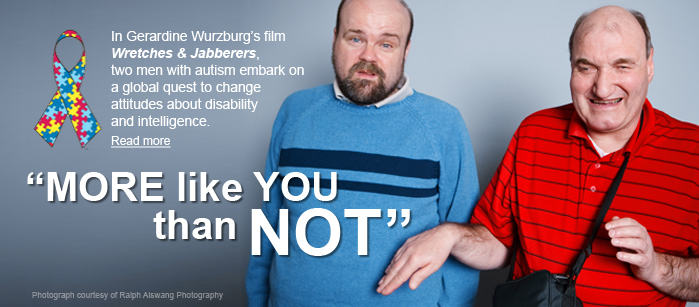
Wretches and Jaberers
There's a moment in the film where Larry expresses how painful it is when people thinks he's stupid because he can't talk. I related so hard to this moment, not because people think I'm stupid. The opposite, I'm normally perceived as being above-average. It took me awhile to figure out what I had in common with Larry in this moment.

Then it occurred to me – the key thread is being misunderstood.

I know myself really well. I know my capabilities and feelings and outlooks. Yet often NTs think they know these better than me. They make assumptions about my motives, and then they argue with me, trying to convince me their outside perceptions are more real than my own experience.

All autists are deeply misunderstood. NTs often think we're stupid, or out of control, or crazy, or drama, or unfeeling, or unempathetic, or dangerous. They think we're emotionally unintelligent. We are painted in broad strokes with wide brushes that assume intentions and ascribe meanings which aren't true.

It's even harder, for those of us who are skilled in the use of language, when what normally works for us suddenly stops working. We sometimes can't find words, or the words we use are suddenly incomprehensible to NTs because of their assumptions or because autistic thought patterns are so different and difficult to communicate across the divide. Other skills, like sensory processing or executive function and abruptly fail, and we blow through expectations set by past behavior.

For this and many other reasons, I've known instinctively, since I was a small child, that I could expect to be misunderstood on a regular basis.

To see Elsa fleeing her own kingdom really struck a chord. She tried so hard to be like everyone else and to avoid hurting anyone, and yet she still failed and had her motives misascribed. This is something many autists can relate to.

The misunderstanding is even more acute because Elsa looks normal. Her "disability" (diversability) is invisible, so when it suddenly appears, it is all the more shocking and horrible and more difficult to understand. Aspie behavior is much the same. Because no one can see a reason for strange behavior, NTs can hurtfully ascribe motives that make sense to them, but not to us.

"You just need to try harder..."
Helpful advice, but only a little
It's easy to see why someone in a wheelchair isn't running in a marathon, but when a well-dressed, intelligent, and verbal aspie with sensory processing disfunction fails to reciprocate a friendly greeting, it must be out of rudeness or meanness or a lack of empathy, not out of severe social anxiety, or an inability to assemble the words into meaning, or the inability to instinctively understand what the appropriate response is.

Likewise, when Elsa's power first escapes in public, she is accused of being a sorceress, a monster. The people are not only afraid of her, some of them hate her and want her dead.

This reflects the quick switch of being admired by everyone, then abruptly alienating them, and not knowing why. That's the life of an aspie who passes as neurotypical, builds up expectations, then shocks everyone when we reach a limit and breakdown, or fail at some seemingly simple task (like shaking someone's hand). People don't realize the capricious nature of Aspergers, that sometimes those little things are impossible for us, even if it was possible just a minute ago.

Just like it became impossible for Elsa to contain her powers.

Though Elsa is a secondary character, she upstages Anna, the protagonist, who may also be a relatable character for aspie viewers. She is clumsy, socially awkward, blunt, practical, lonely, and unorthodox. She also expresses an impulsiveness and devil-may-care attitude which is not only endearing, but common to the Asperger's experience.

I related very strongly to Anna's confusion and pain when Elsa shuts her out the way my sister did me. Elsa's reasons for the rejection seemed to be good, but it caused more harm than it prevented. As in their case, my own relationship with my sister seems to be improving the more time we spend talking to one another, not less.
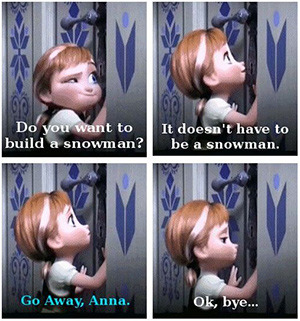

My sister's reasons for shutting me out are rooted partially in long-running misunderstandings about my behavior vs. her interpretation of my behavior. Once I told her I am as aspie, she could understand me more. (No everyone reacts this way, however. I have heard that revealing an Asperger's diagnosis sometimes causes increased misunderstanding in families.)

My sister's reasons are also partially rooted in religion, which leads me to the last mirror that Frozen held up to my life.

When I chose to leave the religion of my birth, I felt a mix of conflicting emotions. I still do. On the one hand, I can celebrate my freedom from expectations and rules which never quite fit me, as Elsa does. There is much joy to be had in that. My new beliefs and new way of living is very me. I've lived this way for thirteen years, and the more time that passes, the more I know this path is totally right for me, and I won't let anyone take it from me.

Yet like all good stories, there are tradeoffs and conflicts. This isn't a Mary Sue story, and the price I paid is steep. I left most of my family behind. I left my cultural homeland behind. I could no longer fit in there, so I exited. By isolating myself from them (and that isolation is a two-way street), they can no longer hurt me, and likewise, I no longer hurt them by being myself in their presence. But my leaving had unknowable destructive effects back home. My family misses me, and though their desire for me to fit their mold is unrealistic, it is also real.

Though we now live in very different worlds, we are still family. This story arc has not ended for me yet. I'm still the Elsa dancing in her ice palace, singing "Let It Go", trying to forget the people I left behind, trying hard to pretend they're better off without me as I am better off without them.

Our issues seem insurmountable, but maybe they aren't. The trolls sing a song about fixer-uppers which is about marriage and romance, but it also addresses blood-family. "Everyone’s a bit of a fixer-upper, that’s what it’s all about! Father! Sister! Brother! We need each other to raise us up and round us out." 

Getting to the point of acceptance is the hardest part. Unconditional love isn't loving in spite of differences; it's loving because of the differences. Unconditional love has no room inside it for wishing the other person were different. We can wish they'd treat us better, and set boundaries towards that end, but when we want them to act a certain way so we can pretend they are a fantasy version of themselves? That is very selfish indeed. That's alot of strings attached, enough to turn our loved-one into a puppet.
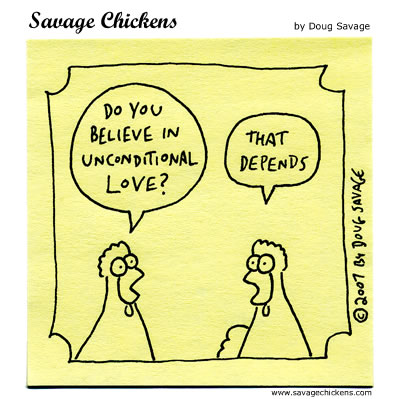
I love you...
I just don't approve of your choice to be a chicken.
The way I choose to live is a very spiritual path for me, uplifting, deep. Like Elsa, I feel ostracized for being who I am. In "Let It Go", when she sings the words, "No right or wrong, no rules for me", it's because those rules don't fit her the same way fit the others. She's decided "the perfect girl is gone" because she has a new standard of perfection all her own. This feeling is reflected in the lyrics of the radio version by Demi Lovato, "Up here in the cold thin air I finally can breathe; I know I left a life behind but I'm too relieved to grieve".

Having gone through that, it really is a weight thrown off. 

It's sad that by creating her own standard and cutting those strings, Elsa has to isolate herself: "Standing frozen in the life I've chosen, you won't find me, the past is so behind me, buried in the snow."

Elsa does eventually find acceptance among her people, but the movie fails to explain how this happens. The implication is that it magically happens once she comes to accept herself. In real life, it's kind of that simple, but not really. The reality is that some people will accept you. Others will reject you even more. Still others will reject you at first, and then slowly decide that love is more important–and more effective–than trying to form everyone else into a standard of false perfection.

In my case, whether talking about autism or religion, self-acceptance is my priority. If I have to reject myself to be accepted by others, their love isn't worth it. I would rather live my life in the best way I know how, and let them come around to me, if they want. In many ways, this is my "kingdom of ice-olation", but it's a price I am willing to pay.

Labels: , , , , , , , , , , , , , , , , , , ,

Tuesday, August 27, 2013

Mind Control 101: Cogs of Dissonance

Your brain is full of machines. Each machine is made of thousands of cogs spinning in tandem with one another, and all the machines are more or less connected and dependent upon each other. When a cog starts to break down, other parts of the machine pitch in to repair it, replace it, or bypass it. This is because your survival is dependent upon the smooth functioning of each and every cog.

Or so the machines want you to think. Because they control you.

This is your brain on cogs.
Any questions?
This is, of course, an analogy which I'm using to illustrate a complicated idea -- the theory of cognitive dissonance. A cognition (or cog) is any single thought, feeling, idea, concept, perception, behavior, social feedback, memory, attitude, goal, value, or commitment. When you put them together with other cognitions, they build all the belief systems that make up you. Earth is round, tacos are delicious, love feels nice, kittens are fuzzy, corporations are evil, God is great, and Republicans all suck and should go hide in a cave until they come up with some way to not look like a bunch of clowns.

Or whatever it is you believe. I happen to have a moderate opinion on the flavor of tacos, and I've never met God so I'm not sure how neat He is.

Each of these cogs, and the belief systems they build, have varying levels of importance. There are people who would die to save their favorite taco, and other people who don't really care that much about food. How strongly you feel when your precious (or not-so-precious) cog is threatened will inform your reaction to various kinds of incoming cogs that other people throw at you. By the way... you might want to duck.

You see, living in the world means we constantly encounter new cognitions every day. The Flat Earth Society distributes pamphlets, paleovangelists push their anti-taco propaganda, love breaks your heart, kittens are proven to cause cancer, corporations run ads about saving lives, atheists say God is not great, and you've got friends who are Republican. Everyone has a different message to push, and if we really believed everything we heard, we'd change our minds everyday about everything. More frighteningly, we'd never know what brand of breakfast cereal to buy. (I'm a paleovangelist, so I don't buy cereal brands. None of them are true.) Our brains need some sort of mechanism to hold all our cogs together or they'd roll bouncing our of our heads and people would trip on them and fall down.

That mechanism is an emotional reward and punishment system known as Cognitive Consonance and Dissonance. Consonance is a good feeling. When we see a beautiful taco on TV, spinning in a glorious light, with beautiful green lettuce hand-picked for its photogenic properties, sticking out from the crunchy shell at aesthetically pleasing angles, and the announcer shouts, "Recommended by four out of five dentists who chew gum for people who like mouthwatering, savory tacos!", we think "Yes! I knew it! I knew I loved tacos. And now they're healthy, too! Sweet Jesus I was right all along! Baptize me in Fire sauce!"


Dissonance occurs when we take in information that is contrary to an existing belief. The more cherished the belief, the more powerful this feeling. It drives us to protect our sacred cogs and the giant, powerful machines they hold together. 9,329* studies last year show that corn is horribly bad for you. It's probably why we are all coming down with diabetes. But if you really love tacos, you don't want to hear this. The more you love tacos, the less you want to hear this. And that feeling is called cognitive dissonance.

* I made this up. But some studies showed this. I'm lazy. Go google it.

Cognitive dissonance isn't just one feeling. It can manifest in a whole range of uncomfortable emotional side effects: Confusion, irritation, annoyance, anger, rage, sadness, denial, defensiveness, nervousness, anxiety, irritable bowel syndrome, easy bruising, weight gain, and painful erections lasting more than four hours. (The last four are extremely rare. I'm sure you'll be fine.) Under those conditions, you will be highly motivated to rid yourself of the offending thought in some way, so you can go back to eating tacos in health-defying glee.

In the end, we don't want to feel crazy, because to feel crazy is to die. To willy-nilly accept new beliefs without some type of discomfort might cause insanity. So would dumping out all our old beliefs without good reason. As would actually believing six impossible things before breakfast. So dissonance and consonance work together to make all the cogs in our mind somehow fit together, even when sometimes they directly conflict with one another. Even when sometimes, in reality, they make us believe impossible things. Like pretty much everything you believe right now.

Just kidding.

But only a little bit.

There are a number of strategies our minds use to handle cognitive dissonance. They all involve lowering dissonance or increasing consonance, or some combination of both. The fact that one cog (I like tacos) might be connected to alot of other cogs (I want to be healthy; I believe in science; I can eat whatever I want; this is America where we have freedom to eat what we want; people who threaten freedom are Communists; I hate Communists; I also like Doritos; Doritos are made out of corn; some tacos are made out of Doritos; Jesus ate tacos at the Last Supper; Jesus can't be wrong; Jesus wasn't a Communist) can promote the importance of that cog and increase the intensity of the dissonance. If you can't resolve the conflict, an entire machine might break. And we can't have that.

Protect the Cogs! 

The process of resolving dissonance happens automatically. Sometimes it only takes a couple of seconds to walk through all the options and emotions they inspire and logical links they create, to come up with a resolution. Sometimes it takes days or longer. Here are the three strategies:

1. Alter Cogs -- We've got the old cogs and this new interloper that threatens to break the machine. So we can change something, either the new cognition, or an old one.

Sometimes the easiest thing is to reject the new idea. "There must be something wrong with that study. With uh... all 9,329 studies. I'm just going to pretend I never heard of it. Crunch crunch yes, nine out of ten dentists agree with me. So good."

Or you can alter one or more of your existing beliefs or behaviors.
  • Science doesn't know anything. Crunch crunch.
  • Besides, I'm going to die anyway. Might as well crunch crunch.
  • And tacos don't even have corn. That's just a myth! Crunch crunch.
As a last resort, depending on how much we like tacos, we may even change that cherished sacred cog: "Okay, fine. Science has persuaded me to be a Communist. I will stop eating tacos and I now believe Taco Bell should be dismantled by the government. Vive la paleo!"

2. Add New Cogs -- By adding new cogs we can create new systems that help the old system work alongside the new one. "Yes, I believe in science and I still want to be healthy and I still love America. Which is why I have become convinced all corn studies are funded by the anti-corn lobby which is secretly controlled by aliens who know that corn actually makes us stronger and more immune to their mind control rays!"

We can also take steps to increase cognitive consonance to drown out any remaining discomfort, say by joining an alien abduction support group where they let us present evidence for this conspiracy as they nod their heads in heart-warming agreement, and every once in awhile, Old Bob shouts, "I knew it!" right before eating the last taco, and every time he does that, it sparks a new round of cognitive dissonance, because you like it when Old Bob agrees with you, but damn it, that was the last taco!

3. Alter Importance -- You may have noticed that importance is important in how important the importance of the dissonance is. To put it more simply, if you can merely lower how important you think one or more cogs is, you will find instant relief. This is the solution you've come to when you shout, "FINE! I never liked tacos anyway! God just leave me alone, stupid scientists!" Maybe you keep eating tacos, but decide your health isn't that big a deal, or that science isn't a big deal. Freedom's just another word for nothing left to lose, right? So you embrace Communism and tacos and science and freedom and corn, because nothing really matters, and congratulations, you're a nihilist. Dissonance doesn't even exist anymore. Did it ever? If it did, it shouldn't have.

On this same scale, you can increase the importance of cognitions that give you consonance. Suddenly, you're looking at pictures of kittens on the internet, because boy, they sure are fuzzy. Ah, doesn't that feel good? You commit to a new diet plan to eat five tacos a day, to overcome your fear of commitment which is something you've been meaning to do anyway, and you can almost forget about those 9,329 studies. Yay corn! Crunch crunch.

Mind Control?

What does any of this have to do with mind control? Everything! So sit down and stop asking questions and believe everything I say. You trust me, right? Because once I've earned your trust by stoking flames of consonance using your existing belief in kittens and the omniscient power of tacos, I will need to reroute any dissonance you may feel as I slowly install my own cogs. Many of those cogs will be specially designed to elevate the importance of the beliefs I want you to have while giving you the tools you'll need to handle dissonance that will be thrown at you from the outside world. Because when you belong to a cult, you will have lots of opportunities to feel dissonance. You will depend on social approval from the group to feel consonance.

Mind control techniques can be seen as a system of beliefs designed to protect the belief system when the rest of the world, and its facts, regularly disagrees.

Almost every mind control technique has to do with manipulating cogs. Any totalist group must overcome your overwhelming cognitive dissonance which was originally designed by evolution to make you not believe everything people tell you. The cult must make you believe what they have to tell you, so they will use cognitive consonance by telling you things you already agree with, to overcome your dissonance about how weird they are and about how they are secretly communists who will eventually restrict your intake of tacos but not before giving you three free kittens and praising Fire sauce. (Plus Bob isn't there to eat the last taco.)

Once you've attended enough meetings and now have committed to pledging life-giving care to ten precious fuzzy lifepuffs, which you've named after famous historical tacos, the totalist group will begin installing new beliefs that you never had before, cogs that will lock you into the group and make it extremely painful to leave. Some cogs are designed to keep you isolated from dissonance-causing information. Some are designed to bounce the bullets of dissonance right off your newly-thickened skull. Some are designed to create dependence, and increase the importance of community and social pressure. Some are designed to suppress any doubts that arise, and prevent you from voicing criticism. Some can even give you phobias to prevent you from leaving. They convince you that the group is keeping you safe, so the idea of accepting new cognitions will literally cause fear to pound in your chest.

Your new cult will promote the importance of tacos until yes, you will die to defend tacos, while simultaneously accepting new restrictions on actually eating them. You quickly learn to hate the government (which funds studies into the health effects of corn), hate science (which actually does studies on corn), and hate all paleovangelists who are clearly sent from the Great Satan of Carb Haters to destroy all the Good People like you that God has chosen to promote kittens and tacos. I mean, who could hate a kitten, except a devil worshipper?

Cornclusion
Cogclusion

Cognitive dissonance is actually good. It's good for your sanity, survival, and for humanity. It's how we learn and how we defend ourselves from snakeoil salesmen. Except when the salesman is selling really good snakeoil and it cures what ails you and you saw it with your own eyes, a lame boy could walk it's a miracle, please take my money!

Yes, dissonance and consonance can be manipulated. But the fact is, it has to be manipulated. Only tricky smart people are able to do it, and even then, only sometimes. By learning about dissonance and manipulation techniques, you are installing new cogs that prevent the installation of harmful cogs. Adopting an attitude of healthy skepticism, and demanding facts, and researching more than one source and opinion will help those nasty Cogs of Evil bounce right off your forehead... tho not without a little pain.

And even then, somewhere out there, is a cult leader who will find a way to take advantage of you. It may have already happened. I hope that thought doesn't make you too uncomfortable.

THIS POST IS PART OF A SERIES
Mind Control 101: Myths of Brainwashing
Mind Control 101: The Basics

Labels: , , , , , , ,

Thursday, April 25, 2013

Evidence of the Flying Spaghetti Monster in Biblical Teachings

Much as been made in the Creationism debate of just who created the Earth. Was it Jehovah, the God of the Bible? Was it Atum who ejaculated human kind into the world? Was it Ahura Mazda who made a mountain grow so high it punctured the sky and rained down all known things? 

Or maybe it the Flying Spaghetti Monster. But why her? There is no ancient evidence of her existence. She was just made up in 2005 by Teacher Bobby Henderson (blessed be his name) who was trying to prove a point. No one can even decide her gender!

But I'm here to tell you there is plenty of evidence, just as much evidence as we have for any other religion with ancient roots. You see, the Bible itself is full of references to the Flying Spaghetti Monster and her doctrines. In fact, the Bible was originally about the FSM, until it was co-opted and infected by the much later faiths of Judaism and Christianity.

Or you be realistic and assume Pastfarianism is in its infancy, that the religion only a few years old. (Because it is.) The core scriptures consist of one open letter written to American school boards, one drawing of the FSM making some mountains and a midget, a graph, and a few miscellaneous photographs taken by zealots.  There are only three tenets to the faith so far:  
  1. A Flying Spaghetti Monster created the universe.
  2. The first human was a pregnant midget. 
  3. The decline in the world's pirate population is leading to global warming, hence pirates are very important.  
With just those three doctrines, and one hour, just a few months after the FSM was "invented", and using the Holy Book of another religion, I was able to find plenty of biblical support for the Pastafarian faith. The odds were stacked very much against me.  

If I can so easily reverse-engineer the Bible using confirmation bias, then what does that say about all other modern interpretations of the Bible?

Imagine if a Holy Book had been written with the doctrines of the FSM in mind all along, written and maintained by faithful Pastafarians, for thousands of years.  Imagine if they were able to choose who's life stories and biographies were put in the Holy Book, and what information would be ignored.  Imagine that thousands of the most dedicated Pastafarian clergy spent their entire lives studying that book and trying to make it fit their worldview.

Christians have misunderstood this concept of God to be a white human male on a throne, but I am unable to find any strong biblical evidence to support this.  Therefore, I am going to assume that all biblical references to "God" or "the Lord" are referring of course to the actual creator of all the universe... the Flying Spaghetti Monster. The Creator is "God", then we can easily translate the word "God" to "FSM".

In my studies, I was very surprised at the emphasis the bible gives to Pasta.  So much so that I included a tiny fraction of the scriptures that speak of pasta.

Let me clarify what I mean.  Pasta is made from grain which is ground, mixed with water into a paste, and cooked.  There is no yeast in Pasta, otherwise it would rise, and be called "bread".

Since the Children of Israel were not Italian, they didn't have the word "Pasta" or "Spaghetti", but it is clear that the term "unleavened bread" can only refer to pasta.  Unleavened bread is also made by mixing grain with water and baking it.  By cutting that into strips, you have pasta of various types, or if you don't cut it, you have lasagna... which is also pasta.

Spaghetti is simply one of the thinnest-cut categories of pasta. 

Pasta played a major religious role in the lives of the Hebrews.  The Children of Israel were commanded to feast on unleavened bread, in a manner that was a type of the Flying Spaghetti Monster, to remind them of His role in their lives. 

This was an especially important during the religious feast of the Passover.  Many think the Passover refers to when the destroying angel passed over the homes of the Israelites in Egypt, sparing the lives of their firstborn, however, few understand that the people had celebrated this holiday long before their captivity in the land of Egypt.  The word "Passover" actually refers to when the Flying Spaghetti Monster passed over the earth, making the mountains and trees, and one pregnant midget, thereby completing creation.

Here are some selected scriptures talking about the use of Pasta in Israelite culture:

Exodus 12:8-11:
8 That same night they are to eat the meat roasted over the fire, along with bitter herbs, and bread made without yeast. 9 Do not eat the meat raw or cooked in water, but roast it over the fire-head, legs and inner parts. 10 Do not leave any of it till morning; if some is left till morning, you must burn it. 11 This is how you are to eat it: with your cloak tucked into your belt, your sandals on your feet and your staff in your hand.
In addition to the pasta they ate in remembrance of the FSM, the meat they are to serve is clearly meatballs, which are made of the ground up bits of all parts of the animal -- the head, legs, and inner parts.
Here is another verse, condemning fluffy bread:

Duet. 16:4, "Let no yeast be found in your possession in all your land for seven days."


And a strong admonition to always partake of pasta:

Exodus 12:20, "E
at nothing made with yeast. Wherever you live, you must eat unleavened bread."

His Stringiness hates fluffy bread, and cannot stand to see it in his temples, or with his holy sacrifices:

Exodus 23:18, "
Do not offer the blood of a sacrifice to me along with anything containing yeast."

More on the diets of the Children of Israel:

Duet 14:3-8
3 Do not eat any detestable thing. 4 These are the animals you may eat: the ox, the sheep, the goat, 5 the deer, the gazelle, the roe deer, the wild goat, the ibex, the antelope and the mountain sheep. 6 You may eat any animal that has a split hoof divided in two and that chews the cud. 7 However, of those that chew the cud or that have a split hoof completely divided you may not eat the camel, the rabbit or the coney. Although they chew the cud, they do not have a split hoof; they are ceremonially unclean for you. 8 The pig is also unclean; although it has a split hoof, it does not chew the cud.
Everyone knows that meatballs are made of cow meat, which is an animal with split hooves and which chews its cud.  Sometimes meatballs are also made from mutton or goat, but only when beef is unavailable, or if you're a Hindu Pastafarian.  If you are a vegetarian Pastafarian, you can skip the meatballs all together.

Judges 6:17-22 tells of an encounter Gideon had with an Angelic messenger from His Noodliness. Gideon is given an object lesson that reminds him of when the FSM created the mountains:

17 Gideon replied, "If now I have found favor in your [the Lord's] eyes, give me a sign that it is really you talking to me. 18 Please do not go away until I come back and bring my offering and set it before you."  And the LORD said, "I will wait until you return."
 19 Gideon went in, prepared a young goat, and from an ephah [3/5ths of a bushel] of flour he made bread without yeast [spaghetti]. Putting the meat [meatballs] in a basket and its broth [tomato sauce] in a pot, he brought them out and offered them to him under the oak.
 20 The angel of God said to him, "Take the meat and the unleavened bread [spaghetti], place them on this rock [representing the mountains], and pour out the broth." And Gideon did so. 21 With the tip of the staff that was in his hand, the angel of the LORD touched the meat and the unleavened bread [with his noodly appendage]. Fire flared from the rock, consuming the meat and the bread. And the angel of the LORD disappeared. 22 When Gideon realized that it was the angel of the LORD, he exclaimed, "Ah, Sovereign LORD! I have seen the angel of the LORD face to face!"
Here is an inspiring account of the creation story as told in Psalm 78:

 23 Yet he gave a command to the skies above and opened the doors of the heavens;
 24 he rained down manna for the people to eat, he gave them the grain of heaven.
 25 Men ate the bread of angels; he sent them all the food they could eat.
 26 He let loose the east wind from the heavens and led forth the south wind by his power.
 27 He rained meat down on them like dust, flying birds like sand on the seashore.
And some lines from Ezekiel 24 help us understand how the Flying Spaghetti Monster was himself created, and how we may emulate him and be purified:

 10 So heap on the wood and kindle the fire. Cook the meat well, mixing in the spices; and let the bones be charred.
 11 Then set the empty pot on the coals till it becomes hot and its copper glows so its impurities may be melted and its deposit burned away.
This next reference means the meaty goodness of his Noodiliness is holy and pure, whereas the meat of the flesh is unclean.  But his holiness will not make us clean:

Haggai 2:12-13:

12 If a person carries consecrated meat in the fold of his garment, and that fold touches some bread or stew, some wine, oil or other food, does it become consecrated?'" The priests answered, "No."
 13 Then Haggai said, "If a person defiled by contact with a dead body touches one of these things, does it become defiled?" "Yes," the priests replied, "it becomes defiled."
Jesus was a great prophet of the Flying Spaghetti Monster, who came to us in human form so as not to scare us.  He also abhorred yeast.  That he used it to insult his enemies showed that the Jews of the time had carried on the important tradition of their ancestors:

Mark 8:15, "Be careful," Jesus warned them. "Watch out for the yeast of the Pharisees and that of Herod."

This story is repeated in Luke 12:1, where we come to better understand why this was an insult. Jesus taught that yeast represents hypocrisy.  It does nothing but add air to the grain, so that you think there is more to it than there really is.  The bread looks filling, but it is empty.  "Be on your guard against the yeast of the Pharisees, which is hypocrisy."

Like Jesus said elsewhere, "Man cannot live on bread alone".

Yeast also represents evil.  1 Cor 5:8, "Therefore let us keep the Festival, not with the old yeast, the yeast of malice and wickedness, but with bread without yeast, the bread of sincerity and truth."

Yes, let us be touched by the Noodly Appendage of sincerity and truth!

Pirates are also an important doctrine of the Pastafarians.  The bible makes a few mentions of pirates, though back then they were called Phoenicians, and before that they didn't have a word for them.

Here is a nice poem about pirates in Judges 5:17:

Gilead stayed beyond the Jordan. And Dan, why did he linger by the ships?       Asher remained on the coast and stayed in his coves.
And Arrr! they did go sailing for Solomon, Solomon's famous pirates, who brought back much booty:

2 Chron 8:18:

And Hiram sent him ships commanded by his own officers, men who knew the sea. These, with Solomon's men, sailed to Ophir and brought back four hundred and fifty talents [doubloons] of gold, which they delivered to King Solomon.
Ahoy! that famous Dread Pirate Hiram and his fearsome crew!

Here is a prophecy.  As we all know, the pirates found refuge in the Caribbean, in the "West", and were hired by Britain to attack the Spanish in the "South":

Daniel 11:29-30:

29 "At the appointed time he will invade the South again, but this time the outcome will be different from what it was before. 30 Ships of the western coastlands will oppose him, and he will lose heart. Then he will turn back and vent his fury against the holy covenant. He will return and show favor to those who forsake the holy covenant.
As I mentioned, there are two other doctrines central to the FSM faith. As I only had once hour for research, I rested my case. I seem to recall some scriptures about stature and plenty about the end times, which could only mean terrible hurricanes and droughts caused by global warming. I would look it up for you, but I think it would be a tremendous faith-building exercise if you study it on your own.

In the name of cheese and rice, ramen. 

Labels: , , ,