Tuesday, January 26, 2016

Radcon 7 and Norwescon 39 Panel Schedule

It's con season again! I'm so excited to announce my panel schedule for Radcon 7 (Pasco, WA) and Norwescon 39 (Sea-Tac, WA March 24-27). These are some really awesome topics at two of my most favorite cons. I hope to see you there!

Radcon Feb 12-14, 2016

The Science of Believing
Lots of people believe in things that are, or aren't, real. Not everyone can be right, but everyone thinks they are. As humans, we cling to our convictions as if they were life preservers. Why do we believe things, even when those things are strange or unpopular? And why is it so hard to face being wrong? Science has studied these questions and come up with interesting answers. Come learn about cognitive dissonance theory, cognitive biases, the levers of influence, and mental shortcuts that leave all of us ready to defend our beliefs, sometimes even to the death.
Fri 1:45-2:45p – Rm 2205 
With: Peter Jones, Rory Miller

Empaths, Synesthetes, & Other Super Powers
What does science tell us about empathic abilities, synesthesia, and other multi-sensory ways of perceiving - and interacting with - the world? Explore the benefits and challenges experienced by people with these "super powers". Be ready to share. Excellent opportunity for writers crafting a character with one or more of these traits.
Fri 5:30-6:30p – Rm 2201
With: Alma Alexander, John Alexander, Joyce Reynolds-Ward, Tamra Excell

Polyamory Revival
Polyamory is returning to mainstream consciousness with hit shows like "Polyamory: Married and Dating" on Showtime and feature stories in major news outlets. Learn how polyamory is from times of old, how agriculture and property ownership changed family dynamics, and how certain polyamory models are especially empowering for women. Enjoy the discussion, and walk away with suggested readings to further your knowledge on this fascinating subject.
Fri 8:00-9:00p – Rm 2201
With: Amanda Baldwin, Bruce Kenoyer II, Craig Jackson, Kevin Wiley, Tamra Excell

50 Shades of Consent
With the success of books like 50 Shades of Grey, more people than ever are reading about BDSM. But when writing about it, what are some misunderstandings or common errors to avoid? How can writers present it in ways that are safe, sane, and consensual?
Fri 9:15-10:15p – Rm 2201
With: Amanda Baldwin, Craig Jackson, Peter Jones, Rhiannon Louve

Mind Control
Your villain runs a creepy cult. Your protagonist chooses to remain in an abusive relationship. Your antagonist is a manipulative con artist. A side character is a cult exit counselor. What can transform an intelligent skeptic into a Koolaid-drinker? No magic, truth serums, hypnotic chants, or hand-waving required. Learn the real science behind cults, cons, and coercion for writing realistic mind control.
Sat 11:15-12:15a – Rm 2201
With: Peter Jones, Rory Miller

Reading: TBA (Theogenesis Gimmick?)
Sat 12:30-1p – Rm 2211

Surviving the Post-Apocalypse with Disabilities
Survive a post-apocalyptic world with disabilities, both mental and physical, visible and invisible. How do you find food when you have difficulty walking? How do you defend yourself against mutants and rogues while managing PTSD triggers? What will you do without ready access to medications that stave off chronic pain, heart disease, depression, or attention difficulties? Might some disabilities actually become hidden strengths in a world where society has been turned upside down? The panelists are personally experienced with disabilities and will discuss their plans to stay alive through whatever may come. Bring your survival instinct and prepare to prevail.
Sat 5:30-6:30p – Rm 2205
With: Bill Holden, Eytan Kollin, John McDonald

Diversity in Fiction
Our world, and our fandom, is expanding. How is a simple SF/F author to keep up? Come talk with a panel of authors who know a thing or two about inclusive writing. Find out how to go about, why to go about it, and when to go about it (Hint: The answer is now!).
Sun 10:00-11:00am – Rm 2203
With: Alma Alexander, J Tullos Hennig, Kaye Thornbrugh, Peter Jones

Geek Boys vs. the Feminists: An Empathetic Look at Gender in the Geek Community
Through the 70s, 80s, and 90s, geeks banded together against an oppressive world that mistreated them and refused to understand them. They created acceptance and friends where previously they had only experienced bullying and ostracism. Now those geeks feel oppressed by a new threat: feminism. Except, the threat isn't new. And it isn't a threat. Male geeks and feminist geeks have more in common than we have different. Let's discuss the intersectionality of the geek cause with the feminist cause, and why inclusion, not busty body armor, should be the common interest that holds the geek community together.
Sun 12:30-1:30p – Rm 2201
With: J Tullos Hennig, Tim Martin

The Psychology of hackers and gamers; a male/female perspective
With the advent of Gamergate and the press a portion of the gaming community has garnered, people are looking at the anti-social aspect of gaming and of hacking. What are these issues, which are real and which are myths? Come join us for what promises to be a lively discussion.
Sun 1:45-2:45p – Rm 2207
With: L James, Meg James, Peter Jones, Tim Martin

Norwescon March 24-27, 2016

The Future of Accessibility
As much as we might want a future where every injury can be healed, chances are there will always be some things beyond our ability to fix, and situations where tried-and-true will remain the best course. So how might one navigate micro gravity with a leg cast? Would a paraplegic still use a wheelchair, or would exo-skeletons or bionic legs be standard practice? Could robots replace service animals? Let's talk.
Thur 9:00-10:00p – Cascade 3&4
With: Pat MacEwen (M), Sar Surmick, Dr. Ricky

Invisibile Disabilities
Not every disability is apparent at a glance, nor is anyone's personal health anyone else's business. From mental illness to chronic disease to a variety of syndromes and impairments too lengthy to list, we'll discuss the difficulties of living with chronic health conditions, the stigmas associated, what progress has (or hasn't) been made in reforming public perception, and strategies on getting other people to mind their own blasted business.
Fri 12:00-1:00p – Cascade 10
With: Gregory Gadow (M), Cheryce Clayton, Michael 'Tinker' Pearce

Magic Rumble
Join our pros as they each are given a magical system and debate which would reign supreme.
Fri 5:00-6:00p – Cascade 3&4
With: Grant T. Riddell (M), Peter Orullian, Logan L. Masterson

Creativity & Disabilities
Whether your problems are physical or psychological, there's no denying that being creative and creating art is difficult to almost impossible when a disability stands in your way. Come learn how different artists and writers work with, past, or through their personal disabilities and limitations to create their art.
Fri 6:00-7:00p – Cascade 10
With: Kevin Mathews (M), Liv Rainey-Smith, Mark Chapman, Spencer Ellsworth

Consensual Non-Monogamy 101
What is consensual non-monogamy? Is it polyamory or swinging or polygamy or relationship anarchy? Why would anyone want more than one partner? What important advice is there for starting out? How do you do you minimize hurt feelings? Can you? How do more conservative family members react to these plural relationships? Should you, shouldn't you? What are the pros and cons?
Fri 7:00-8:00p – Evergreen 1&2
With: Sar Surmick (M), Sheye Anne Blaze, Wednesday Phoenix, Burton Gamble

A Culture By Any Other Name
Many alien cultures bear a strikingly humanized feel to them. Yet, does creating alien cultures too foreign in design make them too hard to be relatable? The pitfalls, pros, and cons of alien cultures is discussed.
Sat 12:00-1:00p – Cascade 10
With: Jason Bourget (M), Caroline M. Yoachim, Kim Ritchie, Lawrence M. Schoen

Reading: Theogenesis Gimmick (forthcoming in the Truth in Paradox anthology by Onyx Path)
A young woman finds out what happens when you click one of those "One Weird Trick!" ads and finds herself awakened to a puzzling world filled with gods and magic.
Sat 1:00-1:30p – Cascade 1

Sex & Gender Fluidity
We are used to thinking about people in binary terms, but reality is nowhere near that simple. Join our panelists as they discuss what we know -- and do not know -- about the biology of sex and gender.
Sat 8:00-9:00p – Cascade 5&6
With: Sar Surmick (M), Amber Clark, Wednesday Phoenix, Gregory Gadow

A Thousand Words
Literature may be the art of beautiful words, but sometimes great writing comes from--or cooperates with--great images. Come hear how writers use drawings, photographs, and maps for inspiration, worldbuilding, character development, and more.
Sun 11:00-12:00a – Evergreen 3&4
With: Brenda Carre (M), Nina Post, Gregory A. Wilson

The Human Element: PTSD in Science Fiction
Be it the rigors of space travel or the weight of destroying an entire species, protagonists in science fiction take those fights home with them. Join our panelists as they discuss the nature of post-traumatic stress disorder in science fiction.
Sun 3:00-4:00p – Cascade 5&6
James C. Glass (M), Sar Surmick, Robert J. Sawyer

Labels: , , , , , , , ,

Monday, October 14, 2013

Splines Theory: A Spoons Metaphor for Autism

An incident occurred last week where my child unexpectedly needed a ride to school in the middle of my writing session. And it ruined my whole day. Why?

I knew it had to do with Aspergers, but I wanted to know more. Puzzling over this question, I went in search for the perfect metaphor to describe the experience.

I love the spoons metaphor for invisible disabilities. It describes a portion of my world, and it goes something like this: Every morning, most typical people wake up with infinite spoons. They don't even think of spoons as a resource because they almost never run out. They can easily choose to do this or that without risking much other than time consumption. Sure, they get tired by the end of a full day, but generally they have enough spoons to do all the normal things. It's a gift they take for granted.

Those with chronic pain or serious illness or certain types of mental illness, like depression, only get twelve or twenty spoons a day. Each activity, even small things like getting dressed or making breakfast, takes a spoon. Careful choices must be made about how the spoons are spent; otherwise, they will be gone before the day is through. Or worse. A bad spoon-management choice might leave them without spoons for several days.

There is no spoon. It's just a theory.
Which states aren't enough spoons.
The word "spoon" is actually quite weird, when you think about it.
Why is it called a spoon?
Oh, that's why.
It's still weird.
I'm already out of spoons. I wonder why?
Oh look, a butterfly!
For the origin of Spoon Theory, and why spoons and not some other eating utinsil, see Christine Miserandino's account on her blog, But You Don't Look Sick.

I relate to this analogy somewhat, but it fails to describe the intricate resource-management I must do as an aspie. I wake up with a random number of spoons. Why? Why do I mysteriously get a bunch of new spoons at unpredictable times? The process of getting ready for a new task seems to cost me "spoons", but that model doesn't reflect the intricacies of the gathering process itself. What about the frustration I feel when I fail to gather or get interrupted? How do I describe the sense that a dozen little things need doing before I can start a big thing, each costing a fractional "spoon"?

Spoon Theory didn't fit the all data for my experience, so I went in search of a Grand Unified Theory of Resources or Law of Conservation of Aspergers Energy that I could use to think about and describe my universe.

I found a few articles on inertia that help describe some aspects of life with Aspergers, like:

Inertia is a term I'd used years ago, long before my diagnosis. The idea is just like the law of motion. An object at rest tends to remain at rest, and an object in motion with a certain trajectory will tend to remain in motion, headed that direction, at that speed, until stopped or bumped off course by an outside force.

Inertia Theory perfectly describes my hyperfocus, or lack thereof, but it failed to describe outside forces I must apply to get up to speed. Or my frustration at outside-outside forces that stop me.

Last night, after doing a little light reading from Olga Bogdashina's book, "Communication Issues in Autism and Asperger Syndrome," eureka! I found it. The perfect metaphor, "Reticulating splines..."

I'm a huge gamer, and in the 90s I loved old school Maxis games. You know, SimCity, SimEarth, SimAnt. Back then, games took forever to load, especially on my old 386. While games loaded or maps generated, many companies showed useful information, like "Decompressing graphics files...", "Loading sounds..."

Maxis wanted to be funny, so their load screens repeated random nonsensical phrases that sounded Really Important™. Some of them flashed by so quickly you couldn't read them. One remained on the screen the longest, while a voice read it aloud: "Reticulating splines..."

Reticulating Splines...
Seems legit.
Maxis has carried on this fine tradition for decades, and while games now load lickity-split, they ensure you have just enough time to see "Reticulating splines..." flash past. For tradition's sake. Other software drops this phrase in as an Easter egg, and everyone who knows the joke gives a chuckle.

Separately, "Reticulating" and "Spline" are real words, but put together they make no sense. Until now.

What does this have to do with Asperger's?

The single greatest resource hog during my day is what some call "shifting gears", or moving from one task to another. Skilled teachers of autistic kids know to give a child ample warning of an upcoming task and to explain the purpose of moving on. Anyone who's worked with autistic kids knows the reason for taking this extra step. It's to avoid meltdowns.

Even the gear metaphor is problematic, because it takes no energy or time or frustration or boredom to shift a real gear. It's just BAM, you're in first and now you're in second. And you're still driving, not suddenly riding an elephant. It totally fails to describe the struggle of wrapping up one task and beginning a new one. For a neurotypical, it's as simple as shifting a gear. For someone on the spectrum, it's something else.

I knew from the get-go that my search for the perfect metaphor would center around this question: "Why does it take so long for me to get started?" The answer is wrapped up in other autistic tendencies: hyperfocus, special interests, distractibility, and "getting stuck".

Bogdashina describes how the autistic brain processes sensory information differently than neurotypical brains. NTs tend to take in sensory data all at once, summarizing, and comfortably filling in gaps with assumptions. As a result, NTs leave alot of things out, and in return for this compression, they get a speed boost.

According to Bogdashina, autists on the severe end of the spectrum cannot sense objects as part of a whole. A face breaks up into "mouth", "nose", "eye", "eye". A person then is "hand", "arm", "ear", "face", "hair". A room is instead a "wall", "wall", "table leg", "table top", "plate", "chair", "floor". Sounds and other senses take on the same fragmentation, and it's difficult for the autist to lump them all together into "mother" or "dining room".

My experience is not so extreme. I can see a person, a face, a room, a coffee shop, as a "whole thing", though sometimes details jump out at me like the eyes on a cartoon character, causing distraction (but it's also a superpower of observation).

Yet there is an aspect of sensory fragmentation I can relate to, and that's in memory storage and in my understandings of concepts.

Take a concept. For instance, one of my special interests, cults and mind control. I can can perceive the concept as a whole, but not without all its parts. Mind control is a network in my brain of all the thousands of things I've read about over the years, and my own experiences, and my views on how it appears in religion, politics, public schools, and the media. Everything I've ever linked to mind control is in there in this massive file, stored by words, principles, feelings, and synesthetic colors. The topic of "mind control" is not complete without all those bits.

Right now, I'm knee-deep in mind control, because that's the writing project I'm working on. If I were to switch to another project, say editing Emerald City Iron, which is a novel about fairies, I'd be knee-deep in fairies, with mind control long forgotten. I need room in my brain to unpack all the details about fairies and my characters and writing fiction. I'd no longer have room for the topic "mind control" and the task "non-fiction writing". The files would have to be stored away.

In order to really understand fairies and fiction editing again, I'd need to get back into that space, open up the whole file with all the parts. And doing that requires a resource which is nothing like a spoon or inertia. It's more like opening a big game on my old, slow 386. Hence:

Reticulating splines. . .<hourglass>

Screenshot of my brain reticulating splines.
Yes, this artist managed to capture it.
Credit: Jon Storm
It makes sense that a complex topic or project, like mind control or fairies, would take a long time to shift into. That would be difficult for anyone. But what is harder to describe is how the little things, things NTs take for granted, can be just as difficult to shift into.

Reticulate means to "make a net or network of". A spline is a number of things, including: "a. Any of a series of projections on a shaft that fit into slots on a corresponding shaft, enabling both to rotate together. b. The groove or slot for such a projection."

When I switch tasks, I am making a network of all the projections and grooves and slots and shafts and strips of metal and curve-drawing tools and geometrical maths used to draw up the task. I am loading and linking together all the details in my brain that are connected to the project at hand. And that's going to take time, whether that project is making a phone call, disciplining the dog, or writing a novel.

It doesn't just take time. It takes a bunch of energy and processing resources. It isn't fun at all. My brain has to work really, really hard. So when something interrupts me, and demands I dump the loaded program to load up a new program, I get very frustrated. When I've got lots of annoying little errands to do outside the scope of my main project, I lose splines and spoons. The more do this in a day, the more frustration builds.

For instance, if I need to make a phone call about a bill, I need to gather the phone number, collect all the data about the bill, and get into the frame of mind to make the call. For me, that requires gathering lots of little pieces, and on my hardware, it's slow loading. On NT hardware, it might flash by, "Reticulating splines!" so fast you can't even see it. Yet because I have more splines, they take longer to reticulate.

This is why, when I made and took twenty phonecalls a day as part of my tech support job, talking on the phone was relatively easy. It didn't take a lot of spoons, because it wasn't reticulating many splines. The "talk on the phone solving technical problems" program was all loaded up. It stayed in memory for years.

These days, using the phone requires all kinds of splines. And when I need to reticulate that many splines, it ends up costing spoons.

Likewise when I ran Sapioscape, an online retail business, I ran to the post office every day, shipping 3-5 boxes at a time. I was efficient, and it was even a pretty fun. Sometimes I still miss those days.

Now, when I need to ship just one box? I procrastinate forever and the task seems impossible. Because I have to reticulate every single spline related to packaging a shipping and item. It's a rather complex task for me, because my memory has stored each step as a separate thing that I have to recompile.

Same goes for home improvement tasks. I loved remodeling my house. I couldn't wait to get home and build bedrooms in the basement, retrofit foundations for earthquakes. and landscape the yard. Now? Hanging a picture seems impossible. Because I have to remember where I keep the nails and how to use a hammer.

Computers can run multiple programs in background, and so can I, which is fortunate. I can keep one or two complex tasks, and several small items partially loaded into memory. So at the end of the day, I can reticulate splines on some smaller tasks and recreational activities (which also require splines), and switch back to the big project again the next day.

It's not entirely free of cost. I can't just Alt-Tab. A few splines get lost and have to be regenerated again in the morning. If I do too many side-tasks or have too many interruptions or too much time passes, loading up the main project begins to cost more and more.

Part of my spline-management system involves ridding myself of potential interruptions before I can start on my real work for the day. So I invest alot of initial spoons and splines into dealing with small tasks. I try to make sure Prince Ryuk of Pomerania (the dog) is happy. I feed myself and make tea. I deal with email and twitter. I cycle through my ritual of lighting candles and taking meds and turning on music. I let kids and other events interrupt me during this time, and work as fast as I can to get through this routine so I can get to my real work. Sometimes even then my brain isn't into gear, and maybe by that time, I'm hungry again or out of tea. I stare at the blank page a few moments, and I'm back to checking twitter or fiddling with things on my desk.

Somedays, I can reticulate my splines within an hour, and I have an amazingly productive writing day. Other days, it takes many hours. With each passing moment, the frustration builds. I fear I won't be productive, that I'm wasting time, that my book will never be written. It's just like waiting for your favorite game to load on an old, slow 386. You're eager to get started, but those damn splines are still reticulating.

This is why my child needing a ride to school ruined my productivity for the day. It had taken me about three hours to prep for writing. (I was coming off a full week non-productivity due to other life tasks that needed attention, so I required additional spline reticulation.) The door slid open just fifteen minutes after I had finally gotten started putting words to page. I was the only one who could drive said child to school.

I thought I'd be able to get her there and home without issue. But no. I lost all the splines on the drive back. And I got angry. I had an anger-meltdown in the car. I screamed at the top of my lungs and smacked the steering wheel. I knew the day was wasted.

I wasn't angry at anyone in particular. Things happen. I was angry at the situation. And a little bit at myself for being this way.

I also knew that Spoon Theory wasn't going to be enough to describe what just happened.

I still have spoons. I have a limited number of social spoons, overstimulation spoons, working hard for too long spoons. There are some splines-to-spoon exchange rates -- reticulating splines can cost spoons, and if I don't get enough sleep, for example, I don't have enough spoons to reticulate many splines at all.

It's just that running out of spoons doesn't lead me to meltdown. Running out of splines can.

There is an upside to having a brain like mine. Once all those splines get reticulate, I have thousands of connected details available to me. That's not to say I have a photographic memory and can actually remember those details perfectly. But I know the parts that lead to the sum, and can look up things up from there. (Thank Google!) If one of the parts changes, I can make adjustments to the entire topic. If a new fact comes in that contradicts the old parts, I can take a look at the parts of the whole structure to quickly see where adjustments need to be made. I think of new ideas quickly because I kept all the bits stored away, not just the unalterable concept as a mushy whole.

It just means it takes a bit longer to load. Even the "easy" stuff like getting dressed or shopping for groceries or talking to humans. All these splines must be reticulated.

To summarize the three complex forces of Asperger's, I've come up with the Three Laws of Thermodynamic Autistic Motion, also known as "Spins, Spoons, and Splines".
  1. Inertial Mechanics, or "The Law of Spins": An autist in motion will remain in motion until acted upon by an outside force, like a barking dog or the need to pee.
  2. The Law of Conservation of Energy, or "Entropy of Spoons": Spoons can neither be created nor destroyed, only washed and placed back in the silverware drawer. It always takes more spoons to wash the spoons than there are total spoons, leading to entropy, and the eventual heat death of the universe and everyone in it.
  3. The Law of Reticulation of Splines: The load time of splines is directly proportional to the number of splines in storage times the distance (in time) since the splines were last loaded times the number of interrupts by other spline-reticulating processes. As implied by the Second Law of Autism, spline reticulation requires energy in the form of spoons, splines, spins, and anger management classes. Moore's Law does not apply.

What do you think about this model? If you're autistic, or know someone who is, does it seem to fit?

Labels: , , , , , , , , , , , , , , ,

Tuesday, September 10, 2013

The Year I Survived Suicide

[Trigger Warning: Uncensored exploration of self-harm, suicide, and extreme exposure to the vulnerable side of Luna's brain. May contain trace amounts of navel-gazing.]

This year, I survived suicide. At least three times. The incidents have started to blur together,  so let's go with three. It's a nice round number.

I've only recently stabilized enough to process what that means. Last week a friend attempted, and the strong emotions that bubbled up showed just how much I needed to process my own recent encounters with death. I'm not here to tell her story. It's not mine to tell. But I've decided to finally tell my own. 


There are far more reasons to not talk about it. Those of us who suffer from suicidal thoughts also suffer shame for thinking them. The illnesses that lead to anguish and despair are themselves shameful, without the added "sin" and "crime" of killing oneself. I didn't want to talk about it then, not on Twitter, not to friends or family, not to therapists, and not even to crisis lines. I didn't want to be drama. I didn't want anyone to think I was manipulating them. When I felt better, I lied and told myself I was fine. When I felt terrible, I wanted everyone to think I was fine. I'm strong, independent, smart, rational. All the time. I wanted to pretend my weak times weren't really me.

Even well after the fact, I've hesitated and procrastinated writing this post. I've debated the merits and drawbacks. And then, along came Suicide Prevention Week. The Bloggess wrote a timely post on it, so I figured...

It's time. I am throwing aside my shame. I will use my aspy powers of unorthodox bluntness, and unwise social decisions, and a general blindness for knowing what's appropriate, and a pinch of impulsivity to tell everyone exactly how close I came to killing myself this year.

Because the stigma needs to end. Because those in pain need to feel okay reaching out. And those who suffer need to realize they're not the only ones who suffer. Anyone who finds themselves grasping the sheets in despair on those long, dark nights need to know that successful, talented, beautiful people also have dark nights, or weeks, or years when we hate ourselves. If someone like me can hate myself*, then maybe, just maybe, those other beautiful, talented, worthwhile souls will realize they, too, have something to be admired for. Something to contribute. Just one more little excuse to hang on a little longer. Because on those dark nights, every little excuse is a lifeline.

* Yes, I just called myself successful, talented, and beautiful. I'm also impulsive, blunt, socially unwise, and yeah we already covered that.

I didn't attempt, but I did everything up to that point. Had there been a quick and painless way to do it, I surely would have. I own a handgun, and thankfully, at the first sign I was remotely suicidal, Roland made me send my handgun to live with my parents, because there were nights when I repeatedly and vividly imagined what I would do with it. There were times when I wished I hadn't given it up. Or that my parents lived closer. Or that pills or knives would be quick and painless. Because honestly, fear of pain and the thought of surviving an attempt were my only deterrents.

I survived suicide. It is hard to admit that to myself and be sympathetic. There is a trauma in surviving any brush with death, and as I've discovered, suicide is no different. Hearing about suicide takes me away to another place now, where I drift off into a melancholic, mild dissociation, where I'm tempted to erect walls to keep away the tears or depression, where I practice avoidance behaviors which are not typical for me, because I normally like to face emotions and problems head-on.

I have worked through enough PTSD to recognize it. Which only follows. If I'd had a gun pointed at me by an angry person (I have) or almost gotten into a car accident (I have), I'd feel the same.. a remnant of fear, lack of safety, the awareness that the same thing could happen again, at any time. And sadness because I remember how I felt. The desire to kill myself was the least of my worries. The relentless pain and terror that led me to that state is a not-too-distant wound that time has yet to heal. I fear that state, I fear myself, I fear the people around me who unwittingly helped me get into that state.

And the empathy I feel for anyone else in that state is overwhelming, if I let myself think about it.

This is not the first time I've felt suicidal. Long, long ago, when I was a young single mother with no prospects, I suffered relentless depression. I ideated, but never got serious. My religion listed suicide as the third worst sin (after murder and denying the Holy Ghost, but slightly worse than sex). The eternal consequences would make my shitty temporal life seem like heaven. This is exactly the type of harmful stigma I am now against, but at least it worked as an effective stop-gap measure to keep serious suicidal desires at bay long enough for me to get help.

I went to 12-step groups, read self-help books, got therapy whenever I could afford it (rarely), and learned about cognitive behavior methods (CBT). My depression became manageable and I left suicide in my distant history.

But the anxiety never really went away. Instead, found the strength to push through it, day after day after day. I did what I had to do to keep down a job and rear a child. I felt fear and did things anyway, never realizing I was suffering needlessly. I also coped by solving all problems as quickly as possible, and avoiding things had no solution.

If I can't solve or ignore a problem, fear builds and leads to situations that cause more anxiety. I'm especially set off by conflict, which, up until I met Roland, I was able to avoid most of the time. But being strong-willed, living with a strong-willed life partner leads to ample unavoidable conflict, which only escalated and compounded over the years. With every fight, so increased my anxiety, until I was melting down regularly, and terrified the rest of the time that a fight was just around the corner. I got to the point where I welcomed depression as a soothing relief from the long term throb of anxiety. It became the new normal. This became unsustainable.

So it was in April 2013 that I got my Asperger's diagnosis. First came relief. Finally, some answers. Finally, validation, an official certificate* I could wave at other people saying, "Yes, I'm really hurting this much. I'm not just throwing a tantrum; I'm not trying to manipulate anyone. I really am terrified and overwhelmed and want to disappear into a tiny dot."

* They don't actually give you a certificate.

But like a blade with two edges, my diagnosis carried with it a frightening new truthI will always be this way. Before, I held onto gossamer threads of hope: Therapy's this week. Once I get to the bottom of this trigger, I'll be okay. Once I improve my communication skills, everything will get better. I'll just read this book. Okay, now that book. I'll try harder to listen. I'll try harder to explain myself. I'll be more patient. He will eventually see how much he's hurting me. He will eventually listen to me. If only, if only... Solve, solve, solve.

Suddenly the spider had stopped spinning the silk. The fantasy of hope had transformed into... into what? I didn't know. All I knew was that parts of me, not sure which parts, but some parts, would never change. I'm just wired that way.

During my meltdowns, I've always tended to turn inward. The pain is raw and searing, a physical pain, like molten lava or acid is pumping through my veins. I am not exaggerating. I used to think it felt this way for everyone. I used to think burning skin was normal anxiety. So I curl inward when I'm melting down, and scratch at myself. I find odd relief in visualizing a physical cause for the pain. Knives stabbing. Razors slicing. I dig my fingernails into my wrists and hands and arms because the sharpness distracts a little from the fire playing on my skin.

So there's an Asperger's element that is not neurotypical, and totally different from traditional self-harm. I seek a sensation strong enough to wipe out my pain. Sometimes that means more pain, or different pain, or at least pain I have some control over. And this leads me to want to stop existing. And that leads me to wanting to die, to cease existing, to vanish from a world of horrors.

Out of long-habit, I grasp for a reason for my pain, and for a comforting explanation for why I'm behaving so shamefully and out of control. The argument begins with me trying to convince the other person of how much they are hurting me. This strategy often fails (why can't people just listen?) so after awhile, I start to blame myself. Every bad thing the other person has said, every shred of criticism, even that spoken out of pain or love, I turn inward, like a dagger. I imagine their words are a knife, and I make up my own phrases, and with all those words, I stab myself in the gut.

I fight off this moment in the conflict. I tell myself to stay calm, rational, but eventually, the dam breaks, the scale tips, and out come the internalized phrases of self-loathing. There's no rational thought left at this pointit isn't even possible. My amygdala has taken over and I'm in flight-fight-freeze-or-appease mode. Yes, I know I should be telling myself rational, true things, not these forms of verbal self-abuse, but I can't help it anymore.

It's like I have two sides, a little cartoon angel on one shoulder, and a devil on the other, representing my healthy and unhealthy voices. The deeper I go into anxiety, the louder the unhealthy one gets, until the healthy voice doesn't even try. That unhealthy voice starts out wanting to protect me in the only way she can. Defense is her goal. Protect the vulnerable bits. Be vigilant for danger. Everything is dangerous. Destroy the danger before it destroys me. Until the unhealthy voice gets too loud, and she wants to lash out, hurt myself, hurt others, wallow in self pity, or die. Her methods take on a life of their own. When it gets that far, I have a murderer living inside me. An ugly, spiteful murderer who knows all my weaknesses.

The healthy voice delivers all the hopeful phrases, the CBT, the patience and validation and self-care. It's that healthy part of me that keeps me alive, even when she's just a whisper. She is what stops me from planning, who puts off doing the worst until the last possible minute. Sometimes she goes silent, and that is when things get most scary.

So I'm used to wanting to die during a meltdown, and used to wanting to hurt myself. That is very different from wanting to kill myself. Which is what changed in April.

My pain had been building for five years. I'd lost many of my previous sources of stability, ability to control my surroundings, and other coping mechanisms. Years of conflict baggage with Roland and a number of destabilizing life events and the diagnosis all culminated in the Grand Answer: It's all my fault. Or so it sometimes seemed. Most days I met with a hopeful outlook. I had information now. I had something I could work with. Roland was beginning to understand me and I was building new coping mechanisms.

But not in my darkest hours. In those moments, when my skin had been drenched in acid and set on fire, I was a broken, useless person. I was a horrible person, forever emotionally damaged, with no hope of improving. I had hurt the people around me, and I would always hurt the people around me, especially those I loved. I couldn't bear that thought. Worse, I felt rejected. No one wants to be around me when I am in pain. I chase everyone away. I am too much for them. Having Asperger's meant I would always be too much for them.

For the first time in nearly two decades, I wanted to kill myself. Unlike then, this time I was serious. No more did I have religious strictures against it. Beyond this life is likely only endless night, a soft peaceful sleep I craved.

My most recent, and worst episode was about a month ago. My healthy voice recognized I needed help, and I managed to mutter a "someone should watch me" warning before rushing to my room to hide under my desk. No one came to watch me right away. My partners had their own pain to figure out. They had to put on their own oxygen mask before helping me.

For first time in my life, I made a plan there, under that desk. I finally let myself figure out how I could do it painlessly. I began walking myself through the steps: Pull the car into the garage, close the door, and leave the engine running. [Spoiler: See below why this is actually a very bad plan.]

My healthy voice got quieter and quieter, yet more and more desperate, as I rehearsed each of the steps like a mantra. Finally, the healthy voice managed a solution that had gotten me through a previous night: Don't fight the self-destructive energies. Reroute them to something safer. I reached for a bottle of alcohol I'd bought in Iceland, which for reasons I'd been storing under there next to the recycling box, and I chugged. I had one goal: to make my body not function. If I couldn't move, then I couldn't park the car in the garage. 

Eventually, Joci came to watch me, and she took care of me, and in my self-loathing drunken state, I could only tell her how sorry I was, over and over. I was ashamed and mortified by my behavior yet again, but at least I lived through the night.

Those who speak of suicide always plead, "Reach out to someone. Please. Just talk to someone." I'm one of those people now. Because I understand how much it hurts and I know exactly how hard it is to talk to anyone. You are so vulnerable in that moment, so tender. You are looking for any excuse to do it, and any excuse not to do it. You feel weak and helpless and whiny. You wonder if you're just trying to get attention. You remember all the weak, helpless, whiny people you've ever judged and realize you are now that person. You desperately need help, you want validation, you want comfort and love, but you know that if you ask someone for help, and they say no, you will suffer the deepest kind of rejection at the worst possible time, as if they are saying, "Go ahead and do it. See if I care." 

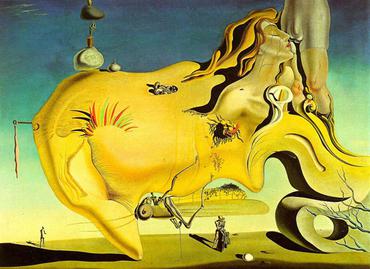
Or so it seems. Because everything in that zone is distorted, like an emotional landscape by Salvador Dalí using your worst nightmares as paint. Anything painful is amplified, shouted over a megaphone, and anything soothing is ephemeral at best, ethereal at worst.

The Great Masturbator, Dalí, 1929
Outside the zone, it's easier to see how people care about you. Of course they care. If someone you knew felt suicidal, you'd rush to help them. In this safe space, I try to memorize what it's like to be the one who wants to help. Most everyone I know would be willing to help me. My inner-angel knows that. My inner-devil doesn't believe a word of it. My inner devil believes everyone hates me, that I'm a bother, and I am crazy or needy or childish, and I should deal with problems on my own.

In April, I contacted a crisis line. And in spite of my shame and fear that it was absolutely the wrong thing to do, I reached out to a relatively new friend. (See previous notes about impulsivity and lack of social filters.) "Gene" at the 839863 text number kept me alive one dark night, and Remy Nakamura kept me afloat through at least another. I don't think I've ever had anyone save my life before. These two did. And they would do it again. As would most anyone else in my close or even far circles.

(Those closest to you may not be capable of certain kinds of support. They are dealing with their own needs and you're entangled with them in ways that may lead to further pain as they try to protect themselves. This isn't because they don't love youit's because they love you. Others may not be able or willing to help for their own reasons. Those are their own reasons that have no actual bearing on your worth.)

Updated to add that many other people helped me through this time, not just the people I've mentioned. I specifically called out people I contacted when I was in the most pain and when it was most difficult to reach out. I didn't want to forget everyone else who also supported me and made their willingness clear.

When fear and pain kick in, the neocortex actually stops working. So I have to spend this time, right now, while I'm feeling okay, to give my healthy voice tools to use when I'm on those dark paths. This is the time to remind myself that people want to help. Because later, it will take everything I have to convince myself.

My unhealthy voice wants tools, too. I sympathize with her (because she is me), and I know that someday I might be hiding under the desk again, and that plan with the car in the garage may come in handy. So I didn't reveal my plan to anyone in my family. But I did tell my psychiatrist, because ultimately, I don't really want a useful plan on standby. That is not conducive to my survival. Without blinking an eye, my psychiatrist informed me that the car-in-the-garage method almost always leaves the victim alive, with brain damage. Not so painless after all. Alive with brain damage is a fate worse than death. So I thankfully have no plan again. (I have such a smart psychiatrist. She knew exactly how to get to me.)

We are programmed by evolutionary forces to stay alive. Our bodies are remarkably resilient and will fight overwhelming odds to keep breathing. So what could cause an override of these instincts?

These three factors together ensure the risk of a completed suicide:

  1. Thwarted Belongingness (feeling alone)
  2. Perceived Burdensomeness (yes, that seems to be a real word)
  3. Capability for Suicide (not afraid to die)


Image from Understanding Suicide In Helping Active Military,
Veterans & Their Families Build Resilience in Facing Risk and Adversity
With only one or two of these items, ideation may occur. A victim may wish to die, or may fantasize about suicide, or attempt without really intending it to work. These are the "cries for help" we hear about, which are also, sadly, stigmatized. These are referred to as "just" cries for help, but think about that. Chances are, that person has been crying for help for so long, and no one has been listening. Their friends and family (and maybe even helping professionals) don't trust that the pain is real. Or perhaps well-meaning people simply don't know how to help. Either way, in this state of perpetual helplessness, the cry for help moves from words to actions, and it's important to listen rather than dismiss it as "just" anything.

Another important thing we learn from this diagram is that suicide is not selfish. "Perceived burdensomeness" comes from a places of self-hatred and a distorted idea that the world would be better off without me. I cause pain, therefore, if I really love my partners, I will remove myself from their lives completely. There's a sense of self-punishment, that I've committed too many crimes against humanity, and that I must take justice into my own hands. As ridiculous as this sounds, it seems as true as toast when it happens.

I feel passionately about reducing stigma around mental health and suicide. The victim is already taking on more than she can handle. At DEFCON 21, I attended a thought-provoking panel on suicide risk assessment given by Amber Baldet. As she rightly pointed out, society views suicide as a moral issue, and the language we use is important for framing that. Yes, had I "killed myself", I would have technically been complicit in my own murder. But it was, in most respects, as outside of my control as cancer or heart disease or a car accident. No one could have done anything more than I did to get healthy. I was seeing a therapist twice a month, and had been for years. I got a diagnosis for my condition. I spent many hours a week reading about how to cope with Asperger's. I was on a healthy diet. I was seeking, and finally taking, medication. I was meditating. I was self-soothing. I was taking deep breaths. I was reading aloud affirmations. I was seeking support from my family and friends while relying on myself as much as possible. 

Even with all that, I still hurt badly enough to override my survival instinct. If that's not an illness, I don't know what is.

In her exit story from the LDS Church, "Losing My Mind, Bit By Bit", Pam Kazmaier said, "The reality of mental illness is discrimination and blame. It’s the only illness we blame people for having. It doesn’t happen with a heart attack, just a brain attack." And what I experienced is a brain attack. My brain seized up and ceased to function for so long and in such painful ways that I could only see one way out.

One dark night, Roland held me. Instead of continuing to vent his own frustration and pain, he simply held me and said, "This is all just a terrible nightmare. You're having a nightmare." He acknowledged my horror, naming it. He rocked me and told me that tomorrow when I awoke it would all be better. For the first time, he seemed to understand how much I hurt. And with that support, I was able to acknowledge to myself how nightmarish it was, like a heart attack, like a car accident, like being tortured.

No one "commits" suicide the way people commit a sin or a crime. Because no one commits a heart attack. This is a health issue, not a moral issue. Instead, people die or nearly die of suicide. It is a terrible health epidemic, and if it is at all a moral issue, we should look at society, not the victim. And no one "fails" a suicide attempt, as if there is success to be found in an otherwise preventable death.

I support Amber Baldet's suggestion that we change the language around this topic, and the morality of it, and the stigma. If I have pain in my chest, I call 911 without hesitation. If I have pain in my heart, I want to hide it. And there's something wrong with that.

No two people are alike, and when we hear that, we think of people's appearance, personality, and talents. But it also means that emotionally, we're also different. It's easy to judge. I think, "If I can do it, so can you. It's easy for me, so it should be easy for you, and if it's not, then there's something wrong with your motivation or drive or morals. I choose to be awesome, and so should you." That is society's predominant view. It stems from the well-intentioned Golden Rule, which states that we should treat others like we want to be treated. But it assumes we play on the same game board and were given the same starting position and none of the dice are loaded. It assumes we all have the same needs and wants and desires. It's a huge mistake because it leads to all kinds of distorted values.

It's easy to assume my experience is the same everyone else's. I compare myself to others. Look how far they got, when I'm still way back here. What we forget is that the playing field isn't the same for everyone. How easy it becomes to judge others. Along the way, we judge ourselves just as, or sometimes more, harshly.

In April, I discovered that I was bad at some things, not because I was lazy, or not trying, or not choosing hard enough. It turns out that some tasks which are simple for most people are extremely difficult for me. Likewise, some things that are super easy for me are really hard for most people.

Your experience of the world is nothing like anyone else's. If it seems easy for everyone else, but not for you, maybe that's because it really is harder for you. Maybe that means you need a little extra help in some areas, and you need people to be more patient and understanding with you. That's okay, because you have other strengths, more than enough to make up for them. That's why we live in a civilization, a society, where people specialize, so they don't have to become good at everything.

One thing I struggle with is that I feel emotions more powerfully than other people. And a number of other problems that lead to meltdowns and long, dark nights that are a struggle to survive. I have strengths to compensate.

I will tell you what I tell myself: There are people willing to help. If you don't feel safe enough trusting your friends or family (which is perfectly understandable if you feel vulnerable), then call a crisis line. If phones scare the hell out of you (like they do me), then did you know there are chat and SMS crisis lines? (Chat lines are often closed late at night. Text "ANSWER" to 839863, which is 24/7).

I know it's hard, scary, painful, but reach out. And if you try once and get turned down, or the number doesn't work, or something happens, don't take it as proof that no one loves you or wants to save you. (Believe me, I understand the allure of that temptation.) Give your angel-voice all the fuel you can and keep reaching out. Try one last time. And then try again.


And seek professional help. If you're already seeing a therapist, call her. (I never manage to call mine, even though she's told me to. It's hard to want to "bother" her in the moment, but she assures me it's okay.) Consider talking to a psychiatrist about taking medication or changing your existing meds. If you're worried about money, I heard Obamacare expands mental health coverage for most people, so look into that. (Thanks, Obama.)

Amber Baldet recommends everyone develop a crisis plan while we're happy and healthy and the neocortex is working properly. Yes, everyone. Because even though it seems like life is perfect and blissful and I'm so healthy and awesome (clearly more heathy and rational than everyone else), we all are at risk of having a dark night. Shit happens, and it comes out of nowhere, and there could be some problem out there that finally gets to you.

A crisis plan is simply a list of things to do and people to talk to at various stages of emotional upset, up to and including feeling suicidal. You obtain agreements from people ahead of time — Person A can offer me X hours of time when things are bad, and person B can offer another Y hours when things are worse. And then you file it away with a giant note written in red marker, "IN CASE OF EMERGENCY!" Here's a link to the form. Fill it out. It's better than filling out a will, and the life you save could be your own.

I had lots of practical fears about reaching out. If you've never done it, it's an uncomfortable mystery. Will they laugh and tell you it isn't so bad? Will they pester you with tons of questions? Will the Secret Red Cross fly in rescue helicopters to rush you to a hospital you can't afford and lock you away without consent?

Well it's your lucky day because I can tell you what happens when you call a crisis line: They listen. You don't have to tell them anything. They aren't pushy. You can just dump on them, and say whatever you want, even your most shameful secrets. They don't send you to the hospital or anything. They just listen. And on dark nights, that means everything.

When you tell a therapist or psychiatrist, unless you're ready to do it right then, they just listen, too. And then they help you to get healthy using their powerful skills and expertise that comes from schooling and experience. They give you tools to self-sooth and otherwise avoid pain and give you strategies for avoiding suicide itself. You may end up with a therapist or doctor that sucks, in which case, by all means, find someone who fits better. You can fire a therapist at any time.

What happens when you tell friends or family? Most of your friends (if they're worth being your friend) care about you and want to help and will do everything within their skills and power to do so. Keep in mind that everyone has their own fears and weaknesses and everyone makes mistakes. Not every friend will handle it well. There are a lot of myths about suicide, and chances are they believe some or all of them, and might react poorly. Don't take this as a sign that you suck, and don't take it as a reason to not reach out. Give it a try, and you might be pleasantly surprised. I know I was.

You are not alone. I don't just mean that in the cliched sense, or in the sense that people are in the room with you right now. I also mean that the person in the room with you may be just as sad as you, just as anxious, just as fearful or dying a little bit, day by day. The people you admire most may have struggled with suicide in their past, or may even be struggling right now. You will probably never know, because they probably will never tell you. They're just as ashamed of it as you are.

It's hard for me to say I survived, past tense, because the threat remains, lurking there in the shadows. I feel fine today; in fact, I feel great. But in many ways, it feels like I am still surviving, like at any moment, great will turn to terrible, and the despair will have me again. Until then, I do all I can to feed the positive voice that wants me to stay alive. And encourage that positive voice in others.

Yeah, the world is filled with an incomprehensible number of unique snowflakes. Yet I cannot be replaced. And neither can you. 

Labels: , , , , , , ,

Tuesday, August 27, 2013

Mind Control 101: Cogs of Dissonance

Your brain is full of machines. Each machine is made of thousands of cogs spinning in tandem with one another, and all the machines are more or less connected and dependent upon each other. When a cog starts to break down, other parts of the machine pitch in to repair it, replace it, or bypass it. This is because your survival is dependent upon the smooth functioning of each and every cog.

Or so the machines want you to think. Because they control you.

This is your brain on cogs.
Any questions?
This is, of course, an analogy which I'm using to illustrate a complicated idea -- the theory of cognitive dissonance. A cognition (or cog) is any single thought, feeling, idea, concept, perception, behavior, social feedback, memory, attitude, goal, value, or commitment. When you put them together with other cognitions, they build all the belief systems that make up you. Earth is round, tacos are delicious, love feels nice, kittens are fuzzy, corporations are evil, God is great, and Republicans all suck and should go hide in a cave until they come up with some way to not look like a bunch of clowns.

Or whatever it is you believe. I happen to have a moderate opinion on the flavor of tacos, and I've never met God so I'm not sure how neat He is.

Each of these cogs, and the belief systems they build, have varying levels of importance. There are people who would die to save their favorite taco, and other people who don't really care that much about food. How strongly you feel when your precious (or not-so-precious) cog is threatened will inform your reaction to various kinds of incoming cogs that other people throw at you. By the way... you might want to duck.

You see, living in the world means we constantly encounter new cognitions every day. The Flat Earth Society distributes pamphlets, paleovangelists push their anti-taco propaganda, love breaks your heart, kittens are proven to cause cancer, corporations run ads about saving lives, atheists say God is not great, and you've got friends who are Republican. Everyone has a different message to push, and if we really believed everything we heard, we'd change our minds everyday about everything. More frighteningly, we'd never know what brand of breakfast cereal to buy. (I'm a paleovangelist, so I don't buy cereal brands. None of them are true.) Our brains need some sort of mechanism to hold all our cogs together or they'd roll bouncing our of our heads and people would trip on them and fall down.

That mechanism is an emotional reward and punishment system known as Cognitive Consonance and Dissonance. Consonance is a good feeling. When we see a beautiful taco on TV, spinning in a glorious light, with beautiful green lettuce hand-picked for its photogenic properties, sticking out from the crunchy shell at aesthetically pleasing angles, and the announcer shouts, "Recommended by four out of five dentists who chew gum for people who like mouthwatering, savory tacos!", we think "Yes! I knew it! I knew I loved tacos. And now they're healthy, too! Sweet Jesus I was right all along! Baptize me in Fire sauce!"


Dissonance occurs when we take in information that is contrary to an existing belief. The more cherished the belief, the more powerful this feeling. It drives us to protect our sacred cogs and the giant, powerful machines they hold together. 9,329* studies last year show that corn is horribly bad for you. It's probably why we are all coming down with diabetes. But if you really love tacos, you don't want to hear this. The more you love tacos, the less you want to hear this. And that feeling is called cognitive dissonance.

* I made this up. But some studies showed this. I'm lazy. Go google it.

Cognitive dissonance isn't just one feeling. It can manifest in a whole range of uncomfortable emotional side effects: Confusion, irritation, annoyance, anger, rage, sadness, denial, defensiveness, nervousness, anxiety, irritable bowel syndrome, easy bruising, weight gain, and painful erections lasting more than four hours. (The last four are extremely rare. I'm sure you'll be fine.) Under those conditions, you will be highly motivated to rid yourself of the offending thought in some way, so you can go back to eating tacos in health-defying glee.

In the end, we don't want to feel crazy, because to feel crazy is to die. To willy-nilly accept new beliefs without some type of discomfort might cause insanity. So would dumping out all our old beliefs without good reason. As would actually believing six impossible things before breakfast. So dissonance and consonance work together to make all the cogs in our mind somehow fit together, even when sometimes they directly conflict with one another. Even when sometimes, in reality, they make us believe impossible things. Like pretty much everything you believe right now.

Just kidding.

But only a little bit.

There are a number of strategies our minds use to handle cognitive dissonance. They all involve lowering dissonance or increasing consonance, or some combination of both. The fact that one cog (I like tacos) might be connected to alot of other cogs (I want to be healthy; I believe in science; I can eat whatever I want; this is America where we have freedom to eat what we want; people who threaten freedom are Communists; I hate Communists; I also like Doritos; Doritos are made out of corn; some tacos are made out of Doritos; Jesus ate tacos at the Last Supper; Jesus can't be wrong; Jesus wasn't a Communist) can promote the importance of that cog and increase the intensity of the dissonance. If you can't resolve the conflict, an entire machine might break. And we can't have that.

Protect the Cogs! 

The process of resolving dissonance happens automatically. Sometimes it only takes a couple of seconds to walk through all the options and emotions they inspire and logical links they create, to come up with a resolution. Sometimes it takes days or longer. Here are the three strategies:

1. Alter Cogs -- We've got the old cogs and this new interloper that threatens to break the machine. So we can change something, either the new cognition, or an old one.

Sometimes the easiest thing is to reject the new idea. "There must be something wrong with that study. With uh... all 9,329 studies. I'm just going to pretend I never heard of it. Crunch crunch yes, nine out of ten dentists agree with me. So good."

Or you can alter one or more of your existing beliefs or behaviors.
  • Science doesn't know anything. Crunch crunch.
  • Besides, I'm going to die anyway. Might as well crunch crunch.
  • And tacos don't even have corn. That's just a myth! Crunch crunch.
As a last resort, depending on how much we like tacos, we may even change that cherished sacred cog: "Okay, fine. Science has persuaded me to be a Communist. I will stop eating tacos and I now believe Taco Bell should be dismantled by the government. Vive la paleo!"

2. Add New Cogs -- By adding new cogs we can create new systems that help the old system work alongside the new one. "Yes, I believe in science and I still want to be healthy and I still love America. Which is why I have become convinced all corn studies are funded by the anti-corn lobby which is secretly controlled by aliens who know that corn actually makes us stronger and more immune to their mind control rays!"

We can also take steps to increase cognitive consonance to drown out any remaining discomfort, say by joining an alien abduction support group where they let us present evidence for this conspiracy as they nod their heads in heart-warming agreement, and every once in awhile, Old Bob shouts, "I knew it!" right before eating the last taco, and every time he does that, it sparks a new round of cognitive dissonance, because you like it when Old Bob agrees with you, but damn it, that was the last taco!

3. Alter Importance -- You may have noticed that importance is important in how important the importance of the dissonance is. To put it more simply, if you can merely lower how important you think one or more cogs is, you will find instant relief. This is the solution you've come to when you shout, "FINE! I never liked tacos anyway! God just leave me alone, stupid scientists!" Maybe you keep eating tacos, but decide your health isn't that big a deal, or that science isn't a big deal. Freedom's just another word for nothing left to lose, right? So you embrace Communism and tacos and science and freedom and corn, because nothing really matters, and congratulations, you're a nihilist. Dissonance doesn't even exist anymore. Did it ever? If it did, it shouldn't have.

On this same scale, you can increase the importance of cognitions that give you consonance. Suddenly, you're looking at pictures of kittens on the internet, because boy, they sure are fuzzy. Ah, doesn't that feel good? You commit to a new diet plan to eat five tacos a day, to overcome your fear of commitment which is something you've been meaning to do anyway, and you can almost forget about those 9,329 studies. Yay corn! Crunch crunch.

Mind Control?

What does any of this have to do with mind control? Everything! So sit down and stop asking questions and believe everything I say. You trust me, right? Because once I've earned your trust by stoking flames of consonance using your existing belief in kittens and the omniscient power of tacos, I will need to reroute any dissonance you may feel as I slowly install my own cogs. Many of those cogs will be specially designed to elevate the importance of the beliefs I want you to have while giving you the tools you'll need to handle dissonance that will be thrown at you from the outside world. Because when you belong to a cult, you will have lots of opportunities to feel dissonance. You will depend on social approval from the group to feel consonance.

Mind control techniques can be seen as a system of beliefs designed to protect the belief system when the rest of the world, and its facts, regularly disagrees.

Almost every mind control technique has to do with manipulating cogs. Any totalist group must overcome your overwhelming cognitive dissonance which was originally designed by evolution to make you not believe everything people tell you. The cult must make you believe what they have to tell you, so they will use cognitive consonance by telling you things you already agree with, to overcome your dissonance about how weird they are and about how they are secretly communists who will eventually restrict your intake of tacos but not before giving you three free kittens and praising Fire sauce. (Plus Bob isn't there to eat the last taco.)

Once you've attended enough meetings and now have committed to pledging life-giving care to ten precious fuzzy lifepuffs, which you've named after famous historical tacos, the totalist group will begin installing new beliefs that you never had before, cogs that will lock you into the group and make it extremely painful to leave. Some cogs are designed to keep you isolated from dissonance-causing information. Some are designed to bounce the bullets of dissonance right off your newly-thickened skull. Some are designed to create dependence, and increase the importance of community and social pressure. Some are designed to suppress any doubts that arise, and prevent you from voicing criticism. Some can even give you phobias to prevent you from leaving. They convince you that the group is keeping you safe, so the idea of accepting new cognitions will literally cause fear to pound in your chest.

Your new cult will promote the importance of tacos until yes, you will die to defend tacos, while simultaneously accepting new restrictions on actually eating them. You quickly learn to hate the government (which funds studies into the health effects of corn), hate science (which actually does studies on corn), and hate all paleovangelists who are clearly sent from the Great Satan of Carb Haters to destroy all the Good People like you that God has chosen to promote kittens and tacos. I mean, who could hate a kitten, except a devil worshipper?

Cornclusion
Cogclusion

Cognitive dissonance is actually good. It's good for your sanity, survival, and for humanity. It's how we learn and how we defend ourselves from snakeoil salesmen. Except when the salesman is selling really good snakeoil and it cures what ails you and you saw it with your own eyes, a lame boy could walk it's a miracle, please take my money!

Yes, dissonance and consonance can be manipulated. But the fact is, it has to be manipulated. Only tricky smart people are able to do it, and even then, only sometimes. By learning about dissonance and manipulation techniques, you are installing new cogs that prevent the installation of harmful cogs. Adopting an attitude of healthy skepticism, and demanding facts, and researching more than one source and opinion will help those nasty Cogs of Evil bounce right off your forehead... tho not without a little pain.

And even then, somewhere out there, is a cult leader who will find a way to take advantage of you. It may have already happened. I hope that thought doesn't make you too uncomfortable.

THIS POST IS PART OF A SERIES
Mind Control 101: Myths of Brainwashing
Mind Control 101: The Basics

Labels: , , , , , , ,

Tuesday, August 6, 2013

Touch of Tides - Crossed Genres

I am exceptionally excited to announce that my story, Touch of Tides, was just published in Crossed Genres magazine. Please check it out, and while you're there, read the other two stories by DeAnna Knippling and Michael Ben Silva III.

In Touch of Tides, a xenobiologist explores the oceans of Europa. Mara has synesthesia, meaning her senses are crossed -- what she feels on her skin she also sees with her eyes. Her passion is studying Europan life, hands-on. Until she finds something dangerous.

Here are the opening paragraphs:
I swim with no light, artificial or natural. A solid ice shell, seven kilometers thick, floats above me in this single ocean that covers the entire moon of Europa. All I can hear is liquid gurgling in my ears and I taste residual salt that leaks in around my gill breather.
My name is Mara. I am naked except for my equipment belt and a molecule-thin coating of nanoscale to protect me from the chill. The other biologists at my barnacle wear full wetsuits when they dive, relying on augmented reality. My gill could report water conditions, geolocation data, and radar sight, if I let it distract me.
I prefer to let the touch-colors lead...
- See more at Crossed Genres.
Crossed Genres also gave me the spotlight interview, in which I answer questions about Touch of Tides, synesthesia, autism, and more.

I am particularly proud of this one, because it is my first hard science fiction story. I spent a lot of time researching, asking experts, sketching, and even doing math, to make sure the details of the story were realistic. Science is very central to the plot, and all of this could actually happen. (Meaning all my other stories are completely impossible, I guess.) It also marks my first pro-rate sale.

I wrote it for you. Please enjoy reading it.

Labels: , , , , , , , , ,

Monday, February 18, 2013

Radcon 6A Madcap Recap

Okay, false advertising. Radcon 6A was not actually madcap, nor is this post. But sometimes a title presents itself and refuses to dislodge itself.

Weather-permitting, Radcon has marked the first of spring for me since my college days in the late 90's. Mid-February is often the first day of warm sun in Eastern Washington, turning the winter's average 20's chill to a nice 50-something. That tradition carried on even after I moved to Seattle, where the winter is a bit warmer, but the sun more scarce. There have been disappointing exceptions, especially the year an icy wind tossed around a thick layer of gravel-sized dust particles all weekend. Yuck.

This year, however, did not disappoint. On our drive, the car reported an outside temperature of 54 degrees, and the sun shone a little too brightly to make for a comfortable drive. I found myself wishing I'd packed more short-sleeved shirts. As soon as we reached the hotel, I stripped out of my boots and thick thigh-high socks to free my feet of the swelter.

This year, the theme for me seemed to be "Growing Old". This was my 18th Radcon, and I've not missed a one since 1995, not even the year I had a kidney infection and had to sit out most of the con. This was my ninth Radcon since moving to Seattle, which means I reached an equilateral point - as many Radcons living away from the Tri-Cities as local.

Radcon used to be a river of familiar faces rushing down the hallways. Each year, there are fewer and fewer, and this time, I realized I can no longer identify Radcon by its people. Some held a hint of familiarity, yet changed so much by age. Most were entirely new faces, a young generation of Tri-Citian geeks. They will never know that I once attended CBC across the street and traveled to NorWesCon with my Sci-Fi Club friends. They will never know that I bounced excitedly through the halls LARPing with my Camarilla friends or that I ran tabletop games and was in a fake secret-society and helped put on the LAN party every year, or that I wore glitter or that people asked me what I was on when I was stone cold sober. They're too busy making their own friends and having their new experiences, which for me are well-tread adventures.

I stopped to chat with very few people, because even of those I recognized, many did not recognize me, and I had long forgotten their names, if I ever knew them. I was happy for the familiar faces I did see, and the people I was able to reconnect with. Those I expected to see, and didn't, I miss with a deep remorse. I am old enough to know that you cannot recapture time.

I am old enough to know nostalgia can be an intense sad feeling of loss.

But I've always complained about being too old, even back at my first Radcon, age 20, when my now-adult son was just a baby. Of course I didn't know what I was talking about then. And I'm sure I don't know what I'm talking about now.

The more things change, the more they stay the same. I'm the one who changes, and even then, not much. Perhaps that is what growing old is -- realizing how little is new.

If being jaded is a result of having too much life experience, there's a flipside to that coin. One I rather enjoyed. Now I don't just know stuff, I've done stuff. Lots of stuff. I'm wise and more confident, and that makes me awesome.

It means this year I got to be on panels, and what a rush that was.

My reading Friday night was sparsely attended, and by sparse, I mean three people. Quite a far cry from my first reading last summer, in which my and Michael Montoure packed the Wayward. But as I learned from another author, Laurel Anne Hill, audience size will vary. Earlier that day she'd spoken to a crowd of 500-700 students. Just a few hours later, we (and our partners) were each other's audience. I greatly enjoyed hearing her story.

After that, I sat on my first panel, Stop Thief!, about piracy and other intellectual property topics. There I met Peter "Frog" Jones and Jim Burk. We didn't agree on everything, and I learned a few new things, and I think our audience learned even more. A question was asked about how to detect online piracy and what to do about it, which requires a far more technical answer than I could offer in person. I promised a detailed post on the subject, so stay tuned.

Roland and I took Friday night pretty easy, which set a pattern for the rest of the con. We had drinks at the Grizzly Bar (yes, that is its real name) and wandered around a bit and then went to bed.

I had two panels the next day. As I guessed, I was sorely outclassed in the Worldbuilding for Planets panel. CJ Cherryh and Hugh Gregory know a ton of science, and when CJ builds, she starts with the geology and astrophysics, and moves up. I have a completely different approach -- I start with the story idea and then research the science to see how I can build a planet to suit. That left me little room to interject.

I learned a valuable lesson that how I introduce myself at a panel will set the tone for the rest of the hour -- a character template of who "Luna Lindsey" is that can open or close doors. Even if I don't have the kind of experience I'd like, it's good for attendees to see a variety of opinions. I will always have something I can highlight, which will direct the conversation towards things I know more about. In this case, I truly love worldbuilding in general, and while I've not completed any sci-fi stories written off-earth, I've been working hard at a couple of hard-sf worlds. I should have made that the focus of my introduction.

I put that hard-earned knowledge to good use later.

Either way, I learned lots of fun things about astrophysics from Hugh and CJ, and even managed to say one or two things.

Directly afterwards, I paneled on Sex, Love, and Writing in a Changing World. That was a really fun one. I got to meet Tamra Excell and Christine Morgan, and got to re-meet Jim Burk and Peter Jones. In this case, I got to rely not only on what I've read and written on the topic, but on my own life experiences. My fellow-panelists were from a wide variety of backgrounds, which I quickly learned makes for the most interesting panels. The attendees had lots of questions and there was never a dull moment.

The next stop was an interactive panel not previously on my schedule -- Image This! hosted by Tim Morgan. The concept is simple - an author (in this case, me) reads a story while artists sketch, as inspired. In the second hour, attendees are shown a painting, and write a story. Thankfully, I had two other stories with me, both of which I've read before and are visual enough to sketch. The Metro Gnome and Let the Bugs Work Themselves Out. Since I couldn't fill the whole hour, another attendee read from his work, which was quite well-written. (I didn't catch his name.) As always, I loved reading aloud. It was a special thrill to see the drawings my words inspired.

The second half was not on my schedule, so I was only able to stay for the first picture. The writing side was fun, but it was even more fun to see what other stories people came up with, all based on the same image. I've done similar activities in writer groups, where we all write a story with the same title, or write to a specific theme. It just goes to show that an "idea" is less important than its implementation, and every writer can have something new to say.

I would love to see this activity at more cons, and I hope Radcon does it again next year.

I met up with my friend Jenboi and with Roland and we hit the parties. We spent most of the time at the SpoCon room party. My favorite con party is the mellow kind, with low-volume music and a small crowd, with places to sit and talk. The SpoCon party did not disappoint, and we conversed until 3 am.

The next day I had only one panel late in the afternoon, so we took it even more easy. Why Horror? was late enough on a Sunday that we could have a small, intimate discussion. Once again, we had a wide variety of panelist backgrounds - Devi Snively is an academic with a background in film and was the Media GOH. Ron Leota authors games and runs a podcast. Eric Morget is a voice actor and indie film maker. Yet despite this, we all had one interesting thing in common -- a religious and sheltered past. I had a lot of fun doing this panel.

Several of the panels generated lots of interest in my writing. I also met a few people who had seen my bookmark and become interested in Emerald City Dreamer just from that. I also ran into a few people who had read my Sucker Punch analysis on this blog.

It's all very encouraging. I hope I was entertaining and informative to those who listened to me, and thanks to Radcon for giving me this opportunity. Being a panelist was everything I dreamed and more, and I hope I can do it again and again.

Labels: , , , , , , , ,

Thursday, October 18, 2012

Grapheme-Color Synesthesia Map

This week I've been doing a lot of thinking about synesthesia, thanks to a video, My Autism and Me. Some stray tweets led to interesting conversations on Twitter and email. Dr. Joe Spataro did a blog post, in which I sum up my synesthesia story in brief.

I have tons of thoughts on this topic, as well as tons of memories and my own story of realizing my rare skill at a young age, before I even knew the word "synesthesia", and before modern science had caught up to the idea of the grapheme-color type, where letters and numbers have color. Eventually, I may put some of those thoughts and stories in this blog.

For now, I've taken the time to map my colors for you. This is a mini-meme going around on DeviantArt and other circles on the internet. The template is made available by a Deviant Artist, Crowbar. Hat tip to my daughter Betsey for pointing me in this direction.

This is part of me. A very deep part of who I am and how my brain works. I love the wonderful colors I "see" every day in the words I read, in license plates, on signs, in phone numbers. I am an associator, which means I visualize the letters in color in my mind. The colors almost seem to pop out at me from the page - but stop just short of being real.

Inside? They are more real than real.

Welcome to my world.


I can't tell you how satisfying it is to look at the page and physically see how the letters should be. How they are meant to be. Not these black pretenders everywhere... I can see into your hearts, all of you, and these are your true colors.

I agonized to get these just right. Some of these letters I didn't get just right, and they're glaring at me. (Shut it, "B", you came early on before I'd figured out the software, and the tan shades are the hardest to find in the color tool!)

Note that none of my letters actually have a black border. I would prefer removing them, but that would require more graphics skills than I have. :) Lowercase letters are the same color as uppercase, though some are slightly different shades.

I shaded some of the letters to help show the motion they have. These are the letters that roam about, swirling or morphing through these particular shades. A few will change a lot. "I" is the hardest to pin down, since it can be a still solid white, gray, or bluish-grayish-morphy-whatever.

All of my letters will influence one another when they sit next to each other in words. That's when things get really interesting. Someday I may get creative and try to show you. I'd also love to show you my symbols like * and ~.

If you believe you may be a synesthete, please do a science. Take the surveys at SynesthesiaResearch.com, and the full battery at synesthete.org.

Labels: , , ,