Wednesday, October 22, 2014

Double-Standards: The Irony of Empathy and Autism

From I, Robopsychologist in Discover Magazine
I sat on the bed across from my partner, tears in my eyes as I prepared to share with him an insight I'd had at therapy that day. I felt incredibly vulnerable, ready to open up this secret part of me I'd kept defensively hidden, even from myself, for many years.

That afternoon, I had become aware that my aloof exterior obfuscated a deep well of emotion and caring. I had blocked myself off from what would otherwise consume me. I'd learned as a child that if I thought about anyone's pain, I'd fall into the vortex. I'd lose myself in a trippy, altered state of consciousness, and not in a good way. 

For example, I once accidentally saw a short video about the maltreatment of animals in the Chinese fur trade, and I couldn't get the horrible feeling or the images out of my head for months. The experience came unbidden, and I couldn't stop imagining what it was like to be those animals. When this inadvertent exposure happens, my only defense is to keep trying to forget, to try to switch off all feeling, to stop caring about anyone. Even as I write these words, I'm fighting off the flood. The result is a hardened exterior, an unfeeling facade, a sort of clinical detachment that I apply to any expression of pain. 

So when I had this insight, I was eager to share it with my partner, who always thought I'd been too distant, too cold. Who had encouraged me to try to open up more, to feel more empathy for others. 

I opened my mouth to speak…

But first, he wanted to share his own insight he'd had that same day. With all the sincerity and loving care he could muster, with the best intentions, he said the most hurtful possible thing he could have:

"I've come to accept that you're just an uncaring person. Feelings for others just don't come naturally to you. I acknowledge that about you. I love you anyway."

I tried to explain. I tried to argue. But he interrupted, insisting. He simply would not hear me out. I'm sure he was trying to soothe my feelings, to argue against what he thought was my own defensiveness and lack of self-acceptance.

But in so doing, he couldn't really hear me. He loved and accepted someone else in that moment. Not me. Who I really was, was being ignored, erased, written over with yet another misunderstood Luna.

All my life I've been misunderstood, even by those closest to me. It's something I've gotten used to, and something I didn't understand until my Asperger's diagnosis last year. 

I can't get over the irony or the pain of that moment. Nor can I get over the irony and pain I feel when I see this scene enacted over and over in my own life and in the lives of other autists.

And so a post on empathy. And on being misunderstood. Because it's really all about the same thing.

The Mechanics of Empathy


Autists supposedly don't feel empathy, or perhaps much of anything, and this assumption comes with moral implications. We see it in popular portrays of autism in entertainment. In the news, anytime there's a school shooting, the mental health speculations begin. "Oh, maybe he had Asperger's. They don't feel any empathy, so maybe that's why he did it!" To this day, "lack of empathy" is phrased in different ways on diagnostic lists, an echo from ancient diagnostic criteria for Asperger's, which have long since been clarified and rewritten as "deficits in social or emotional reciprocity," which is more accurate, but still lacking in some ways. 

This (and several other faulty criteria) is one reason why I went undiagnosed for so many years.

It's a dangerous belief that persists in spite of the truth. It dehumanizes autstists, and ironically, gives allists (non-autistics) a get-out-of-empathy-free card. It contributes to greater misunderstandings, bullying, and maltreatment from a supposedly moral and caring society.

In order to understand autistic empathy, we have to understand empathy in general. It's something scientists spend plenty of time studying, so this is something we can know.

First of all, empathy requires the ability to perceive what someone else is feeling. This isn't a psychic phenomenon. It's a type of emotional communication that requires a sender and a receiver who are both conversant in the same languages. It involves the ability to physically perceive body language, to interpret tone of voice, context and subtext, as well as literal meaning of words. 

If the receiver gets the emotional message, then she may feel empathy for the pain the sender feels. Then the empathy must be communicated. She must know how to react in a way that the sender can understand.

So three parts: 
  • Understand something is wrong
  • Feel empathy
  • Communicate that feeling back
For a person with autism, there are many things that can go wrong in this chain of events. Being able to "feel empathy" is only one of the many things that can break down.

Autism Factors in Expression of Empathy

“Dora Maar” 1936 by: Pablo Picasso
We already know that autists often have difficulty understanding facial expressions, tone, and body language. So right there, that's an issue. Very often, an autist may not even understand that the other person is in pain.

Alexithymia is an issue for many (but not all) autists — that's an impairment in the ability to know what you are feeling. You still feel it, but can't translate it into meaning.

There are other emotional factors as well, such as chronic depression and anxiety.

We also know that autists, even verbal "high functioning" autists have a hard time expressing themselves. This is compounded under stress, which can increase in the kinds of situations where empathy is required. The stress goes up even higher if, based on past experience, the autist is afraid of screwing up.

Sensory issues compound all these already-complicated factors. Arguably, all autsits have issues processing sensory information. Sound, touch, light, emotion, spatial awareness, and more, are all subject to confusion.

As Olga Bogdashina describes in her book, "Communication Issues in Autism and Asperger Syndrome," autists can be hyper- or hyposensors. We can over-sense, and we can under-sense, depending on the person, the sensation, the situation, and dozens of other elements. It leads to problems like I have with hearing. I can hear tiny sound across the house that keep me awake at night, but have to cup my hands around my ears to listen to a friend in a restaurant.

So imagine if I'm stressed out trying hard to process a conversation over the noise of cafe chatter, which is taking most of my concentration and causing me some anxiety. On top of that, I've got to interpret your tone and body language. This alone can pretty much max me out. If I have any processing power left to feel empathy, will I have the wherewithal to react empathetically? 

Sometimes yes. Sometimes no.

Sensory processing can cause problems with understanding facial expressions, too. Autists often avoid making eye contact because the sensory cost of doing so is far too intense. These autists are missing information for determining the moods of others. One aspie I know describes the feeling of eye contact as if someone were touching him all over. He can't concentrate and he feels violated. 

Bogdashina describes a sensory processing phenomenon where parts of a face detach and can't be seen as a whole face. The nose becomes a separate object from the mouth, and the eyes seem unconnected to one another. This would make interpreting body language impossible. 

Emotions themselves are sensations. Some have speculated that alexithymia and other hyposensory issues might be the result of sensory overwhelm, as Kamil and Henry Markham point out in their Intense World Theory.  As a defense against an onslaught of loud music and emotions ramped up to 11, autists might simply shut out the world. The fuse blows, the circuits are tripped, the system powers off. This seems to happen particularly in a temporary condition some autists get called a "shutdown." Like a meltdown, it happens in response to overstimulation, but instead of creating an uncontrollable emotional reaction, it results in the senses completely turning off — no more feelings, and sometimes no more sound, sights, or ability to speak or move.

If feelings can become overwhelming, then empathy, as a feeling, can too. This suggests that many autists have the opposite problem from the one we're infamous for. We may be feeling too much empathy, so, like a hand shading our eyes from a bright sunset, we block it out. "Seventh Voice" describes this phenomenon in more detail.

Assuming we manage to get all that processed and don't clamp down from the overwhelm, we've got to communicate the empathy we feel to people who might not interpret it the way we intend. Here's a heartwarming piece about a mother who was able to read her daughter's nonverbal form of helping, because she was paying attention and learning her daughter's autistic language. 

Fight or Flight or Freeze or Appease


Gazelle got no time for empathy.
via discoverwildlife.com
We also know that autists are more prone to suffer PTSD. This is likely due to the sensory processing issues, and the fact that for some of us, physical and emotional pain hurts us more than it hurts a neurotypical. We are more likely to generalize PTSD triggers as well, and we are definitely more likely to be bullied. This is all in need of further study, but it's clear that most autists will be dealing with these factors.

Any human being, when triggered by PTSD, is put into an extreme fear state. The higher functions of the brain shut down, and the body and mind go into complete focus on self-preservation. There is no logic in this state, there is no reasoning, and for some autists, there aren't even words because even verbal autists may become non-verbal when triggered.

If an autist is triggered by trauma, or in a constant state of sensory overwhelm to the point of pain, there will be no mental resources left to think about the pain of another person. Survival instincts come first. It's just the way the human mind works.

The "Experience" Angle of Empathy


Experience plays a huge role in how all human beings experience empathy. Professor of Psychology and Neuroscience, Warren H. Meck, says, "To be empathic towards others you have to have something in common with them."

You can only feel empathy when you know what it's like to be in the other person's shoes. Empathy is tied to the ability to realize how much you are like another person and to have some level of experiential understanding of what they are going through. We literally can only be empathetic to people we relate to. 

fMRI studies show what's called the perception-action model of empathy, that when we truly know what something feels like, it activates a different region of the brain than when we are struggling to imagine. One is felt, the other is thought.

This creates massive cultural divides. As writer Tim Wise puts it, "Empathy — real empathy, not the situational and utterly phony kind that most any of us can muster when social convention calls for it — requires that one be able to place oneself in the shoes of another, and to consider the world as they must consider it. It requires that we be able to suspend our own culturally-ingrained disbelief long enough to explore the possibility that perhaps the world doesn't work as we would have it, but rather as others have long insisted it did."

Researchers study what they call ethnocultural empathy. According to Wikipedia, "…increasing research found that people usually hold different levels of empathy toward different individuals based on perceived psychological similarity." 

It makes sense that it is easier for us to empathize with people from our own culture, because we have walked similar paths. It is much more difficult to understand people with whom we have no common experiential dialect. At least, until we are exposed to the narratives from that culture — stories, movies, personal interactions, that put us, temporarily, in their shoes through a process called "experience taking." Simply reading fictional stories about people from other walks of life is enough to boost empathy

Dehumanization is the wicked, jagged edge of this double-edged sword. It is the act of "othering," of tearing down the ability to feel empathy for an individual or a group of people by focusing on how different they are, so they can be mistreated without a single shred of guilt.

This is all related to "dominant culture arrogance," coined by Nicole Nicholson in her blog, Woman With Aspergers, to describe the idea that the right way to do things is morally right because the dominant culture says so. 

Is Autism a Different Culture?


I think so. We are raised in the same culture as allists, but our fundamental wiring is significantly different. We process senses and memories differently, we learn language differently, and we experience the world differently. So while we're all using the same words and growing up with the same social norms, we're viewing them through a different lens.

Many autists describe themselves as feeling like aliens, forced to live on this inhospitable planet with "normal" humans who will never understand them. It's where the name for the popular autism site, WrongPlanet.net, comes from. The communication difficulties between allist and autist cultures are very similar to those experienced by people from differing countries.

It seems pretty obvious to me the effect this would have on mutual empathy, yet for some reason, it's not obvious to those in the "dominant culture" who are in a position to judge our supposed "lack of empathy." They view it a symptom inherent to the "disease" of autism. 

Autists simply don't know what it's like to be an allist. We think differently, speak different languages (using the same words), and we care about different things. I pretended to be an allist all my life, and I've passed most of the time, and yet I still don't know what it's like to walk in an allist's shoes. This may be why I struggle to empathize with people who stress about sports teams, fall fashions, or dinner etiquette. I can sympathize, I can try to imagine, I can try to remember what it's like to be stressed about something I care about, but I will never know what it's like to care about a losing sports team.

Just like allists don't easily understand why I need to stim, why it's important that certain of my routines never be interrupted, why I meltdown, or why I care so goddamn much about spiders. And most allists will never understand what it's like to be regularly misunderstood by virtually everyone.

These cultural differences don't prevent me, however, from deeply empathizing with someone in physical pain, someone who has lost a loved one, someone who is suffering from poor health. I've experienced these problems, or something close enough, to understand why it's important. Yet the lack of one type of empathy (say, sadness over ruined wedding plans) does not equate to a lack of all empathy.

Allists have just as much of a struggle to empathize with autists for exactly the same reasons. Our needs and feelings are incomprehensible to those outside our "culture." But for some reason, the responsibility to learn empathy lies on us, even thought it arguably is more challenging for us because of all the sensory processing, PTSD, anxiety, and verbal issues. 

If allists are so socially capable, then why don't they put in the extra effort to learn our language, to feel our pain?

Dehumanization of Autists


The way autism is handled by just about everyone (researchers, medical and mental health professionals, teachers, families, the media) is very divisive and problematic, and, ironically, leads to a destruction of empathy.

Dehumanization destroys empathy by creating divisions and making groups of people seem more different than they actually are. The shoes we might otherwise be walking in are torn off our feet.

The military dehumanizes the enemy when they train soldiers to shoot on command. It's what religions do when they demonize anyone outside their faith, and why members of some religions can literally blow themselves up in efforts to destroy innocent civilians — because they're not really people.

When news media speculates on how the latest shooter had Asperger's, it removes society's ability to understand people with autism. And when this comes alongside moral judgement, it also removes society's responsibility to be empathetic. The obligation of reciprocity is removed. Allists don't have to feel personally responsible for the plight of fellow humans who are suffering in their midst.

I am frustrated when I see this happening in research methodology and the conclusions they reach. For instance, one line of thinking has concluded that there are two classes of empathy, cognitive and emotional empathy. "Normal" people of course have both kinds of empathy, and autists only have emotional empathy, which is sort of like a lesser version of empathy, not "real" empathy. As M Kelter points out, this turns autistic empathy into some kind of fake empathy, as if we're not really human, or some other class of human.

Allist researchers don't stop to think that maybe we're people, and that maybe we act the way we do for good reasons, and that maybe they could just ask us about our "mysterious" behavior before developing studies to delve deeper. Yes, quantitative studies are needed to weed out biases and poor data, but when these studies are based on faulty assumptions in the first place, the output will be faulty.

It's clear from a majority of studies that researchers never did the initial legwork of treating us like human beings who have mouths and can communicate. Much of the Theory of Mind research is a good example of this, as are most of the autism diagnostic and trait lists, especially prior to the last decade or so. This approach seems to treat autism in terms of how it is a problem for caregivers, and does not, instead, consider how autism affects us, the actual autistics.

Imagine if we treated heart disease this way; if the list of symptoms for a heart attack were framed in terms of how the patient were a burden on those around him:
  • Patient clutches chest even though nothing is there
  • Patient gasps even though there is plenty of air in the room
  • Patient makes loud nonsensical non-communicative noises, disturbing those around him
  • Patient falls down without a care for the needs of others present
  • Patient leaves his dead body on the floor as a tripping hazard, with no consideration for public safety
Would it be any surprise then, if after decades of research, no one could figure out the root cause of heart attacks? Would it be a surprise if standard treatments of, "Yell at the patient until he understands how to be kind to others," and "Force patient to remain standing and to breathe normally," don't really work?

Such treatments would be considered highly inhumane and unempathetic

Quite frankly, I find much of the common wisdom and current understanding and treatments for autism to be highly unempathetic, precisely because this is the still approach taken.

The Pain of Being Misunderstood


I spent most of my life not knowing about autism or that I was on the spectrum. Once I started learning, the floodgates opened. My own empathy for other autists flows easily and very deeply. 

I am an exceptionally verbal person who can socially pass as neurotypical, and I am mostly functional. Yet I relate strongly even with non-verbal autists, who don't seem to share much in common with me. What do we have in common?

Autists seem so very, very different from one another. They say that once you've met one person with Asperger's, you've only met one person with Asperger's. Externally, autists seem incredibly diverse, struggling with very different kinds of problems.

Yet when I watch movies and read about non-verbal autists, I feel like I know them. These are my people. I instinctively understand all their unusual behaviors, even behaviors I don't do myself. 

The first time I watched this video about Carly Flieshman, before I suspected I was autistic, I cried. Her story broke through my hardened, defensive exterior like a wrecking ball. I felt somehow as if I had walked in her shoes, as if I had lived her experience, even though her life is nothing like mine. Her traits are nothing like mine. But somehow I had some inkling of what it was like to be her.

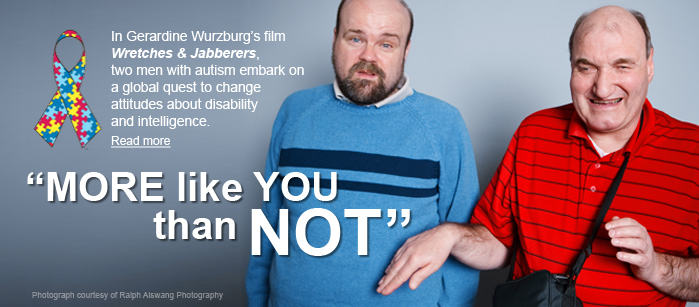
I also strongly empathized with all the autists represented in the documentary Jabbers and Wretches. While watching this film, I realized the one single thing that all autistic people have in common: 

We are all misunderstood.

And we are misunderstood for all the same reasons. No matter how verbal we are, we have struggled our whole lives to communicate. Not just because we have various levels of ability to speak the allist language, but also because our very state of existence is misunderstood. Few allists will relate to a persistent struggle with itchy clothing, lights too bright, sounds too loud, input too confusing, emotions amped up too high, when everyone else around us is just fine with the brightness, the sounds, the social inputs, and the emotions.

Our behaviors are misattributed. Our good intentions are misread. We always seem to be missing the mark, not measuring up, and not fitting in.

No matter where you fall on the spectrum, you know how frustrating it is to get the world to simply understand. I can speak just fine, but I can easily imagine the horror of not being able to. And the nightmare of people assuming stupidity because of it. How heart-wrenching! Their misfortune could have easily been mine. And sometimes it is, in spite of my skill with words.

Autists Struggle with Empathy? Or Humans Struggle with Empathy?


What puzzles me is why we autists are the ones with empathy problems. But allists have the privilege of being the "normal" ones who get to make the judgment call. In our case, lack of empathy is a pathology. In their case it's a perfectly understandable reaction because it's ok to treat freaks without compassion. 

Yet we were the ones kept in cruel and unsanitary institutions for centuries, and who are currently undergoing questionable treatments that ignore our pain and deny our humanity. 

So who really lacks empathy? Why must the burden of learning empathy for the "other culture" fall on autists? Shouldn't the heavy lifting fall to those who are supposedly better at it?

Allists demand empathy. We just want some empathy in return. Yes, allist caregivers are frustrated with the one autistc in their life who cannot reciprocate… well imagine if no one around you could empathize with you? How lonely would that be? 

That's the experience of a person with autism. That's what it's like to be in these shoes.

The Golden Rule Sucks and Here's Why


I'd suggest that many of these problems boil down to a saying we all learned in kindergarten. It is a phrase designed to teach children empathy, but, in fact, it impairs empathy: 

"Do unto others as you would have them do unto you." 

This one statement has some pretty serious flaws. It presumes everyone is the same. It presumes everyone wants the same things. And if you don't want the same thing, then you're abnormal. You're malfunctioning in some way that must be set right.

The Golden Rule causes us to make assumptions about what other people want based on our own needs. So when we give someone these things, and they reject it, we personally feel rejected. The defensive reaction is to blame them. After all, you were doing the morally right thing that you learned in kindergarten. You're a good person, so they must be the bad one.

Shark's just following the Golden Rule!
There is no room in this phrase for constructive feedback or the collecting information to correct the method of giving. We don't learn to ask people questions about their different experiences and what they need. There is no room for active "experience taking" that leads to greater understanding and empathy.

The Golden Rule instills in all human beings the assumption that we ought to just know what others are feeling. But sometimes, no matter how socially capable we are, we have to ask. This goes for neurotypicals as well. Assuming that others need what we need, though well-intentioned, is literally self-centered. Not other-centered. We are interpreting others as if they are us.

Remember the full cycle of reciprocating empathy? Know what someone is feeling, feel it, and react appropriately. The golden-rule assumption causes these steps to break down.

The Golden Rule may be partly at the root of reinforcing the ignorance that surrounds all types of privilege. The subconscious logic goes like this:

"I'm normal, and I want X. Now you're telling me you want Y. That makes no sense, because everyone already has Y. They all have Y because I have Y! And I'm a nice person — I learned to be a nice person in kindergarden — and you're telling me I'm not a nice person because I won't give you Y, but you have Y! Everyone has Y! You must really want X, the way I want X. So I'll give you X. 

"But now you say you don't want X. The only reason you would be acting that way is if you're irrational. You're crazy. You're stupid. You have a chip on your shoulder. You're angry for no reason. You have a disorder and need to be cured." 

If you're a person who wants something different from "normal," you must be inferior. And we come back around to othering and dehumanization.

In the case of autism, maybe X is the neurotypical need to be touched. Y is not wanting to be touched because of sensory overwhelm. 

Or Y can be extra time to take tests, or the ability to avoid eye contact without overt pressure, or the ability to stim freely without being mocked or punished, or the need to take extra breaks, or sometimes just the chance to be taken seriously, a very important privilege many neurotypicals take for granted. 

The Platinum Rule Leads to Greater Empathy for Everyone

A small change to The Golden Rule would fix everything. I invented this on my own, and called it the Platinum Rule, only to discover that someone else had beat me to it:

"Do unto others as they would have you do," or "Treat others as they want to be treated."

There are no faulty assumptions in this rule. It destroys the presumption that we're all the same. In order to follow it, you must really listen to others. The act of listening itself can be very healing and trust-building. It is a skill that can be difficult for any type of mind to learn, allist or autist. The art of active listening and validation are key ingredients to skillful empathy that rarely comes naturally to anyone.

If we're taught to treat everyone the way they want to be treated, our first question would be, "How do you want to be treated?" And in that, we constantly practice experience taking, and therefore, gain greater capacity for empathy.

In an alternate world, where this is taught in kindergarten, you would have to try to understand others to be a good person. 

And isn't that what we all want? To be understood?

Labels: , , , , , , , ,

Monday, February 24, 2014

Reflected in Ice: An Aspergers Review of Frozen

The following movie review contains mild spoilers. I try to tread lightly, but can't avoid addressing a few in-movie moments or thematic elements.


There are two measures of good art.

The first is anything that can make me feel strongly. The other is that which holds up a mirror to the viewers, in which, each sees herself.

Frozen accomplished both of these goals with resounding success.

Secret Wish - Tami Vaughn
I had this printed on a mousepad I used for years.
Good mirrors are composed of metaphors and character traits and plot in the right combination of vague and specific to reflect a broad range of life situations and personalities. Many types of people see themselves in Frozen: girls who are raised to be perfect, sisters who struggle in their relationships, women who are deceived by those they trust, those who have secrets, neurodiverse people, anyone who is misunderstood, and anyone who is rejected for all the wrong reasons. And like the second trial in The NeverEnding Story, a mirror which reveals the viewers "true self", Frozen's mirror can reflect the ugly parts of some people, like the blogger, "Well-Behaved Mormon Woman", who calls Frozen part of the "gay agenda to normalize homosexuality" and who says it's terrible we're letting kids get the message that rebellion is better than obedience.

Can you hold it down, please?
I'm trying to make history over here.
Whatever, lady. I have an entirely different view when I look at myself in art.


Frozen reflected many visions for me. Most strongly, it portrayed my autism in a very accurate way. It also reflected my relationship with my sister, and my struggles to leave the religious culture of my birth (incidentally, Mormonism), and my struggles relating to my family members who still belong to that culture. I will cover my thoughts on all these points.

Social equality activists argue for more representation of minorities in fiction. There are many good reasons to do this, but for any creator, the biggest reason should be "to make better art". When the same old characters are dancing to the same old plots choreographed with the same old tropes and the same old twists, only the same old segment of society is allowed to see themselves reflected in art. And even that segment is only allowed to get the same messages they always have about themselves. The mirror is cracked and the reflective backing is faded. It ceases to be useful even for the intended audience.

What's fun is a funhouse with only one twisted mirror?


Frozen is the first movie I can remember that explores the relationship between two sisters. I'm sure there are other examples, but they are few and far between. Often, to find them, you have to leave the mainstream film scene, into the art houses and foreign films.

Because of this dearth, Frozen had it easy. Its subject and plot is low hanging fruit. Disney made the only mainstream movie about sisters in recent history, so of course anyone who is a sister and has a sister is going to see herself in it. Finally, someone is showing her herself.

Because women are so rarely represented in movies, outside certain highly limiting tropes, we latch on to anything we're given. And it benefits us all greatly. Frozen allowed my sister and I to have a conversation we were unable to have before, because we lacked any kind of context to have it. Frozen helped her and I understand one another more.

Any filmmaker following in Frozen's footsteps will face a steeper challenge. The next attempt will require a little more thought and nuance in order to be good art and not simply derivative.

This is a good thing. I hope many attempts will be made to best Frozen's "sisters" mirror. And while we're at it, let's take a look at other female-female relationships. Mother-daughter? (Brave got us started there.) Business partners? Partners in crime? Buddies? (More Thelma and Loiuse, please.)

And God forbid.. Perhaps we could see female-female romantic partners? In spite of the success of the big gay agenda, I currently only have one small part of one song that describes what it feels like to be snuggled up with my lovely girlfriend. That ought to give well-behaved blogger up there a real example of homosexuality portrayed in the media.

Anyway, there's plenty more low-hanging-good-art fruit for the picking. Half the movie-viewing audience are women who really want, crave, and need more mirrors.

Now, I'm not implying Frozen's creators were amateurs and that it only succeeded because they entered unexplored territory. They tread some other ground which is extremely well-trod and managed to find a fresh mirror there, too.

The "be your own unique self no matter what people say" theme has been done to death. It's part of American culture, and we love it every single time. Where this theme gets stale is, again, where we endlessly see the same take on it. The underdog nonconformists who win in the end, they all start to blur together after awhile, until we forget that this is the theme of pretty much every single movie, ever. We don't even notice it anymore. The individualist rebel has become the new conformity, the ideal that we all strive for equally, to the point where we shun anyone who fails.

Repeat after me...
For Frozen to pull this old trick out of the bag, dust it off, and make it seem like they were the first to ever think of it, is a pretty tremendous feat. A mirror is pointless if we keep seeing the same image. It's the one that reveals a different side, or that pimple hiding under the chin, is the one that wins the "Good Art" award from me.

The song "Let It Go" is good art for the same reasons. It speaks to these common themes and others, of social rejection, of turning ostracization into chosen isolation, of the damage caused by suppressing feelings, of finding self-acceptance, and of having uncontrollable emotions or an inner power which is misunderstood.

This scene made me cry the first time I saw it. Which leads us to autism.

Others have written about this topic. But I shall write more about it. Because when you meet one person with autism, you've only met that one person with autism, so there's no one definitive autistic perspective.

[Mild spoilers incoming!]

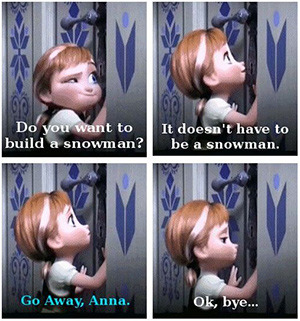
Elsa is born with her power, and she is taught to hate and suppress it. She learns from her well-meaning parents that she is dangerous and likely to hurt others, especially her sister Anna, who she loves. She has to hide away in her locked room, stuff her feelings, and resist using her powers because of these inaccurate beliefs about herself.

Her powers are a double-edged sword. They started as a force for good, which she used to make her sister happy and strengthen their sisterly bonds. But after one mistake, her talent turns into a dark and ugly thing, not because of Elsa herself, but because of how the people around her view it.

Ironically, it isn't her magic that hurts Anna. It's Elsa's self-imposed isolation because she believes herself to be dangerous. All Anna wants is the same love they once shared. The door that separates them wounds more sharply than the ice which was easily healed.

In a perfect case study of unintended consequences, Elsa's suppression of her power is what keeps her from controlling it. It all comes out sideways at the worst time, and she ends up in mutually-agreed upon exile, but with disastrous results for both her and her people. Again, it isn't her powers that are dangerous, it is how she and everyone else is handling them.

Olga Bogdishina's book, "Communication Issues in Autism and Asperger's Syndrome", talks about the ways autists process sensory information differently from neurotypicals (NTs). Among other issues, autists deal with being either hypo- or hyper-sensitive to stimuli. "Their senses seem to be too acute…or not working at all…"

Excellent book.
So read it.
Every autistic individual has a mashup of different conditions under which their senses are either ramped up or remote and blocked off. For some, sounds will always be too loud (auditory hypersensitivity) but they have no idea what they're feeling (alexithymia). For others, they do fine with sound... until they get overstimulated. Then they can hear a pin drop on the other side of the house.

Emotions should be counted among the "five" senses. Emotions are a sense, giving us information about our internal reactions to outside events, and are subject to hypo- or hyper- sensitivity effects. For autists, emotions can be remote and incomprehensible, or very loud like a blaring siren. While I've had periods in my life where I was more hyposensitive to my feelings (my teen years), these days, I tend to be more hypersensitive. I usually know what I'm feeling, and why, and even what I need to do to change those feelings. The downside is that strong emotions are very, very strong. Overwhelmingly so. Uncontrollably so.

And that's where meltdowns come in. 

Add to the complication, I was raised in a passive-aggressive environment, where showing certain emotions was never allowed. I quickly learned that crying would invoke an angry response, or accusations, or that I could hurt the people I loved. I became very good at repressing my tears if anyone else was around. When I became an adult, I had to teach myself to cry. It's a lesson I've never fully learned, and I have lots of triggers and shaky boundaries around that. All stuff I continue to work on.

When I feel cornered and triggered, I can meltdown. My emotions become so overwhelming that they shut down my thinking brain, with symptoms very similar to panic attack. I feel anxiety like fire, in my whole body, even my skin. I can't breathe, I can't think straight, I can't act in the best ways to protect myself. Everything becomes all-or-nothing. I may lash out and say hurtful things.

I'd put something funny here but it isn't really funny.
Cue Elsa. Here she has this double-edged power. She can build magnificent complicated fractal-based buildings using only her mental powers, but when she loses control, she shoots icicles from her hands.

Elsa's big triggers are related to emotions. When her parents die, her room turns frosty. And just like me, she becomes most dangerous during conflicts. She always risks hurting someone when she feels powerful things. And most of all, no one understands her. She's hurting and afraid, but everyone thinks she's a monster.

Her powers are just like my overwhelming emotions. As a child, I dealt with them by never feeling anything. As an adult, I still try to stuff them sometimes, but it totally backfires, especially when it reminds me of being a helpless child and I get triggered.

Power over ice is the best metaphor here. Aspies are often thought of as being emotionally cold, yet like Elsa's power, our emotions are often very active and passionate. Emotional repression is like trying to freeze feelings. And when I get upset, words come more difficult to me, as if my thoughts are freezing up. When the panic sets it, it's hard to breath, like my chest is frozen with fear.

It's not an icebeam, no that's all Jonny Snow!
(And Elsa the Snow Queen)
Anna tries to reason with Elsa, so together they can solve the endless winter problem. I related to Anna here, as well. My solutions are so simple, yet sometimes so hard to convey.

This is when Elsa whirls around in frustration, erecting a defensive ice barrier all around herself. Unknowingly, she hits Ana in the heart with an icy ray.

How often have I whirled about in my own pain and frustration said something that wounded someone I love? The closer to meltdown I am, the worse it is. I'm not trying to hurt anyone, though people accuse me of doing so. I'm as surprised as Elsa is, when she hears Ana's little cry of pain.

The metaphor continues through Anna's reaction. She seems fine for awhile. She knows she's got a problem, but she runs around for awhile and even has a comedic musical number with the trolls, before the ice starts to take over and incapacitates her. That's how painful words work. We stand up and shake them off and move along in life, but if the words were painful enough, they cause traumas that are hidden but still slowly freezing us to death.

Elsa finds her answer, and it's the answer I found. By stuffing her emotions, by trying to deny who she really is, by allowing social shame to consume her, she becomes explosive. It's only when she "lets it go" and accepts who she is in spite of what others tell her, that her talent becomes a controllable force for good. A unique power no one else has.

The message here, for anyone with autism or Aspergers, is to be true to your autistic self. NTs are going to set up alot of incomprehensible social standards for you to follow, but maybe you don't have to. At least not all of them, not all the time. Maybe there are ways around them, or maybe you can just do what you're going to do anyway, without shame. Maybe some of those social standards are lame and need to be questioned and rejected.

Art by FabUUlousGear.
Because you can get this as a mousepad.
By accepting and being open about all facets of your personality, you learn to control your powers. You can avoid those pesky painful meltdowns altogether, and forgive yourself when you can't. You can create your own environment, a palace on a hill, free from overstimulation and ridiculous social rules. And when you get really good at that, maybe you can come down off the hill and be a leader for others.

Or not, and that's okay, too.

One of the emotional elements of Frozen, for me, was Elsa's entire story arc. I had a rotten 2013. I was diagnosed in April. Conflicts between me and Roland were increasing in intensity and frequency. For many reasons, my anxiety continued to increase, until it pained me every single day. I was melting down every couple of weeks, every month at a minimum. I had multiple scary suicidal moments which recurred for months.

My diagnosis was helpful, but it also spun me into turmoil. I had my own self-rejection/self-acceptance narrative arc. I had to learn about my traits, my powers, and my limits, and then learn to articulate them to others.

As I watched Elsa struggle on screen, trying on various options to deal with her power/curse, I watched myself. I felt her pain and confusion. I understood her loneliness. But I also triumphed with her. I danced with her as she sang of how she no longer cared what anyone else thought, she no longer wanted to hide her true self, she would no longer try to be the perfect girl everyone expected her to be.

It's making me tear up as I write about it.

By the end of the year, I'd found my balance, an equilibrium, of how to live with autism and accept myself. The hardest part was learning how to be around others. Living in an ice castle is one thing, but I have family. I learned to set boundaries to keep other people from hurting me, which also resulted in me hurting them less. Like Elsa, I am now able to step out on the stage, confident, knowing I am loved.

That's not to say I won't continue to struggle. Every story arc repeats itself. On screen, it's just a sliver, a slice, of the cyclic life-themes we continue to deal with. Frozen gives us a common language to think about it and discuss it.

The story also reflects isolation, of being around others and yet effectively alone because true communication is impossible. This is the story of autism.

When I first started researching autism, I wondered what non-verbal autists could possibly have in common with me and other aspies. Yet I still had this deeply empathetic response to any non-verbal autist I read about or saw on video.

In the documentary Wretches & Jabberers, two men with classical autism travel the world to meet other autists and advocates. I found myself almost in tears through the whole film. Even though their experience of life is, in so many ways, very different from mine, I felt some common, mysterious tie.

Wretches and Jaberers
There's a moment in the film where Larry expresses how painful it is when people thinks he's stupid because he can't talk. I related so hard to this moment, not because people think I'm stupid. The opposite, I'm normally perceived as being above-average. It took me awhile to figure out what I had in common with Larry in this moment.

Then it occurred to me – the key thread is being misunderstood.

I know myself really well. I know my capabilities and feelings and outlooks. Yet often NTs think they know these better than me. They make assumptions about my motives, and then they argue with me, trying to convince me their outside perceptions are more real than my own experience.

All autists are deeply misunderstood. NTs often think we're stupid, or out of control, or crazy, or drama, or unfeeling, or unempathetic, or dangerous. They think we're emotionally unintelligent. We are painted in broad strokes with wide brushes that assume intentions and ascribe meanings which aren't true.

It's even harder, for those of us who are skilled in the use of language, when what normally works for us suddenly stops working. We sometimes can't find words, or the words we use are suddenly incomprehensible to NTs because of their assumptions or because autistic thought patterns are so different and difficult to communicate across the divide. Other skills, like sensory processing or executive function and abruptly fail, and we blow through expectations set by past behavior.

For this and many other reasons, I've known instinctively, since I was a small child, that I could expect to be misunderstood on a regular basis.

To see Elsa fleeing her own kingdom really struck a chord. She tried so hard to be like everyone else and to avoid hurting anyone, and yet she still failed and had her motives misascribed. This is something many autists can relate to.

The misunderstanding is even more acute because Elsa looks normal. Her "disability" (diversability) is invisible, so when it suddenly appears, it is all the more shocking and horrible and more difficult to understand. Aspie behavior is much the same. Because no one can see a reason for strange behavior, NTs can hurtfully ascribe motives that make sense to them, but not to us.

"You just need to try harder..."
Helpful advice, but only a little
It's easy to see why someone in a wheelchair isn't running in a marathon, but when a well-dressed, intelligent, and verbal aspie with sensory processing disfunction fails to reciprocate a friendly greeting, it must be out of rudeness or meanness or a lack of empathy, not out of severe social anxiety, or an inability to assemble the words into meaning, or the inability to instinctively understand what the appropriate response is.

Likewise, when Elsa's power first escapes in public, she is accused of being a sorceress, a monster. The people are not only afraid of her, some of them hate her and want her dead.

This reflects the quick switch of being admired by everyone, then abruptly alienating them, and not knowing why. That's the life of an aspie who passes as neurotypical, builds up expectations, then shocks everyone when we reach a limit and breakdown, or fail at some seemingly simple task (like shaking someone's hand). People don't realize the capricious nature of Aspergers, that sometimes those little things are impossible for us, even if it was possible just a minute ago.

Just like it became impossible for Elsa to contain her powers.

Though Elsa is a secondary character, she upstages Anna, the protagonist, who may also be a relatable character for aspie viewers. She is clumsy, socially awkward, blunt, practical, lonely, and unorthodox. She also expresses an impulsiveness and devil-may-care attitude which is not only endearing, but common to the Asperger's experience.

I related very strongly to Anna's confusion and pain when Elsa shuts her out the way my sister did me. Elsa's reasons for the rejection seemed to be good, but it caused more harm than it prevented. As in their case, my own relationship with my sister seems to be improving the more time we spend talking to one another, not less.


My sister's reasons for shutting me out are rooted partially in long-running misunderstandings about my behavior vs. her interpretation of my behavior. Once I told her I am as aspie, she could understand me more. (No everyone reacts this way, however. I have heard that revealing an Asperger's diagnosis sometimes causes increased misunderstanding in families.)

My sister's reasons are also partially rooted in religion, which leads me to the last mirror that Frozen held up to my life.

When I chose to leave the religion of my birth, I felt a mix of conflicting emotions. I still do. On the one hand, I can celebrate my freedom from expectations and rules which never quite fit me, as Elsa does. There is much joy to be had in that. My new beliefs and new way of living is very me. I've lived this way for thirteen years, and the more time that passes, the more I know this path is totally right for me, and I won't let anyone take it from me.

Yet like all good stories, there are tradeoffs and conflicts. This isn't a Mary Sue story, and the price I paid is steep. I left most of my family behind. I left my cultural homeland behind. I could no longer fit in there, so I exited. By isolating myself from them (and that isolation is a two-way street), they can no longer hurt me, and likewise, I no longer hurt them by being myself in their presence. But my leaving had unknowable destructive effects back home. My family misses me, and though their desire for me to fit their mold is unrealistic, it is also real.

Though we now live in very different worlds, we are still family. This story arc has not ended for me yet. I'm still the Elsa dancing in her ice palace, singing "Let It Go", trying to forget the people I left behind, trying hard to pretend they're better off without me as I am better off without them.

Our issues seem insurmountable, but maybe they aren't. The trolls sing a song about fixer-uppers which is about marriage and romance, but it also addresses blood-family. "Everyone’s a bit of a fixer-upper, that’s what it’s all about! Father! Sister! Brother! We need each other to raise us up and round us out." 

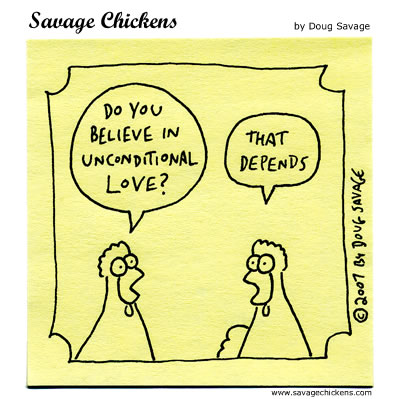
Getting to the point of acceptance is the hardest part. Unconditional love isn't loving in spite of differences; it's loving because of the differences. Unconditional love has no room inside it for wishing the other person were different. We can wish they'd treat us better, and set boundaries towards that end, but when we want them to act a certain way so we can pretend they are a fantasy version of themselves? That is very selfish indeed. That's alot of strings attached, enough to turn our loved-one into a puppet.

I love you...
I just don't approve of your choice to be a chicken.
The way I choose to live is a very spiritual path for me, uplifting, deep. Like Elsa, I feel ostracized for being who I am. In "Let It Go", when she sings the words, "No right or wrong, no rules for me", it's because those rules don't fit her the same way fit the others. She's decided "the perfect girl is gone" because she has a new standard of perfection all her own. This feeling is reflected in the lyrics of the radio version by Demi Lovato, "Up here in the cold thin air I finally can breathe; I know I left a life behind but I'm too relieved to grieve".

Having gone through that, it really is a weight thrown off. 

It's sad that by creating her own standard and cutting those strings, Elsa has to isolate herself: "Standing frozen in the life I've chosen, you won't find me, the past is so behind me, buried in the snow."

Elsa does eventually find acceptance among her people, but the movie fails to explain how this happens. The implication is that it magically happens once she comes to accept herself. In real life, it's kind of that simple, but not really. The reality is that some people will accept you. Others will reject you even more. Still others will reject you at first, and then slowly decide that love is more important–and more effective–than trying to form everyone else into a standard of false perfection.

In my case, whether talking about autism or religion, self-acceptance is my priority. If I have to reject myself to be accepted by others, their love isn't worth it. I would rather live my life in the best way I know how, and let them come around to me, if they want. In many ways, this is my "kingdom of ice-olation", but it's a price I am willing to pay.

Labels: , , , , , , , , , , , , , , , , , , ,

Monday, January 27, 2014

Label Me, Illuminate Me

The label-debate rages on, and now that I know I have autism, I have firmly come down on one side: I am in favor of labels.

Labels can be used to dehumanize, to misconstrue, to overgeneralize, and to blind us to a person's humanity and individuality. As Wayne said, "If you label me, you negate me".

Preach it, Wayne.
Then party on.
Actually, it was the philosopher Søren Kierkegaard who originally said this. "Butterflygirl" on Yahoo Answers summarized Kierkegaard thusly:
Once you label someone you cancel out their own individuality and replace it within the boundaries of that label, so their individually has been restricted within that label and therefore, for all those who accept that label for that person they have no longer accepted that person for who they really are but understand them only to the limit of that label.
And I know all too well from my research into mind control that loaded language combined with us vs. them techniques can indeed leverage labels to negate an individual and render her selfless. It can be used to dismiss external points of view. Labels can make a group insider feel benevolent and normal while demonizing outsiders as inhuman and evil.

Many people fairly point out that labels, particularly psychological labels, can divide people. Labels can become truth. We are all individuals, but dumping thousands or millions of people into the same bucket removes some sense of self. Being labeled in school can make kids a target of bullying, not just from other kids but from teachers as well. It can impose expectations in education and in the workplace and among peers. Labeling can trigger tribalism and hostility. When people are unfairly labeled, they end up filling the role others expect of them.

I've met people in person and read blog posts from people who hate all labels. Here's a dude summing up this line of thought:


These are certainly valid drawbacks, but like The Spork of Truth, it has four tines. Hm, no I need something else... Like the Spoon of Truth, it has two edges. The same aspects that make labels problematic also give labels power. And when your label has power, you have power.
I used to feel neutral about labels. Now, with my diagnosis, I've made up my mind. I now celebrate and champion labels. Bring it. More labels for all! Yes, definitely beware of all the pitfalls that come with labeling, and then proceed with label punch in hand, like that one episode of Dexter's Lab.
Dexter and Dee Dee battle one another
for the right to label everything and then
[SPOILERS SPOILERS]
They say, "If you meet one person with Asperger's, you've met just one person with Asperger's." This applies to everyone on the spectrum. We are all very unique individuals and our traits manifest in thousands of different ways – just like the colors in a rainbow. So the label seems perhaps limiting. Yet those of us with autism have more in common with one another than we do with allists (non-autists). Knowing that is useful.

I lived 38 years of my life without a label to accurately describe who I am. As a kid, a psychologist said I was "hyperactive", and in my 20s, I got an ADHD label from a psychiatrist. These labels helped my know myself a little, but were not accurate enough. All my other traits, which I now know were due to Asperger's, were just unique snowflake Luna oddness. Easily distracted, hyperfocused, shy, socially awkward, nerdy, impolite, smart, pedantic, pensive, weird, misunderstood, seemingly self-centered, anxious, difficult, distant... I projected these "personality traits" which, prior to last April, were merely marks of my individuality with no cause. In essence, all of my negative traits were "choices", bad things I did that I didn't understand, that I blamed myself for. Shortcomings with no solution. Without the label, people still perceived me as all those things. But I had no way to talk about it, and no way to understand. I beat myself up for not going out more, not talking at parties, not flirting, not being productive, for being lazy, for being depressed, for being scared, for forgetting birthdays and being inconsiderate and clumsy and absent-minded.

It's not the words that made me view myself this way. The words are just handles attached to concepts. I saw myself this way without words, because I naturally compared myself with others… Other people had it together and I never quite knew why I didn't.

The words didn't make the reality. They only filtered it. And they weren't filtering it very accurately.

The label allowed me to understand why. "Autism" is a label with definitions, entire books and websites and scientific studies devoted to defining what it means. It's a handle I can wrap my fingers around and manipulate. It's connected to a vast network of related thoughts by those who think about and study and share my autism. Now I can google this label and find others talking about it. Anyone affected by autism can share our thoughts and find others like ourselves. Without the label, all this would be impossible.

Moreover, I can tell those around me, "I have Asperger's", and that means something. It's not an excuse, it's a reason. It describes why I'm different. Many times people don't know what it means, or they have misconceptions, and the label itself gives me an opportunity to educate them. Now anyone who wants to understand me better has ahold of that same handle, and I can draw their attention to all the connections attached to the handle.
This is an actual font. Groovy.
Available from Smashing Hub.
That's the power inherent in words, in all words. As a society, we've agreed upon the meaning of these words. Words allow us to think and share our thoughts with one another. In the dystopic novel, 1984, the goal of Big Brother was to eliminate words, reduce the language down to only those necessary for labor. Authorities knew that if no one had words like"Freedom" or "Rebellion", they could never imagine or communicate about those concepts. Orwell called this language Newspeak.

Those who wish to eliminate labels may have good intentions, but their wish expresses a nihilistic cynicism, and the resulting language would stifle thought, discussion, and mutual understanding.

Knowing I have autism helps me understand myself. And it's helped others understand me. Getting personal for a moment, my sister and I have been distant most of our lives. I never quite understood why, and neither did she. A few months ago, when I told her I had Asperger's, and explained to her what that meant to me, it opened whole new doors in our relationship. She revealed that all these years, my behavior confused her and that, among other things, I seemed self-centered. The new label gave us a way to talk about it, and an alternate explanation for my actions. My label gave us a pathway to get closer.

That's the thing. Yes, we are who we are, unique snowflakes. And we act how we act. But without taking on one label, people will give us another. Maybe the label isn't a word. Maybe it's just an image or feeling in their mind. They ascribe reasons and motivations for why we do what we do. People are going to think things about us anyway. Misunderstanding and hate is not the fault of the label. That's an oversimplification. Reality is more complex than that.

Labels give us a starting point to explore those assumptions and identify ways in which individuals differ from the stereotypes -- stereotypes that already exist, even without the labels.

Accurate labeling lets us be more in control of how other see us. That's part of what the coming out movement is. It is owning that label and maybe even proud of it. You think I'm gay? Yes, I'm gay. (Bisexual actually.) It's a label, and it's part of why I'm a unique snowflake, and now you can't rob me of that, because I wield the word for my own ends.

You think I'm weird? Yes, I'm weird. And I'm partly weird because I have Asperger's. Letting everyone know that helps them understand me more, not less. And if they still choose not to understand, well that's their problem. Not the label's problem.

I have embraced labels and now I advocate for them. If you feel mislabeled, then find labels that better describe you, give them a big hug, and offer them to others as replacements. Use them as a starting point for further discussion. Maybe it's hard to find labels for yourself. So invent new ones. The process of thinking about how to describe yourself is an opportunity for greater self-awareness and self-actualization. You are building a language for your own mind to use about itself.

And when you share those labels with others, maybe they'll accept your self-identification, and maybe they won't. But at least you have something to own, a handle to hold on to when the world knocks you around.

Let your labels illuminate you.

Labels: , , , , , , , , , ,

Wednesday, November 6, 2013

Autism and Shame

At the end of the week when I literally wrote the chapter on shame (in my book Recovering Agency: Lifting the Veil of Mormon Mind Control), I found myself curled up on my bed, sobbing, in the throes of a meltdown, feeling like the worst person on earth -- feeling vitally broken in all the ways that count -- feeling like the unresolvable source of pain for everyone around me. 

And I was helpless to watch from somewhere within, knowing I was suffering from shame, but unable to think my way out of its cage.

What is shame?

The concepts of guilt and shame are frequently confused with one another. They both seem triggered by the same stimuli. Yet they are two distinct feelings with quite different implications and outcomes. 

I've seen two definitions of the differences that ring true to me.

The first is that shame is related to your social position, while guilt is a personal feeling. That is, shame requires your sense of relation to others -- you have done something and others are exerting pressure on you to stop. OR, if they don't know what you've done, you are afraid they will find out because if they did, they would exert pressure on you. Whereas guilt is the knowledge that you've done something wrong, and you feel remorse and a desire to correct the behavior regardless of whether anyone else knows about it.

The second difference is perhaps the most enlightening. Guilt is about what you have done; shame is about who you are. Guilt is, "I have done something bad". Shame is "I am bad".

Brené Brown gave two powerful TED talks on the concept of vulnerability that both focus heavily on the concept of shame. I cannot overstate this concept enough, so I will repeat it in her words: "Shame is a focus on self; guilt is a focus on behavior. Shame is I am bad, guilt is I did something bad."


Shame, no matter how powerful it feels, does nothing to alter behavior. Usually shameful feelings arise around behaviors which are difficult to correct, and so the motive to change quickly devolves into defensiveness or into hiding shameful behavior. Shame has been shown to be highly counterproductive in combatting addictions, for instance. 

Guilt, on the other hand, can be useful in combatting behaviors. It is a sincere remorse and a drive to become a better person. Within guilt, there is the possibility to improve. Because there is no sense that the core self is damaged.

But when the self is inherently broken, then what is there to fix? Nothing.

According to Brown, shame is so painful because it makes us feel unworthy of acceptance. It makes us feel alone. 

To me, the feeling of shame is very closely related to the feeling of rejection. Both tell me I am unworthy of acceptance. Both emotions seek to push me from the tribe. Both say, "You are not enough like the others to belong."

A recent fMRI study on rejection showed that being rejected activates the same regions of the brain as physical pain. According to the article, "As far as your brain is concerned, a broken heart is not so different from a broken arm." Researchers also found that this kind of emotional pain can be treated by taking Tylenol. (Keep this in mind next time you are tempted to wield shame as a weapon. If you are unwilling to punch someone, perhaps you shouldn't shame or ostracize them, either.)

So here I am. I know all this. I've spend decades getting healthy, reading all the self-help books, going through the therapies and support groups and memorizing daily affirmations. I have literally written the chapter on shame. I know better. I am even surrounded by people who I know love me, even though I hurt them sometimes. 

And yet I still find myself on those dark nights, hating myself with every fiber of my being. Feeling like a horrible, worthless creature.

How do I get from Point A to Point B?

Because I have Asperger's

I have a constant sense, when dealing with people, that sooner or later, I am going to say the wrong thing. Eventually, out of nowhere, the peaceful pond is going to erupt into a geyser. I spend significant energies managing that pond, keeping it still, but it always erupts.

From childhood, I've known this. This incontrovertible fact of life has been a part of me. I have been unacceptable in so many ways, being a nerd, being an introvert, but the worst crime of all is making social faux pas. Of thinking differently. Of thinking so differently that perfectly innocent utterances randomly cause people to cry, or turn away, or lash out, or get angry, or accuse me, or cease being my friend. I'm not so impaired as to be unable to recognize when I've done something wrong, though perhaps my brain should be merciful enough to grant me this relief.

My young self learned that the consequences for making such mistakes could be severe. The trauma built up over the years, compounding the punishment for screwing up. Now, not only do I have to deal with another person feeling bad because of the mysterious thing I did wrong, but I have to also deal with my own fears and pain which have been building into this near-PTSD level.

Putting in the effort to avoid these mistakes only works for so long. Because I have Asperger's. I will miss the social cues. Sometimes, everyone misses the social cues, but I have had a lifetime of doing so. 

What may be the even more important distinction, I don't have the skills to recover from social mistakes. I can't gracefully apologize or flatter or smile my way out of trouble. I'm usually still stuck on Step 1: flabbergasted, trying to understand where I went wrong.

For those of us on the spectrum, this is normal. We live life in the face of continual negative social feedback and the constant making of incomprehensible mistakes. And it is here where the dangers of shame lurk. Where no matter how many times I tell myself how wonderful and likable and lovable I am, I still find myself on those dark nights hating myself. Because I'd done it again.

It is very easy to feel like nothing I do will improve my ability to be acceptable. After trying so hard and making so many mistakes, eventually I can't help but think of myself as intrinsically broken.

This topic is particularly important. I hope healing professionals and researchers will look into it on a scientific level and counsel their ASD clients accordingly. But it's possible they won't for a long time. 

And yet, they should, because suicidal ideation is 28 times more likely for autistic kids than neurotypical kids. To me, this comes as absolutely no surprise. Aside from my own struggles with suicide, we already know from other research that three things are needed for the risk of suicide to be concerning: 

  • Thwarted belongingness (I am alone)
  • Perceived burdensomeness (I am a burden)
  • Capability (I am not afraid to die)

Shame sends two of these three messages: 
  • I am intrinsically unacceptable which will make me always be alone
  • I am inherently unfixable and therefore will always be a source of trouble for those who do love me.
And shame (and resulting anxiety and depression) causes so much pain, that the third ingredient is an easy leap. After suffering long enough, suddenly death seems like a relief.

It is this deep sense that we will always be unacceptable that makes autists more likely to ideate. So the real question is, how can we help autistic kids and adults feel acceptable in a world full of people who struggle to understand us as much as we struggle to understand them? Especially when we continue to bear the brunt and blame for the misunderstandings?

Solutions

The day is far, far off when we can expect much from the world at large. But there are things we can do for ourselves, and, if we're fortunate enough to have a loving, and capable support network, we can help them understand and so they can give us what we need.

Affirmations. For starters, when I feel this way, I often find relief from reading the well-crafted and autism-specific affirmations by Liane Holliday Willey which are posted on the WrongPlanet forums. These work most of the time, except for when, for whatever reason, I'm feeling overly cynical and don't believe them.

A great song full of affirmation-in-spite-of-flaws, that almost always makes me cry, is Alanis Morissette's "That I Would Be Good".

Self-acceptance for an aspie means accepting that you are fundamentally different. Because of these differences, there are many behaviors that will always be difficult or even impossible for NTs to accept, and you have to accept that, too. 

Identify your aspie superpowers. These are examples of how ASD makes you particularly awesome. They are the other side of the coin, your X-ray vision to the kryptonite. For examples, see the two links at the beginning of the paragraph. Come up with your own list. During shame-filled times, go over them and remind yourself of your strengths.

Consider coming out. According to Brené Brown, shame requires secrecy, silence, and judgement to survive. Without these things, it will die. Consider finding a safe space, free of judgement, either with safe family, or safe friends, or with a therapist, or online at a place like WrongPlanet. Bring your shameful moments to light. If you feel judged, then go back into your shell until you do find someplace safe.

If you can, explain your condition to others. Point them to online resources and descriptions. While that doesn't necessarily help keep you from making the same mistakes and hurting people with them, it may help people feel less offended because they understand that the source of your mistakes isn't intentional.

The debate rages over whether autism is a disability, but here it may be useful to think of it as one. NTs don't have to struggle quite so hard to be understood or to avoid being misunderstood. Even though those behaviors are caused by your disability, you must separate your behaviors from who you are

Remember that if your disability were something more obvious, like inability to walk or see, it would be unthinkable to shame you for avoiding stairs or not looking people in the eye. Sometimes you will miss social cues or not understand what's going on or forget someone's birthday or be late or dozens of other things. While this isn't an excuse, nor does it mean you should stop trying to do those things, it also means that if you fail them, it's nothing to be ashamed of. 

There may be unhealthy people in your life who are compounding the issue. They may be incapable of separating behavior from the person and may be reinforcing shame while you are struggling to overcome it. That is something NTs also deal with, and is a subject of a great many books and therapies. When it comes to feeling shame and dealing with abuse, we're not terribly different from NTs, and those materials should be helpful. Just keep in mind we have additional factors which compound the issue, and we may feel shame and rejection more strongly or be more easily triggered by it.

And lastly, here is a post by another aspie who also struggles with shame, and how she deals with it. 

No Shame

I once overheard a caring mother say of her daughter, "She has no shame. She has Asperger's. She is incapable of shame." This mother meant well -- what she meant is that there are some things aspies do without regard or care to social customs. In that sense, we have no shame. 

But in other areas, where it matters most, we know all too well that our lives have been one steady stream of rejections and social pitfalls. We walk cautiously through a minefield of shame.

We can build up heavy defenses against them, sometimes becoming unapologetic or defensive or even aggressive to avoid touching those mines. Other times, we take the timid approach, avoiding people whenever possible and accepting blame instantly, even when we don't know what we've done wrong. Sometimes I oscillate between these two extremes in the course of a single evening. 

Nevertheless, shame is a barrier to intimacy. If we can find ways to grapple with it, no matter how powerful it seems, we'll have more opportunities for closer connections and freer, happier lives.

Labels: , , , , , , , ,