Friday, February 20, 2015

The Meaning of Dreams

Stories are metaphors. From the moment they arise from the author's deepest dreams, to the second they enter the reader's mind, a story is a form of telepathic communication that conveys images, ideas, and philosophy in a way that no other medium can.

The message may become garbled. The reader may experience something other than what the author intended. And that's okay. Because the reader can only take in what she is ready to take. She can only comprehend what she is prepared for, and for what every unique moment in her individualized life experience has set her up for. She may feel completely different feelings than I've sent to her, but if she feels something that is personally meaningful to her, then the cycle of communication is complete.

Fantasy, science fiction, and horror, otherwise known as "speculative fiction", is the most ripe for conveying messages on this wavelength of metaphor. Because anything can happen, because fantastic worlds are built with rules that differ from our own, those rules can better represent the wispy, intangible form of language our subconscious minds speak: the language of symbols.


The Legends and Dreams story bundle contains eight such stories. What will pop into your subconscious when you experience a world in which entertainment conveys not only light and sound, but also touch and sensation, as it does in Tonya Macalina's Faces in the Water?


What speaks to you about a human boy capable of turning into an aquatic being of myth, like in Roslyn MacFarland's See No Sea?

What is most intriguing about a society of masked political maneuvering and courtly subterfuge as depicted in E.M. Prazeman's Masks?

Where will your mind take you when you read about a girl born with a spectral limb in Ripley Paton's Ghost Hand?

Or more down to earth, will you connect to Courtney Pierce's protagonist, who hunts for a killer and deals with her mother's death, in Stitches?

Perhaps a tale of traveling to magical realities will speak to your psyche, like Pamela Bainbridge-Cowan's The Butterfly.

If that doesn't call to your inner Jungian archetypes, there's another world you can travel to via the two characters in Crystal Doors: A steampunk world of science and magic by bestsellers Kevin J. Anderson and Rebecca Moesta.


As the author of Emerald City Dreamer, also included in the bundle, I can speak to the metaphors I hoped to convey. But perhaps you will have a different take away. I wanted to show the struggle between reason and hope, between cold logic and creativity. It is dedicated to those of us who have worked corporate day jobs, but wanted more; those of us with dreams bouncing eagerly (or scratching menacingly) just beneath the surface, struggling against reality to finally escape.

So I wrote about faeries living in the modern world, and about the two women who desperately want to kill them.

Is this a sales pitch? Yes, it is. I want you to experience the Legends and Dreams bundle because I believe in the power of books and in the majesty of the dying art of reading. Catch a dream. Experience a legend. All eight books are available in one bundle, and you can simply name your price.

What's even better is that all but one of these authors are women. And all but one book has female protagonists. #WeNeedDiverseBooks? Yes.

Legends and Dreams story bundle at WeBundle.it

Labels: , , , ,

Monday, February 24, 2014

Reflected in Ice: An Aspergers Review of Frozen

The following movie review contains mild spoilers. I try to tread lightly, but can't avoid addressing a few in-movie moments or thematic elements.


There are two measures of good art.

The first is anything that can make me feel strongly. The other is that which holds up a mirror to the viewers, in which, each sees herself.

Frozen accomplished both of these goals with resounding success.

Secret Wish - Tami Vaughn
I had this printed on a mousepad I used for years.
Good mirrors are composed of metaphors and character traits and plot in the right combination of vague and specific to reflect a broad range of life situations and personalities. Many types of people see themselves in Frozen: girls who are raised to be perfect, sisters who struggle in their relationships, women who are deceived by those they trust, those who have secrets, neurodiverse people, anyone who is misunderstood, and anyone who is rejected for all the wrong reasons. And like the second trial in The NeverEnding Story, a mirror which reveals the viewers "true self", Frozen's mirror can reflect the ugly parts of some people, like the blogger, "Well-Behaved Mormon Woman", who calls Frozen part of the "gay agenda to normalize homosexuality" and who says it's terrible we're letting kids get the message that rebellion is better than obedience.

Can you hold it down, please?
I'm trying to make history over here.
Whatever, lady. I have an entirely different view when I look at myself in art.


Frozen reflected many visions for me. Most strongly, it portrayed my autism in a very accurate way. It also reflected my relationship with my sister, and my struggles to leave the religious culture of my birth (incidentally, Mormonism), and my struggles relating to my family members who still belong to that culture. I will cover my thoughts on all these points.

Social equality activists argue for more representation of minorities in fiction. There are many good reasons to do this, but for any creator, the biggest reason should be "to make better art". When the same old characters are dancing to the same old plots choreographed with the same old tropes and the same old twists, only the same old segment of society is allowed to see themselves reflected in art. And even that segment is only allowed to get the same messages they always have about themselves. The mirror is cracked and the reflective backing is faded. It ceases to be useful even for the intended audience.

What's fun is a funhouse with only one twisted mirror?


Frozen is the first movie I can remember that explores the relationship between two sisters. I'm sure there are other examples, but they are few and far between. Often, to find them, you have to leave the mainstream film scene, into the art houses and foreign films.

Because of this dearth, Frozen had it easy. Its subject and plot is low hanging fruit. Disney made the only mainstream movie about sisters in recent history, so of course anyone who is a sister and has a sister is going to see herself in it. Finally, someone is showing her herself.

Because women are so rarely represented in movies, outside certain highly limiting tropes, we latch on to anything we're given. And it benefits us all greatly. Frozen allowed my sister and I to have a conversation we were unable to have before, because we lacked any kind of context to have it. Frozen helped her and I understand one another more.

Any filmmaker following in Frozen's footsteps will face a steeper challenge. The next attempt will require a little more thought and nuance in order to be good art and not simply derivative.

This is a good thing. I hope many attempts will be made to best Frozen's "sisters" mirror. And while we're at it, let's take a look at other female-female relationships. Mother-daughter? (Brave got us started there.) Business partners? Partners in crime? Buddies? (More Thelma and Loiuse, please.)

And God forbid.. Perhaps we could see female-female romantic partners? In spite of the success of the big gay agenda, I currently only have one small part of one song that describes what it feels like to be snuggled up with my lovely girlfriend. That ought to give well-behaved blogger up there a real example of homosexuality portrayed in the media.

Anyway, there's plenty more low-hanging-good-art fruit for the picking. Half the movie-viewing audience are women who really want, crave, and need more mirrors.

Now, I'm not implying Frozen's creators were amateurs and that it only succeeded because they entered unexplored territory. They tread some other ground which is extremely well-trod and managed to find a fresh mirror there, too.

The "be your own unique self no matter what people say" theme has been done to death. It's part of American culture, and we love it every single time. Where this theme gets stale is, again, where we endlessly see the same take on it. The underdog nonconformists who win in the end, they all start to blur together after awhile, until we forget that this is the theme of pretty much every single movie, ever. We don't even notice it anymore. The individualist rebel has become the new conformity, the ideal that we all strive for equally, to the point where we shun anyone who fails.

Repeat after me...
For Frozen to pull this old trick out of the bag, dust it off, and make it seem like they were the first to ever think of it, is a pretty tremendous feat. A mirror is pointless if we keep seeing the same image. It's the one that reveals a different side, or that pimple hiding under the chin, is the one that wins the "Good Art" award from me.

The song "Let It Go" is good art for the same reasons. It speaks to these common themes and others, of social rejection, of turning ostracization into chosen isolation, of the damage caused by suppressing feelings, of finding self-acceptance, and of having uncontrollable emotions or an inner power which is misunderstood.

This scene made me cry the first time I saw it. Which leads us to autism.

Others have written about this topic. But I shall write more about it. Because when you meet one person with autism, you've only met that one person with autism, so there's no one definitive autistic perspective.

[Mild spoilers incoming!]

Elsa is born with her power, and she is taught to hate and suppress it. She learns from her well-meaning parents that she is dangerous and likely to hurt others, especially her sister Anna, who she loves. She has to hide away in her locked room, stuff her feelings, and resist using her powers because of these inaccurate beliefs about herself.

Her powers are a double-edged sword. They started as a force for good, which she used to make her sister happy and strengthen their sisterly bonds. But after one mistake, her talent turns into a dark and ugly thing, not because of Elsa herself, but because of how the people around her view it.

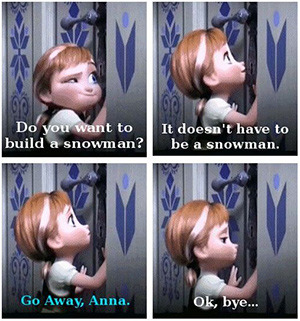
Ironically, it isn't her magic that hurts Anna. It's Elsa's self-imposed isolation because she believes herself to be dangerous. All Anna wants is the same love they once shared. The door that separates them wounds more sharply than the ice which was easily healed.

In a perfect case study of unintended consequences, Elsa's suppression of her power is what keeps her from controlling it. It all comes out sideways at the worst time, and she ends up in mutually-agreed upon exile, but with disastrous results for both her and her people. Again, it isn't her powers that are dangerous, it is how she and everyone else is handling them.

Olga Bogdishina's book, "Communication Issues in Autism and Asperger's Syndrome", talks about the ways autists process sensory information differently from neurotypicals (NTs). Among other issues, autists deal with being either hypo- or hyper-sensitive to stimuli. "Their senses seem to be too acute…or not working at all…"

Excellent book.
So read it.
Every autistic individual has a mashup of different conditions under which their senses are either ramped up or remote and blocked off. For some, sounds will always be too loud (auditory hypersensitivity) but they have no idea what they're feeling (alexithymia). For others, they do fine with sound... until they get overstimulated. Then they can hear a pin drop on the other side of the house.

Emotions should be counted among the "five" senses. Emotions are a sense, giving us information about our internal reactions to outside events, and are subject to hypo- or hyper- sensitivity effects. For autists, emotions can be remote and incomprehensible, or very loud like a blaring siren. While I've had periods in my life where I was more hyposensitive to my feelings (my teen years), these days, I tend to be more hypersensitive. I usually know what I'm feeling, and why, and even what I need to do to change those feelings. The downside is that strong emotions are very, very strong. Overwhelmingly so. Uncontrollably so.

And that's where meltdowns come in. 

Add to the complication, I was raised in a passive-aggressive environment, where showing certain emotions was never allowed. I quickly learned that crying would invoke an angry response, or accusations, or that I could hurt the people I loved. I became very good at repressing my tears if anyone else was around. When I became an adult, I had to teach myself to cry. It's a lesson I've never fully learned, and I have lots of triggers and shaky boundaries around that. All stuff I continue to work on.

When I feel cornered and triggered, I can meltdown. My emotions become so overwhelming that they shut down my thinking brain, with symptoms very similar to panic attack. I feel anxiety like fire, in my whole body, even my skin. I can't breathe, I can't think straight, I can't act in the best ways to protect myself. Everything becomes all-or-nothing. I may lash out and say hurtful things.

I'd put something funny here but it isn't really funny.
Cue Elsa. Here she has this double-edged power. She can build magnificent complicated fractal-based buildings using only her mental powers, but when she loses control, she shoots icicles from her hands.

Elsa's big triggers are related to emotions. When her parents die, her room turns frosty. And just like me, she becomes most dangerous during conflicts. She always risks hurting someone when she feels powerful things. And most of all, no one understands her. She's hurting and afraid, but everyone thinks she's a monster.

Her powers are just like my overwhelming emotions. As a child, I dealt with them by never feeling anything. As an adult, I still try to stuff them sometimes, but it totally backfires, especially when it reminds me of being a helpless child and I get triggered.

Power over ice is the best metaphor here. Aspies are often thought of as being emotionally cold, yet like Elsa's power, our emotions are often very active and passionate. Emotional repression is like trying to freeze feelings. And when I get upset, words come more difficult to me, as if my thoughts are freezing up. When the panic sets it, it's hard to breath, like my chest is frozen with fear.

It's not an icebeam, no that's all Jonny Snow!
(And Elsa the Snow Queen)
Anna tries to reason with Elsa, so together they can solve the endless winter problem. I related to Anna here, as well. My solutions are so simple, yet sometimes so hard to convey.

This is when Elsa whirls around in frustration, erecting a defensive ice barrier all around herself. Unknowingly, she hits Ana in the heart with an icy ray.

How often have I whirled about in my own pain and frustration said something that wounded someone I love? The closer to meltdown I am, the worse it is. I'm not trying to hurt anyone, though people accuse me of doing so. I'm as surprised as Elsa is, when she hears Ana's little cry of pain.

The metaphor continues through Anna's reaction. She seems fine for awhile. She knows she's got a problem, but she runs around for awhile and even has a comedic musical number with the trolls, before the ice starts to take over and incapacitates her. That's how painful words work. We stand up and shake them off and move along in life, but if the words were painful enough, they cause traumas that are hidden but still slowly freezing us to death.

Elsa finds her answer, and it's the answer I found. By stuffing her emotions, by trying to deny who she really is, by allowing social shame to consume her, she becomes explosive. It's only when she "lets it go" and accepts who she is in spite of what others tell her, that her talent becomes a controllable force for good. A unique power no one else has.

The message here, for anyone with autism or Aspergers, is to be true to your autistic self. NTs are going to set up alot of incomprehensible social standards for you to follow, but maybe you don't have to. At least not all of them, not all the time. Maybe there are ways around them, or maybe you can just do what you're going to do anyway, without shame. Maybe some of those social standards are lame and need to be questioned and rejected.

Art by FabUUlousGear.
Because you can get this as a mousepad.
By accepting and being open about all facets of your personality, you learn to control your powers. You can avoid those pesky painful meltdowns altogether, and forgive yourself when you can't. You can create your own environment, a palace on a hill, free from overstimulation and ridiculous social rules. And when you get really good at that, maybe you can come down off the hill and be a leader for others.

Or not, and that's okay, too.

One of the emotional elements of Frozen, for me, was Elsa's entire story arc. I had a rotten 2013. I was diagnosed in April. Conflicts between me and Roland were increasing in intensity and frequency. For many reasons, my anxiety continued to increase, until it pained me every single day. I was melting down every couple of weeks, every month at a minimum. I had multiple scary suicidal moments which recurred for months.

My diagnosis was helpful, but it also spun me into turmoil. I had my own self-rejection/self-acceptance narrative arc. I had to learn about my traits, my powers, and my limits, and then learn to articulate them to others.

As I watched Elsa struggle on screen, trying on various options to deal with her power/curse, I watched myself. I felt her pain and confusion. I understood her loneliness. But I also triumphed with her. I danced with her as she sang of how she no longer cared what anyone else thought, she no longer wanted to hide her true self, she would no longer try to be the perfect girl everyone expected her to be.

It's making me tear up as I write about it.

By the end of the year, I'd found my balance, an equilibrium, of how to live with autism and accept myself. The hardest part was learning how to be around others. Living in an ice castle is one thing, but I have family. I learned to set boundaries to keep other people from hurting me, which also resulted in me hurting them less. Like Elsa, I am now able to step out on the stage, confident, knowing I am loved.

That's not to say I won't continue to struggle. Every story arc repeats itself. On screen, it's just a sliver, a slice, of the cyclic life-themes we continue to deal with. Frozen gives us a common language to think about it and discuss it.

The story also reflects isolation, of being around others and yet effectively alone because true communication is impossible. This is the story of autism.

When I first started researching autism, I wondered what non-verbal autists could possibly have in common with me and other aspies. Yet I still had this deeply empathetic response to any non-verbal autist I read about or saw on video.

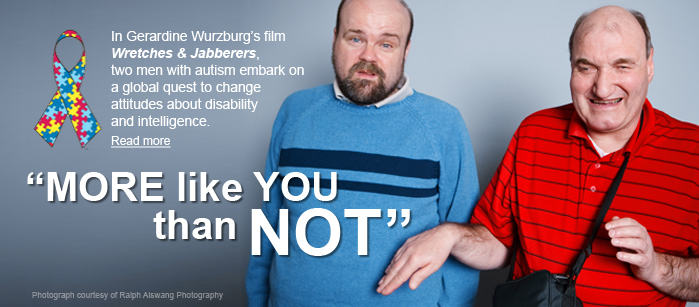
In the documentary Wretches & Jabberers, two men with classical autism travel the world to meet other autists and advocates. I found myself almost in tears through the whole film. Even though their experience of life is, in so many ways, very different from mine, I felt some common, mysterious tie.

Wretches and Jaberers
There's a moment in the film where Larry expresses how painful it is when people thinks he's stupid because he can't talk. I related so hard to this moment, not because people think I'm stupid. The opposite, I'm normally perceived as being above-average. It took me awhile to figure out what I had in common with Larry in this moment.

Then it occurred to me – the key thread is being misunderstood.

I know myself really well. I know my capabilities and feelings and outlooks. Yet often NTs think they know these better than me. They make assumptions about my motives, and then they argue with me, trying to convince me their outside perceptions are more real than my own experience.

All autists are deeply misunderstood. NTs often think we're stupid, or out of control, or crazy, or drama, or unfeeling, or unempathetic, or dangerous. They think we're emotionally unintelligent. We are painted in broad strokes with wide brushes that assume intentions and ascribe meanings which aren't true.

It's even harder, for those of us who are skilled in the use of language, when what normally works for us suddenly stops working. We sometimes can't find words, or the words we use are suddenly incomprehensible to NTs because of their assumptions or because autistic thought patterns are so different and difficult to communicate across the divide. Other skills, like sensory processing or executive function and abruptly fail, and we blow through expectations set by past behavior.

For this and many other reasons, I've known instinctively, since I was a small child, that I could expect to be misunderstood on a regular basis.

To see Elsa fleeing her own kingdom really struck a chord. She tried so hard to be like everyone else and to avoid hurting anyone, and yet she still failed and had her motives misascribed. This is something many autists can relate to.

The misunderstanding is even more acute because Elsa looks normal. Her "disability" (diversability) is invisible, so when it suddenly appears, it is all the more shocking and horrible and more difficult to understand. Aspie behavior is much the same. Because no one can see a reason for strange behavior, NTs can hurtfully ascribe motives that make sense to them, but not to us.

"You just need to try harder..."
Helpful advice, but only a little
It's easy to see why someone in a wheelchair isn't running in a marathon, but when a well-dressed, intelligent, and verbal aspie with sensory processing disfunction fails to reciprocate a friendly greeting, it must be out of rudeness or meanness or a lack of empathy, not out of severe social anxiety, or an inability to assemble the words into meaning, or the inability to instinctively understand what the appropriate response is.

Likewise, when Elsa's power first escapes in public, she is accused of being a sorceress, a monster. The people are not only afraid of her, some of them hate her and want her dead.

This reflects the quick switch of being admired by everyone, then abruptly alienating them, and not knowing why. That's the life of an aspie who passes as neurotypical, builds up expectations, then shocks everyone when we reach a limit and breakdown, or fail at some seemingly simple task (like shaking someone's hand). People don't realize the capricious nature of Aspergers, that sometimes those little things are impossible for us, even if it was possible just a minute ago.

Just like it became impossible for Elsa to contain her powers.

Though Elsa is a secondary character, she upstages Anna, the protagonist, who may also be a relatable character for aspie viewers. She is clumsy, socially awkward, blunt, practical, lonely, and unorthodox. She also expresses an impulsiveness and devil-may-care attitude which is not only endearing, but common to the Asperger's experience.

I related very strongly to Anna's confusion and pain when Elsa shuts her out the way my sister did me. Elsa's reasons for the rejection seemed to be good, but it caused more harm than it prevented. As in their case, my own relationship with my sister seems to be improving the more time we spend talking to one another, not less.


My sister's reasons for shutting me out are rooted partially in long-running misunderstandings about my behavior vs. her interpretation of my behavior. Once I told her I am as aspie, she could understand me more. (No everyone reacts this way, however. I have heard that revealing an Asperger's diagnosis sometimes causes increased misunderstanding in families.)

My sister's reasons are also partially rooted in religion, which leads me to the last mirror that Frozen held up to my life.

When I chose to leave the religion of my birth, I felt a mix of conflicting emotions. I still do. On the one hand, I can celebrate my freedom from expectations and rules which never quite fit me, as Elsa does. There is much joy to be had in that. My new beliefs and new way of living is very me. I've lived this way for thirteen years, and the more time that passes, the more I know this path is totally right for me, and I won't let anyone take it from me.

Yet like all good stories, there are tradeoffs and conflicts. This isn't a Mary Sue story, and the price I paid is steep. I left most of my family behind. I left my cultural homeland behind. I could no longer fit in there, so I exited. By isolating myself from them (and that isolation is a two-way street), they can no longer hurt me, and likewise, I no longer hurt them by being myself in their presence. But my leaving had unknowable destructive effects back home. My family misses me, and though their desire for me to fit their mold is unrealistic, it is also real.

Though we now live in very different worlds, we are still family. This story arc has not ended for me yet. I'm still the Elsa dancing in her ice palace, singing "Let It Go", trying to forget the people I left behind, trying hard to pretend they're better off without me as I am better off without them.

Our issues seem insurmountable, but maybe they aren't. The trolls sing a song about fixer-uppers which is about marriage and romance, but it also addresses blood-family. "Everyone’s a bit of a fixer-upper, that’s what it’s all about! Father! Sister! Brother! We need each other to raise us up and round us out." 

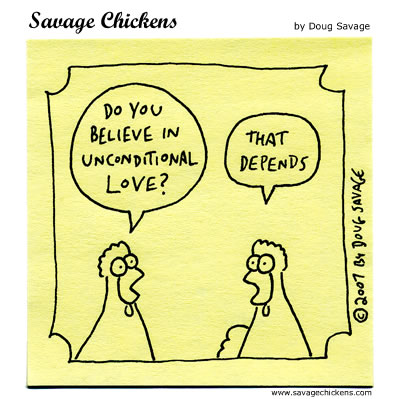
Getting to the point of acceptance is the hardest part. Unconditional love isn't loving in spite of differences; it's loving because of the differences. Unconditional love has no room inside it for wishing the other person were different. We can wish they'd treat us better, and set boundaries towards that end, but when we want them to act a certain way so we can pretend they are a fantasy version of themselves? That is very selfish indeed. That's alot of strings attached, enough to turn our loved-one into a puppet.

I love you...
I just don't approve of your choice to be a chicken.
The way I choose to live is a very spiritual path for me, uplifting, deep. Like Elsa, I feel ostracized for being who I am. In "Let It Go", when she sings the words, "No right or wrong, no rules for me", it's because those rules don't fit her the same way fit the others. She's decided "the perfect girl is gone" because she has a new standard of perfection all her own. This feeling is reflected in the lyrics of the radio version by Demi Lovato, "Up here in the cold thin air I finally can breathe; I know I left a life behind but I'm too relieved to grieve".

Having gone through that, it really is a weight thrown off. 

It's sad that by creating her own standard and cutting those strings, Elsa has to isolate herself: "Standing frozen in the life I've chosen, you won't find me, the past is so behind me, buried in the snow."

Elsa does eventually find acceptance among her people, but the movie fails to explain how this happens. The implication is that it magically happens once she comes to accept herself. In real life, it's kind of that simple, but not really. The reality is that some people will accept you. Others will reject you even more. Still others will reject you at first, and then slowly decide that love is more important–and more effective–than trying to form everyone else into a standard of false perfection.

In my case, whether talking about autism or religion, self-acceptance is my priority. If I have to reject myself to be accepted by others, their love isn't worth it. I would rather live my life in the best way I know how, and let them come around to me, if they want. In many ways, this is my "kingdom of ice-olation", but it's a price I am willing to pay.

Labels: , , , , , , , , , , , , , , , , , , ,

Monday, September 17, 2012

Ultimate Fantasy Escapism: Choose Your Race, Choose Your Class.

You're starting a new game. It may be a table-top RPG, or the latest MMORPG. You create a character.

Your very first choice: Race. You can be a human, elf, dwarf, halfling, orc, lizardman, or cat-person. Some games even offer different kinds of elves (light vs. dark elves), and in still others you can be mixed-race -- say half-elf.

Your choice isn't just cosmetic. Your race will provide you with a starter personality and an ethnic background you can expand upon. Based on your race, your character will be given inborn advantages and disadvanges: differences in intelligence, strength, dexterity, charm, health, and ability to buy and sell at a discount.

Next you choose gender, which usually provides no difference in gameplay, other than how cute the ass is you will be staring at for the next eighty hours.

Then you choose your class. Do you want to be a fighter, or thief? Monk or mage? Archer or knight? Will you rule your foes with magic or might? Your birthright is yours for the choosing.

Of course we know fantasy is escapism. The real question is: What are we escaping from? The doldrums of life, certainly. Who wouldn't want the chance, through hard work and many hours of rolling dice and clicking mice, to eventually become a king? Or a powerful mage? (Alongside thousands of our peers.) It's the perfect blend of aristocracy and meritocracy: A world ruled by invincible hereditary dominance, with all the upward mobility of modern society.

But is there something deeper we're escaping from? It has bothered me somewhat, as David Brin has put it well, that fantasy glorifies a non-existent golden age. A medieval time when benevolent kings and mages (aka religious priests) kept the kingdom in a perpetual state of peace so the happy farmers could live out their simple pastoral lives, never having to worry about rush hour, corporate mergers, and Manager Rob.

That is, until Evil McOverlord comes along to stir up the joyous peasant's otherwise idyllic lives. This is the time when that one special peasant takes the chance every peasant has, to climb the serfdom ladder and, by luck of destiny and/or secret birthright, exercise his right to become a king or mage himself. Through his well-rewarded efforts, the countryside can go back to blissfully herding sheep.

If only...

So what is it that attracts us to that specific time? Why the middle ages? Why not the Enlightenment, when the class system began to change and people began to demand freedom and equality? What is it about the values of one of the lowest points of Western Civilization, sandwiched between the glory of the Roman Empire and the Enlightenment, that attracts millions of fans?

Could it be those worlds are acting as a surrogate for something we all crave? Could the clues to this craving be in the very words we use to describe our first choices in character creation -- "race" and "class"?

Violence is another nasty little element we idolize in our entertainment. When we look at history, we realize why the past wasn't so idyllic. Violence has been a part of regular human experience of nearly every individual on earth until very recently. Men were sent to war not once a generation, but once a year, with cattle raids and such happening more frequently. Even in peacetime, dinner came from the pasture or the forest and it was something you had to kill and dress with your own hands. No one had to wonder if blood had a smell, because it was more than just a smudge of red pixels on your computer screen -- blood was simply a part of life.

Violence is written in our genes. Now that we are more civilized, we have a historical privilege we all take for granted. We rarely commit or are victims of violence. Fiction is our outlet. We give life to imaginary phantoms, only so we can take it away with the slash of a sword. We can watch death, read about it, and even act it out, in a way that hurts no one.

Likewise, tribalism is writ in our genes. Racism, classism, religious hate. There was a time when the majority of our ancestors believed there were tangible physical, moral, and spiritual differences between peoples of other races, cultures, and castes. People outside the familiar group were not human, they were "other". And those groups were generally very small, limited to families, tribes, small kingdoms, or local religions. Killing someone outside your group came easily and without regret. Like violence itself, these were survival tools in a world where letting go of limited resources or undefended territories could mean your death.

Here in the United States in 2012, we have new values to live by. These values are luxuries we enjoy in a world with abundant resources, and in part, we have abundant resources because of these values.

Among them:
  • All humans are created equal. 
  • All humans have the same capacity for achievement, regardless of gender, race, or class. 
  • The playing field should be level so that hard work can lead to success. 
  • We all deserve equal reward for equal effort.
  • Those at the top who do not contribute should fall to make room for those who do contribute.
Not everyone holds these values. (Just go read the comments section on news articles and YouTube.) But they are our cultural standard. It is what we strive for.

We take for granted that even mere decades ago, majorities held opposite values. During those medieval times, races were considered fundamentally superior and inferior. Members of the upper class were divinely chosen by birth. Knowledge was reserved for those privileged enough to join the clergy. Enslaving others, be it through ownership or serfdom, was considered noble. Forcibly robbing whole nations of their cultures was thought to be an act of moral goodness.

As our society slowly outgrows our base instincts, we have replaced real hate with playful outlets. We've built political groups, religious factions, sports teams, and subcultures, and most of the time, tribalism is harmless. More or less.

Racism and classism still very much exist, even in "civilized" America, just as violence still exists. People still die because of their race, and upper classes still believe themselves better and use power to maintain position. We are always poised on the brink of some terrible mob-mentality disaster.

At heart, we are still tribal. "Us vs. Them" is wired in the very nature of the human spirit. It is manipulated by politicians and religious leaders to keep us committing guilt-free acts of violence, large and small, real and metaphorical, against other human beings.

The important thing is that our society now strives to overcome it. Our fiction reflects this: The "underdog" movie is ever popular. The little guy works hard, and in spite of the odds, in spite of the intolerance and hate directed at him, he rises to the top. This is our culture's idea of a happy ending.

Yet our culture makes violent films as well. An outlet. A way to pretend.

Unlike violence, depictions of justified hate can actually reinforce real hate. How can we feel the satisfaction of superiority, without it being at another's expense? How can we foster a sense of equality while at the same time, satisfy our intolerant urges?

We log in, we choose our race, we choose our gender, and we choose our class.

Oh, we may not realize it. We don't set out to play at racism anymore than we set out to commit play-violence. All we know is that it's fun to fight goblins and orcs and lizardmen. Everyone knows goblins are ugly and genetically inferior. They aren't human. We can kill them with glee, secure in the knowledge that they don't deserve to live. Secure in our knowledge that no one in the real world is hurt by our hate.

It's taken for granted that elves hate dwarves, and everyone justifyably hates goblins, and there's nothing wrong with that; no harm done. Dwarves can go on cracking elf jokes and having a good time, at no one's expense. 

(That's not to say fantasy is entirely free from real-world parallels to existing cultures who are harmed by stereotypes. I frequently see culture appropriation that goes a little too far. Likewise, violence in media is not completely free from influencing violence in real life.)

We have the privilege to play at being underprivileged. If we decide we don't like life as an Asura Thief, because the Asura are too short and everyone thinks we look like children and we're big nerds, and we find out the life of a thief really stinks, we can start again, as a giant Norn guardian with a big sword, who doesn't have to take orders from anybody.

A new life and new destiny is just a re-roll away.

Most of the time, fantasy fiction is completely unaware of its own themes. Sometimes, much to my delight, a game or novel becomes aware, and uses uses fantasy intolerance to hold a mirror up to our society.

Dragon Age springs to mind. In this fantasy world, elves are considered inferior to all other races and have been segregated into "Alienages". The game explores themes of racism and segregation. Most non-elves accept this reality. Some don't think it's fair. The elves themselves react sometimes passively, sometimes actively, and some have formed into groups to change things, sometimes using violent means. Your own character gets to make choices, and those choices have real consequences.

We play this game through our own culture's eyes. Unlike the dehumanized goblins of other games, where the world is bettered by the hated-group's demise, the elves have personalities. They are humanized. We know the elves' suffering is unjust.

Even when we commit genocidal acts against the elves, we know they are the "evil" choices, and we make them with a sick kind of glee, (just like when the game gives us violent and sadistic choices), because we are not allowed to feel that way in real life. Unlike our ancestors, we know these choices are wrong. And you get to see exactly how those choices play out.

Even when we're playing at being evil, we see how the virtual elves are hurt.

This can't be said of real-world hatred. Those who wrap themselves up in racism or religious hatred or other forms of tribalism, do not see their enemies as human. They see them as "the other". They feel no more moral crisis at the deaths of black people, or Mulsims, than I feel getting an achievement for slaughtering my 1,000th green-skinned goblin.

Fantasy gives us pretend racism and classism, and when we're done, we can return to our privileged and moral lives. I choose to see it for what it is, and rest easy knowing that, just as I wouldn't wield a sword against a real human being, I also wouldn't really want to live in a world where inequality, injustice, intolerance, and genocide are glorified.

Games provide an acceptable outlet for make-believe hate. And the more people who redirect their hatred away from real human beings, towards virtual races, the better.

Labels: , , , , , , , , , , ,

Friday, June 15, 2012

Scarcity Mentality vs. The Abundance of Ideas

Writers get asked all the time, "Where do you get your ideas?"

To most active writers, ideas are easy. They flow faster than we have time to write them. Anyone can get ideas. 

Some people seem to have a zero-sum notion of ideas, that there is a set number, and once those run out, they're all gone. This leads to lots of idea-stifling behaviors. It is a notion that proves itself. Imagine if we had a scarcity notion about muscles, that each of us has a top limit on the number of motions we can make, or pounds we can lift. We'd all sit around because we think it's healthy; meanwhile our muscles atrophy, and sure enough, after walking a few paces, we'd collapse, having "run out" of muscles.

Ridiculous, yet it is something most people believe about a muscle we call the "brain".

Like any other muscle, the Ideaceps Major gets stronger the more you flex it. The brain only likes to do work that it thinks you find useful. All ideas need are a little attention, a little appreciation. Don't judge your ideas, don't stuff them away. Just jot them down, or reflect on them for a moment and thank them for being so brilliant. Your brain will kicks in and give you more. It's that simple.

Let's look at some idea-stifling behaviors that come from zero-sum thinking:

The Unworthy

Some think good ideas only come to those magically blessed to receive them. They believe themselves unworthy for inspiration. When an idea pops into An Unworthy's head, she thinks, What a stupid idea! After such abuse, her brain naturally assumes that thinking of ideas is a useless skill, so it resorts to thinking up ideas rarely, and only on accident.

The Hoarder

Hoarders get ideas that they think are good. In fact, they think they're such good ideas, they grow paranoid, afraid someone will steal them. So they keep them secret.

This comes from the mistaken belief that ideas are unique. Once an idea is given to one person, it is reserved forever, as if the idea gets patented right then and there, restricted from anyone else's use. No one else could possibly think of such a good idea simultaneously.

I used to be a hoarder. I've had dozens of million-dollar ideas I kept to myself. A year or two later I would see my product idea on the store shelf, or my story idea in someone else's book. eCigs? Yeah, I thought of those. I didn't know a thing about atomizers, but I imagined a delivery system of flavored nicotine that looked cool without the smoke, that would come in all colors. I even thought of the LED to simulate the ember.

Ideas are out there for the picking. Just because I think something up doesn't mean it's mine. Someone else will think of it, too.

The Perfectionist

Some hoarders keep their ideas in reserve for "someday". I'm not talking about those who have so many ideas they have to pick and choose which ones to work on – I'm talking about people who have one or two great ideas, but wait for the day when they can get it perfect. The idea gets put away, never to be seen again.

This also stems from the zero-sum notion. This is my one perfect idea. This is my Ringworld or Snowcrash or Foundation, and it will make me rich and famous.

An idea is just a small piece of the craft. There's prose, pacing, setting, characters, plot, editing, grammar, and voice. When the idea is so perfect, the other ingredients may feel unworthy. It is tempting to put a good idea on the shelf until the perfect time, when the stars align.

Sometimes as I write, I am tempted to reject an idea for a character, or setting, or twist that otherwise fits. Why? Because it seems too perfect, to "big" for the story at hand. I may be tempted to save that idea for later. Oh, I think, That twist is far too cool to throw away on a simple scene in this novel. I should save it for a story all of its own!

But I know better. I fight this temptation. If this story inspired that idea, it belongs here. That idea has some magic to it, some energy. If I set it on the backburner for the day when I can supposedly do it justice, it will grow stale, and possibly die completely. My current project will want for lack of that energy.

Abundance

Trust. Trust that ideas will always be available. Those ideas are here for me today, and new ideas will be there for me tomorrow. As I reward my brain by giving its ideas life, so it will reward me.

There is no upper limit on the number of ideas I will have in my lifetime. Time is the real limitation, an actual zero-sum. I flex my Ideaceps Major all the time and my brain has given me notebooks full of seeds. There is no end to material I can work on, as long as I keep working. That's the hard part. That's the limited resource. Time and work.

Ideas don't make success. Success comes from the implementation and marketing of those ideas. That is much more difficult. There's a reason why eCig-makers in China are raking in the dough for my idea. Let them. I don't care. Lots of people think up the same ideas at the same time, and he who acts on it wins. That guy in China put in all the work, and I can buy an eCig and puff away. I get to use their inventions or read their stories and not have to invent or write it myself.

I've got plenty of other ideas I can act on.

Labels: , , , , , ,

Friday, March 16, 2012

Final Cover... (or IS it?)


This is what I went with.  I had a number of people offer feedback, and my friend Michael Montoure even did his own fantastic design, which I borrowed some ideas from.  I took all of your advice, except one good suggestion from two people, relating to the title, which would have been too time-consuming to implement with the tools I used.

Everything is uploaded to Amazon and pending publication.  Look forward to an announcement tomorrow.  It's a perfect synchronicity -- tomorrow is St. Patrick's Day, and my book is about faeries!  How's that for lucky charms?

Labels: , , , , , , , , , , , ,

Thursday, March 15, 2012

Cover Draft - Judge This Cover

Here it is, at long last:


This is a low-res JPEG draft of my cover with layout.  I am not an expert at design, although I know a couple of the basics.  Please let me know what you think, and if there's something I could do better, please let me know!

This was designed with the Amazon site in mind.  I made sure the title and my name are both readable at super-tiny thumbnail sizes.  I also wanted it to look good at Amazon's medium thumbnail size, and work as a trade-paper cover in a large size.  (It may need slight tweaks for the trade paper version.  My focus was on the initial ebook release.)

Please leave feedback in the comments.  Thanks!

Labels: , , , , , , , , , , ,

Thursday, March 8, 2012

Emerald City Dreamer Cover Art

One of the best parts about going indie is having full control over the cover art.  My artist is Ana Cruz, (DeviantArt profile) and I was able to explain to her my vision, and work with her until the cover art for Emerald City Dreamer was perfect.  She was a joy to work with.  I am very proud of the final product:


I will be doing design myself, which includes cropping and adding the title.

Some people may wonder how this process works.  I will tell you.

I went to DeviantArt.com and searched on "fairy", not only to find an artist, but to get an idea of what kind of cover I wanted.  I had recently browsed the sci-fi/fantasy section at the bookstore to see what current trends were, so I didn't end up with something out of date.

By browsing here, I decided I wanted a photo manipulation style, and then I let my visualization processes stew for a while until I imagined my character in the pose I wanted, with props and background.  I made a terrible sketch in pencil just so I could remember the details, bookmarked the artists and images I liked, and waited a few months.  (I was still running the manuscript past my fellow Wordslingers, and publication was still far off.)

When I returned to the process, I ruled out the artists I had bookmarked for various reasons, so I had to start over again -- this time I searched for "photo manipulation".  I chose three artists based on these criteria:  1) I liked their art, 2) they seemed professional -- i.e. they presented their gallery in a professional manner, they listed the fact that they took commissions, they had their own website, and they had a portfolio of previously commissioned work.

Here are some examples of what I looked for.  Notice the sidebars are well laid out, contain links to offsite profiles including a professional website, and they state she offers artistic services.  Deviant Art hobbyists often do amazing work, but will not list their credentials or mention commissions.  They may or may not be able to do a great cover for you, and who knows if they can act professionally.

I contacted these artists with a professional, serious email, stating my intentions and asking for details such as timeline and price.  I settled on one artist, but her workload was full, so I started the process again, contacting three more artists, at which point I found Ana.

What impressed me most about Ana was her professional attitude in her email replies.  She stated that she always produces a "sketch" or outline of the art before spending too many hours on it, so that if there were foundational corrections, it saves time and money.  That showed me that she'd given this lots of thought.  If you are commissioning cover art, I would strongly recommend you request this of the artist.  Given that this is a digital image, my "sketch" was full color and consisted of the basic model standing in front of the basic background.  Details such as her hair, props, touch-ups, color-finishing, etc. had not yet been done.  The feedback I gave at this level greatly improved the direction of the image, so I was able to get exactly what I had envisioned.

As an indie writer, my toolbox needs to include the ability to describe an image to an artist in sufficient detail to get what I want.  I'd had some practice on a tattoo I got just a few months before starting this, and I quickly learned not to be fuzzy on any detail.  It forced me to really dive in and not gloss over anything I thought might be important.  Ana was a perfect fit, because she was able to listen.  She got it all, including the facial expression I wanted -- which I thought would be impossible to achieve.

The next time I do this, I will plan ahead a lot further.  It's difficult when you're in the middle of the second draft of a novel to think about the cover art, and to commit to getting started on that piece, especially when you're full of uncertainties and self-doubt.  But the process did take three or four months.  Fortunately, I was far enough behind on the revisions, line edits, and everything else, that it didn't matter.  Of course in the future, now that I've gone through the full process, I should be able to better plan the timing of everything.

They say you should also begin marketing efforts long before release date, and I don't even have a release date.  I've been reluctant to commit to anything until certain things are done -- and it feels weird to market without a cover.  For my second novel, I will be better prepared on all levels.  This novel has very much been a learning process.

Labels: , , , , , , , , , , ,

Saturday, August 21, 2010

Anatomy of a Magic System

I posted over at Indie Urban Fantasy last week, on the topic "Anatomy of a Magic System".

Any sufficiently advanced technology is indistinguishable from magic. -Arthur C. Clarke

At my writer's critique group last week, one reviewer asked of a fellow-novelist, "Your character used a lot of magic here. What does it cost your character?" Like any good writer, he had an answer -- an answer he assures us will be made clear in a later chapter. 

There are two types of magic in fantasy genres: Mystical and Scientific. 

Mystical Magic unapologetically has no explanation. As readers, we are asked to suspend disbelief for the sake of the story. Magic just is, and you shouldn't question it. Gandalf appears out of nowhere, The Force is present in all things, and Excalibur is stuck in a stone because that's just how it is.

Scientific magic has a system, rules which a caster must follow, and reasons (implied or express) for its existence. As readers, we are let in on these secrets (more or less), and the plot itself is driven or bound by an internal consistency. Vampires must drink blood, mages must recharge their mana supply, and water spells always beat fire. 

Traditional fantasy exists in a self-contained world, so it's easier to believe mystical systems.  It's set so far in the past, or in a completely alternate reality, that it we don't always need an explanation. Magic just is, and that's ok. The evil overlord is evil because he ... well... isn't it obvious? Needless to say, there are many examples of scientific magic in traditional fantasy, for instance The Sword of Truth series by Terry Goodkind, The Wheel of Time series by Robert Jordan, and His Dark Materials series by Philip Pullman. But we're just much more likely to see Mystical, especially in older works.

Contemporary magic systems are more likely to use scientific magic. In the context of technology (cars, cellphones, computers), modern characters are used to having their questions answered (like "Where is that blue light coming from?" and "How does this telepathy stuff work, anyway?") If the character doesn't know (or at least ask), the reader will not suspend disbelief when the demon is summoned or when the second law of thermodynamics is broken.

In order to make the reader believe that the character believes, the writer has to explain. Or at least give the sense that there are rules, and that those rules are being followed. 

The explanations themselves can be scientific in nature (genetics, radiation, toxic chemicals, or untapped human powers) but not necessarily. The important thing is that magic follows some set of consistent rules, and that those rules match some kind of internal logic.

A good magic system must contain a few basic elements. The easiest, and most obvious, is power. Magic can bring about the improbable and impossible. Mystic magic operates this way, as well. We don't really need a complex set of rules for this to be true.

The next most important piece is the cost of magic. If magic were free, then why don't witches rule the world? Wizard duels would go on forever, with nary a clear victor. So magic has to cost something. By default, it is assumed magic costs energy, be that in the form of mana, MP, blood, or just the need to eat more than usual. But some systems get delightfully more creative. Sometimes overuse of magic leads to a karmatic cost. Or one of my favorites (and the one used by my fellow critique-group novelist in the example above) you pay for magic by slowly losing your sanity.

You also need a believable (and hopefully interesting) casting method. It's kind of boring if your mage walks around snapping his fingers to shoot fireballs or make kittens disappear. Isn't it more interesting when there is some kind of ritual, chant, or coveted magic item? Harry Potter wouldn't be nearly so entertaining without the silly magic words. I love innovative spellcasting methods. One of my favorites was from the Myst video game series, where spells had to be sketched in a book before they could be made real.

Limitations. Magic must have some limits. Again, we wouldn't have a plot if a vampire with a year's supply of blood, or a mage standing on the world's strongest ley line, could instantly take over the world. In some systems, spellcasters are bound to the class of magic they are trained in (Necromancers can't heal and druids can't raise the dead.) Fast zombies die easily, and while slow-zombies are impossible to kill.. at least they're slow. I especially love spellcasting characters who always need a certain material to work with. I can't help but think of the anime series, Read or Die, in which the protagonist can only cast spells that affect paper. It's really fun to see how she resolves problems with this limitation!

Weakness is the last requirement. Superman has his kryptonite, vampires have their sunlight and stakes, werewolves have their silver, and faeries have iron. Not only do mythological characters need weaknesses, but so does their magic. This is often a paper-rock-scissors pattern of white magic beats black, air beats water, brains beat brawn. In my urban fantasy system, faeries depend upon human credulity in order for their magic to work. In the face of willful disbelief, their power crumbles.

What are your favorite magic systems? What is your favorite magical weakness, limitation, cost, or casting method? I'd love to hear it!

Labels: , , , ,

Thursday, August 19, 2010

Anatomy of a Magic System

Any sufficiently advanced technology is indistinguishable from magic. -Arthur C. Clarke

At my writer's critique group last week, one reviewer asked of a fellow-novelist, "Your character used a lot of magic here. What does it cost your character?" Like any good writer, he had an answer -- an answer he assures us will be made clear in a later chapter. 

There are two types of magic in fantasy genres: Mystical and Scientific. 

Mystical Magic unapologetically has no explanation. As readers, we are asked to suspend disbelief for the sake of the story. Magic just is, and you shouldn't question it. Gandalf appears out of nowhere, The Force is present in all things, and Excalibur is stuck in a stone because that's just how it is.

Scientific magic has a system, rules which a caster must follow, and reasons (implied or express) for its existence. As readers, we are let in on these secrets (more or less), and the plot itself is driven or bound by an internal consistency. Vampires must drink blood, mages must recharge their mana supply, and water spells always beat fire. 

Traditional fantasy exists in a self-contained world, so it's easier to believe mystical systems.  It's set so far in the past, or in a completely alternate reality, that it we don't always need an explanation. Magic just is, and that's ok. The evil overlord is evil because he ... well... isn't it obvious? Needless to say, there are many examples of scientific magic in traditional fantasy, for instance The Sword of Truth series by Terry Goodkind, The Wheel of Time series by Robert Jordan, and His Dark Materials series by Philip Pullman. But we're just much more likely to see Mystical, especially in older works.

Contemporary magic systems are more likely to use scientific magic. In the context of technology (cars, cellphones, computers), modern characters are used to having their questions answered (like "Where is that blue light coming from?" and "How does this telepathy stuff work, anyway?") If the character doesn't know (or at least ask), the reader will not suspend disbelief when the demon is summoned or when the second law of thermodynamics is broken.

In order to make the reader believe that the character believes, the writer has to explain. Or at least give the sense that there are rules, and that those rules are being followed. 

The explanations themselves can be scientific in nature (genetics, radiation, toxic chemicals, or untapped human powers) but not necessarily. The important thing is that magic follows some set of consistent rules, and that those rules match some kind of internal logic.

A good magic system must contain a few basic elements. The easiest, and most obvious, is power. Magic can bring about the improbable and impossible. Mystic magic operates this way, as well. We don't really need a complex set of rules for this to be true.

The next most important piece is the cost of magic. If magic were free, then why don't witches rule the world? Wizard duels would go on forever, with nary a clear victor. So magic has to cost something. By default, it is assumed magic costs energy, be that in the form of mana, MP, blood, or just the need to eat more than usual. But some systems get delightfully more creative. Sometimes overuse of magic leads to a karmatic cost. Or one of my favorites (and the one used by my fellow critique-group novelist in the example above) you pay for magic by slowly losing your sanity.

You also need a believable (and hopefully interesting) casting method. It's kind of boring if your mage walks around snapping his fingers to shoot fireballs or make kittens disappear. Isn't it more interesting when there is some kind of ritual, chant, or coveted magic item? Harry Potter wouldn't be nearly so entertaining without the silly magic words. I love innovative spellcasting methods. One of my favorites was from the Myst video game series, where spells had to be sketched in a book before they could be made real.

Limitations. Magic must have some limits. Again, we wouldn't have a plot if a vampire with a year's supply of blood, or a mage standing on the world's strongest ley line, could instantly take over the world. In some systems, spellcasters are bound to the class of magic they are trained in (Necromancers can't heal and druids can't raise the dead.) Fast zombies die easily, and while slow-zombies are impossible to kill.. at least they're slow. I especially love spellcasting characters who always need a certain material to work with. I can't help but think of the anime series, Read or Die, in which the protagonist can only cast spells that affect paper. It's really fun to see how she resolves problems with this limitation!

Weakness is the last requirement. Superman has his kryptonite, vampires have their sunlight and stakes, werewolves have their silver, and faeries have iron. Not only do mythological characters need weaknesses, but so does their magic. This is often a paper-rock-scissors pattern of white magic beats black, air beats water, brains beat brawn. In my urban fantasy system, faeries depend upon human credulity in order for their magic to work. In the face of willful disbelief, their power crumbles.

What are your favorite magic systems? What is your favorite magical weakness, limitation, cost, or casting method? I'd love to hear it!

Labels: , , , , ,