Monday, February 24, 2014

Reflected in Ice: An Aspergers Review of Frozen

The following movie review contains mild spoilers. I try to tread lightly, but can't avoid addressing a few in-movie moments or thematic elements.


There are two measures of good art.

The first is anything that can make me feel strongly. The other is that which holds up a mirror to the viewers, in which, each sees herself.

Frozen accomplished both of these goals with resounding success.

Secret Wish - Tami Vaughn
I had this printed on a mousepad I used for years.
Good mirrors are composed of metaphors and character traits and plot in the right combination of vague and specific to reflect a broad range of life situations and personalities. Many types of people see themselves in Frozen: girls who are raised to be perfect, sisters who struggle in their relationships, women who are deceived by those they trust, those who have secrets, neurodiverse people, anyone who is misunderstood, and anyone who is rejected for all the wrong reasons. And like the second trial in The NeverEnding Story, a mirror which reveals the viewers "true self", Frozen's mirror can reflect the ugly parts of some people, like the blogger, "Well-Behaved Mormon Woman", who calls Frozen part of the "gay agenda to normalize homosexuality" and who says it's terrible we're letting kids get the message that rebellion is better than obedience.

Can you hold it down, please?
I'm trying to make history over here.
Whatever, lady. I have an entirely different view when I look at myself in art.


Frozen reflected many visions for me. Most strongly, it portrayed my autism in a very accurate way. It also reflected my relationship with my sister, and my struggles to leave the religious culture of my birth (incidentally, Mormonism), and my struggles relating to my family members who still belong to that culture. I will cover my thoughts on all these points.

Social equality activists argue for more representation of minorities in fiction. There are many good reasons to do this, but for any creator, the biggest reason should be "to make better art". When the same old characters are dancing to the same old plots choreographed with the same old tropes and the same old twists, only the same old segment of society is allowed to see themselves reflected in art. And even that segment is only allowed to get the same messages they always have about themselves. The mirror is cracked and the reflective backing is faded. It ceases to be useful even for the intended audience.

What's fun is a funhouse with only one twisted mirror?


Frozen is the first movie I can remember that explores the relationship between two sisters. I'm sure there are other examples, but they are few and far between. Often, to find them, you have to leave the mainstream film scene, into the art houses and foreign films.

Because of this dearth, Frozen had it easy. Its subject and plot is low hanging fruit. Disney made the only mainstream movie about sisters in recent history, so of course anyone who is a sister and has a sister is going to see herself in it. Finally, someone is showing her herself.

Because women are so rarely represented in movies, outside certain highly limiting tropes, we latch on to anything we're given. And it benefits us all greatly. Frozen allowed my sister and I to have a conversation we were unable to have before, because we lacked any kind of context to have it. Frozen helped her and I understand one another more.

Any filmmaker following in Frozen's footsteps will face a steeper challenge. The next attempt will require a little more thought and nuance in order to be good art and not simply derivative.

This is a good thing. I hope many attempts will be made to best Frozen's "sisters" mirror. And while we're at it, let's take a look at other female-female relationships. Mother-daughter? (Brave got us started there.) Business partners? Partners in crime? Buddies? (More Thelma and Loiuse, please.)

And God forbid.. Perhaps we could see female-female romantic partners? In spite of the success of the big gay agenda, I currently only have one small part of one song that describes what it feels like to be snuggled up with my lovely girlfriend. That ought to give well-behaved blogger up there a real example of homosexuality portrayed in the media.

Anyway, there's plenty more low-hanging-good-art fruit for the picking. Half the movie-viewing audience are women who really want, crave, and need more mirrors.

Now, I'm not implying Frozen's creators were amateurs and that it only succeeded because they entered unexplored territory. They tread some other ground which is extremely well-trod and managed to find a fresh mirror there, too.

The "be your own unique self no matter what people say" theme has been done to death. It's part of American culture, and we love it every single time. Where this theme gets stale is, again, where we endlessly see the same take on it. The underdog nonconformists who win in the end, they all start to blur together after awhile, until we forget that this is the theme of pretty much every single movie, ever. We don't even notice it anymore. The individualist rebel has become the new conformity, the ideal that we all strive for equally, to the point where we shun anyone who fails.

Repeat after me...
For Frozen to pull this old trick out of the bag, dust it off, and make it seem like they were the first to ever think of it, is a pretty tremendous feat. A mirror is pointless if we keep seeing the same image. It's the one that reveals a different side, or that pimple hiding under the chin, is the one that wins the "Good Art" award from me.

The song "Let It Go" is good art for the same reasons. It speaks to these common themes and others, of social rejection, of turning ostracization into chosen isolation, of the damage caused by suppressing feelings, of finding self-acceptance, and of having uncontrollable emotions or an inner power which is misunderstood.

This scene made me cry the first time I saw it. Which leads us to autism.

Others have written about this topic. But I shall write more about it. Because when you meet one person with autism, you've only met that one person with autism, so there's no one definitive autistic perspective.

[Mild spoilers incoming!]

Elsa is born with her power, and she is taught to hate and suppress it. She learns from her well-meaning parents that she is dangerous and likely to hurt others, especially her sister Anna, who she loves. She has to hide away in her locked room, stuff her feelings, and resist using her powers because of these inaccurate beliefs about herself.

Her powers are a double-edged sword. They started as a force for good, which she used to make her sister happy and strengthen their sisterly bonds. But after one mistake, her talent turns into a dark and ugly thing, not because of Elsa herself, but because of how the people around her view it.

Ironically, it isn't her magic that hurts Anna. It's Elsa's self-imposed isolation because she believes herself to be dangerous. All Anna wants is the same love they once shared. The door that separates them wounds more sharply than the ice which was easily healed.

In a perfect case study of unintended consequences, Elsa's suppression of her power is what keeps her from controlling it. It all comes out sideways at the worst time, and she ends up in mutually-agreed upon exile, but with disastrous results for both her and her people. Again, it isn't her powers that are dangerous, it is how she and everyone else is handling them.

Olga Bogdishina's book, "Communication Issues in Autism and Asperger's Syndrome", talks about the ways autists process sensory information differently from neurotypicals (NTs). Among other issues, autists deal with being either hypo- or hyper-sensitive to stimuli. "Their senses seem to be too acute…or not working at all…"

Excellent book.
So read it.
Every autistic individual has a mashup of different conditions under which their senses are either ramped up or remote and blocked off. For some, sounds will always be too loud (auditory hypersensitivity) but they have no idea what they're feeling (alexithymia). For others, they do fine with sound... until they get overstimulated. Then they can hear a pin drop on the other side of the house.

Emotions should be counted among the "five" senses. Emotions are a sense, giving us information about our internal reactions to outside events, and are subject to hypo- or hyper- sensitivity effects. For autists, emotions can be remote and incomprehensible, or very loud like a blaring siren. While I've had periods in my life where I was more hyposensitive to my feelings (my teen years), these days, I tend to be more hypersensitive. I usually know what I'm feeling, and why, and even what I need to do to change those feelings. The downside is that strong emotions are very, very strong. Overwhelmingly so. Uncontrollably so.

And that's where meltdowns come in. 

Add to the complication, I was raised in a passive-aggressive environment, where showing certain emotions was never allowed. I quickly learned that crying would invoke an angry response, or accusations, or that I could hurt the people I loved. I became very good at repressing my tears if anyone else was around. When I became an adult, I had to teach myself to cry. It's a lesson I've never fully learned, and I have lots of triggers and shaky boundaries around that. All stuff I continue to work on.

When I feel cornered and triggered, I can meltdown. My emotions become so overwhelming that they shut down my thinking brain, with symptoms very similar to panic attack. I feel anxiety like fire, in my whole body, even my skin. I can't breathe, I can't think straight, I can't act in the best ways to protect myself. Everything becomes all-or-nothing. I may lash out and say hurtful things.

I'd put something funny here but it isn't really funny.
Cue Elsa. Here she has this double-edged power. She can build magnificent complicated fractal-based buildings using only her mental powers, but when she loses control, she shoots icicles from her hands.

Elsa's big triggers are related to emotions. When her parents die, her room turns frosty. And just like me, she becomes most dangerous during conflicts. She always risks hurting someone when she feels powerful things. And most of all, no one understands her. She's hurting and afraid, but everyone thinks she's a monster.

Her powers are just like my overwhelming emotions. As a child, I dealt with them by never feeling anything. As an adult, I still try to stuff them sometimes, but it totally backfires, especially when it reminds me of being a helpless child and I get triggered.

Power over ice is the best metaphor here. Aspies are often thought of as being emotionally cold, yet like Elsa's power, our emotions are often very active and passionate. Emotional repression is like trying to freeze feelings. And when I get upset, words come more difficult to me, as if my thoughts are freezing up. When the panic sets it, it's hard to breath, like my chest is frozen with fear.

It's not an icebeam, no that's all Jonny Snow!
(And Elsa the Snow Queen)
Anna tries to reason with Elsa, so together they can solve the endless winter problem. I related to Anna here, as well. My solutions are so simple, yet sometimes so hard to convey.

This is when Elsa whirls around in frustration, erecting a defensive ice barrier all around herself. Unknowingly, she hits Ana in the heart with an icy ray.

How often have I whirled about in my own pain and frustration said something that wounded someone I love? The closer to meltdown I am, the worse it is. I'm not trying to hurt anyone, though people accuse me of doing so. I'm as surprised as Elsa is, when she hears Ana's little cry of pain.

The metaphor continues through Anna's reaction. She seems fine for awhile. She knows she's got a problem, but she runs around for awhile and even has a comedic musical number with the trolls, before the ice starts to take over and incapacitates her. That's how painful words work. We stand up and shake them off and move along in life, but if the words were painful enough, they cause traumas that are hidden but still slowly freezing us to death.

Elsa finds her answer, and it's the answer I found. By stuffing her emotions, by trying to deny who she really is, by allowing social shame to consume her, she becomes explosive. It's only when she "lets it go" and accepts who she is in spite of what others tell her, that her talent becomes a controllable force for good. A unique power no one else has.

The message here, for anyone with autism or Aspergers, is to be true to your autistic self. NTs are going to set up alot of incomprehensible social standards for you to follow, but maybe you don't have to. At least not all of them, not all the time. Maybe there are ways around them, or maybe you can just do what you're going to do anyway, without shame. Maybe some of those social standards are lame and need to be questioned and rejected.

Art by FabUUlousGear.
Because you can get this as a mousepad.
By accepting and being open about all facets of your personality, you learn to control your powers. You can avoid those pesky painful meltdowns altogether, and forgive yourself when you can't. You can create your own environment, a palace on a hill, free from overstimulation and ridiculous social rules. And when you get really good at that, maybe you can come down off the hill and be a leader for others.

Or not, and that's okay, too.

One of the emotional elements of Frozen, for me, was Elsa's entire story arc. I had a rotten 2013. I was diagnosed in April. Conflicts between me and Roland were increasing in intensity and frequency. For many reasons, my anxiety continued to increase, until it pained me every single day. I was melting down every couple of weeks, every month at a minimum. I had multiple scary suicidal moments which recurred for months.

My diagnosis was helpful, but it also spun me into turmoil. I had my own self-rejection/self-acceptance narrative arc. I had to learn about my traits, my powers, and my limits, and then learn to articulate them to others.

As I watched Elsa struggle on screen, trying on various options to deal with her power/curse, I watched myself. I felt her pain and confusion. I understood her loneliness. But I also triumphed with her. I danced with her as she sang of how she no longer cared what anyone else thought, she no longer wanted to hide her true self, she would no longer try to be the perfect girl everyone expected her to be.

It's making me tear up as I write about it.

By the end of the year, I'd found my balance, an equilibrium, of how to live with autism and accept myself. The hardest part was learning how to be around others. Living in an ice castle is one thing, but I have family. I learned to set boundaries to keep other people from hurting me, which also resulted in me hurting them less. Like Elsa, I am now able to step out on the stage, confident, knowing I am loved.

That's not to say I won't continue to struggle. Every story arc repeats itself. On screen, it's just a sliver, a slice, of the cyclic life-themes we continue to deal with. Frozen gives us a common language to think about it and discuss it.

The story also reflects isolation, of being around others and yet effectively alone because true communication is impossible. This is the story of autism.

When I first started researching autism, I wondered what non-verbal autists could possibly have in common with me and other aspies. Yet I still had this deeply empathetic response to any non-verbal autist I read about or saw on video.

In the documentary Wretches & Jabberers, two men with classical autism travel the world to meet other autists and advocates. I found myself almost in tears through the whole film. Even though their experience of life is, in so many ways, very different from mine, I felt some common, mysterious tie.
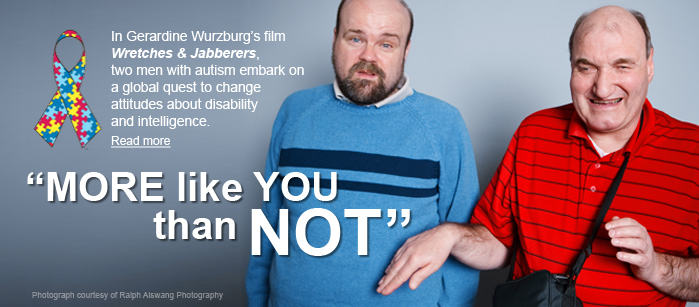
Wretches and Jaberers
There's a moment in the film where Larry expresses how painful it is when people thinks he's stupid because he can't talk. I related so hard to this moment, not because people think I'm stupid. The opposite, I'm normally perceived as being above-average. It took me awhile to figure out what I had in common with Larry in this moment.

Then it occurred to me – the key thread is being misunderstood.

I know myself really well. I know my capabilities and feelings and outlooks. Yet often NTs think they know these better than me. They make assumptions about my motives, and then they argue with me, trying to convince me their outside perceptions are more real than my own experience.

All autists are deeply misunderstood. NTs often think we're stupid, or out of control, or crazy, or drama, or unfeeling, or unempathetic, or dangerous. They think we're emotionally unintelligent. We are painted in broad strokes with wide brushes that assume intentions and ascribe meanings which aren't true.

It's even harder, for those of us who are skilled in the use of language, when what normally works for us suddenly stops working. We sometimes can't find words, or the words we use are suddenly incomprehensible to NTs because of their assumptions or because autistic thought patterns are so different and difficult to communicate across the divide. Other skills, like sensory processing or executive function and abruptly fail, and we blow through expectations set by past behavior.

For this and many other reasons, I've known instinctively, since I was a small child, that I could expect to be misunderstood on a regular basis.

To see Elsa fleeing her own kingdom really struck a chord. She tried so hard to be like everyone else and to avoid hurting anyone, and yet she still failed and had her motives misascribed. This is something many autists can relate to.

The misunderstanding is even more acute because Elsa looks normal. Her "disability" (diversability) is invisible, so when it suddenly appears, it is all the more shocking and horrible and more difficult to understand. Aspie behavior is much the same. Because no one can see a reason for strange behavior, NTs can hurtfully ascribe motives that make sense to them, but not to us.

"You just need to try harder..."
Helpful advice, but only a little
It's easy to see why someone in a wheelchair isn't running in a marathon, but when a well-dressed, intelligent, and verbal aspie with sensory processing disfunction fails to reciprocate a friendly greeting, it must be out of rudeness or meanness or a lack of empathy, not out of severe social anxiety, or an inability to assemble the words into meaning, or the inability to instinctively understand what the appropriate response is.

Likewise, when Elsa's power first escapes in public, she is accused of being a sorceress, a monster. The people are not only afraid of her, some of them hate her and want her dead.

This reflects the quick switch of being admired by everyone, then abruptly alienating them, and not knowing why. That's the life of an aspie who passes as neurotypical, builds up expectations, then shocks everyone when we reach a limit and breakdown, or fail at some seemingly simple task (like shaking someone's hand). People don't realize the capricious nature of Aspergers, that sometimes those little things are impossible for us, even if it was possible just a minute ago.

Just like it became impossible for Elsa to contain her powers.

Though Elsa is a secondary character, she upstages Anna, the protagonist, who may also be a relatable character for aspie viewers. She is clumsy, socially awkward, blunt, practical, lonely, and unorthodox. She also expresses an impulsiveness and devil-may-care attitude which is not only endearing, but common to the Asperger's experience.

I related very strongly to Anna's confusion and pain when Elsa shuts her out the way my sister did me. Elsa's reasons for the rejection seemed to be good, but it caused more harm than it prevented. As in their case, my own relationship with my sister seems to be improving the more time we spend talking to one another, not less.
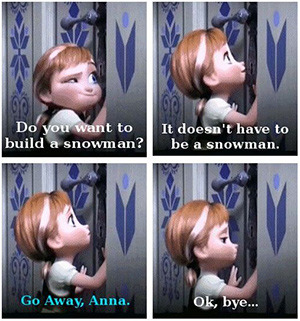

My sister's reasons for shutting me out are rooted partially in long-running misunderstandings about my behavior vs. her interpretation of my behavior. Once I told her I am as aspie, she could understand me more. (No everyone reacts this way, however. I have heard that revealing an Asperger's diagnosis sometimes causes increased misunderstanding in families.)

My sister's reasons are also partially rooted in religion, which leads me to the last mirror that Frozen held up to my life.

When I chose to leave the religion of my birth, I felt a mix of conflicting emotions. I still do. On the one hand, I can celebrate my freedom from expectations and rules which never quite fit me, as Elsa does. There is much joy to be had in that. My new beliefs and new way of living is very me. I've lived this way for thirteen years, and the more time that passes, the more I know this path is totally right for me, and I won't let anyone take it from me.

Yet like all good stories, there are tradeoffs and conflicts. This isn't a Mary Sue story, and the price I paid is steep. I left most of my family behind. I left my cultural homeland behind. I could no longer fit in there, so I exited. By isolating myself from them (and that isolation is a two-way street), they can no longer hurt me, and likewise, I no longer hurt them by being myself in their presence. But my leaving had unknowable destructive effects back home. My family misses me, and though their desire for me to fit their mold is unrealistic, it is also real.

Though we now live in very different worlds, we are still family. This story arc has not ended for me yet. I'm still the Elsa dancing in her ice palace, singing "Let It Go", trying to forget the people I left behind, trying hard to pretend they're better off without me as I am better off without them.

Our issues seem insurmountable, but maybe they aren't. The trolls sing a song about fixer-uppers which is about marriage and romance, but it also addresses blood-family. "Everyone’s a bit of a fixer-upper, that’s what it’s all about! Father! Sister! Brother! We need each other to raise us up and round us out." 

Getting to the point of acceptance is the hardest part. Unconditional love isn't loving in spite of differences; it's loving because of the differences. Unconditional love has no room inside it for wishing the other person were different. We can wish they'd treat us better, and set boundaries towards that end, but when we want them to act a certain way so we can pretend they are a fantasy version of themselves? That is very selfish indeed. That's alot of strings attached, enough to turn our loved-one into a puppet.
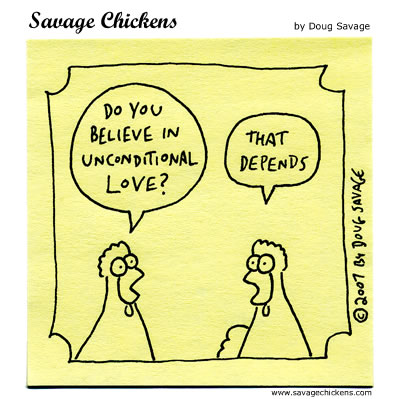
I love you...
I just don't approve of your choice to be a chicken.
The way I choose to live is a very spiritual path for me, uplifting, deep. Like Elsa, I feel ostracized for being who I am. In "Let It Go", when she sings the words, "No right or wrong, no rules for me", it's because those rules don't fit her the same way fit the others. She's decided "the perfect girl is gone" because she has a new standard of perfection all her own. This feeling is reflected in the lyrics of the radio version by Demi Lovato, "Up here in the cold thin air I finally can breathe; I know I left a life behind but I'm too relieved to grieve".

Having gone through that, it really is a weight thrown off. 

It's sad that by creating her own standard and cutting those strings, Elsa has to isolate herself: "Standing frozen in the life I've chosen, you won't find me, the past is so behind me, buried in the snow."

Elsa does eventually find acceptance among her people, but the movie fails to explain how this happens. The implication is that it magically happens once she comes to accept herself. In real life, it's kind of that simple, but not really. The reality is that some people will accept you. Others will reject you even more. Still others will reject you at first, and then slowly decide that love is more important–and more effective–than trying to form everyone else into a standard of false perfection.

In my case, whether talking about autism or religion, self-acceptance is my priority. If I have to reject myself to be accepted by others, their love isn't worth it. I would rather live my life in the best way I know how, and let them come around to me, if they want. In many ways, this is my "kingdom of ice-olation", but it's a price I am willing to pay.

Labels: , , , , , , , , , , , , , , , , , , ,

Wednesday, March 20, 2013

Build a Bigger Berry

You're in a restaurant supply grocery store, the kind with walk-in freezers and where you can buy 5 lb boxes of strawberries. The produce refrigerator, in which you're standing, smells like old broccoli. As you lift the box of strawberries to place on the cart, the lid pops open, and the biggest strawberry you've ever beheld falls to the gray concrete floor.

What do you do?

* Actual Size. Not part of this complete breakfast.
or, "It's dangerous to go alone. Take this!"

Nothing could be less interesting than a strawberry falling on the floor. Or so it seems. Yet the circumstances  for this event can shape important elements of story: the stakes, character development, plot, worldbuilding, and theme. The first three are essential, but if a writer does her job right, a minor strawberry-fumble scene should convey all five.

Stakes & Tension


This true story (which actually happened to me) only became interesting because of two factors:

1) A strawberry the size of my fist,
2) a floor of the sort my mother taught me never to even walk on without washing my feet afterwards.

The stakes were raised. Not a small berry, a big one. Not a clean floor, a nasty one.

Circumstances had set up a dichotomy for me. A difficult choice. I became fascinated with how I would meet this challenge. In order for your plot to be interesting, your choices must be interesting.

To increase stakes, you can tweak the circumstances. Is the strawberry large or small? Ripe or rotten? Is the character is starving? Was she commanded by the king to find the largest strawberry ever, on penalty of death? (The king will never know it hit the floor... right?)

Character Development

"I'm going to give you the choice I never had."
 Lestat, Interview with a Vampire
Choice defines character. Once you've given them a quirky laugh and a lopsided hat (characteristics), ultimately, your character is made by the choices they make.

If your character picks up the berry with a look of wonder, it tells us she is mesmerized by large berries.

If it's a normal berry and she picks it up, maybe she is a spendthrift and can't let anything go to waste. Or maybe she doesn't care about cleanliness.

If she leaves it on the ground where someone else can step on it and make a mess or even get hurt, maybe she's thoughtless or reckless.

If she puts the strawberry back in the box and places it on the shelf so she can buy a different box, we have all kinds of subtle, and potentially negative, indicators about her personality.

The results of one decision will still leave motives and personality vague, so a series of choices across scenes can compound to paint the broader picture.

Plot


A series of decisions constitutes plot. Events can occur randomly or coincidentally, but preferably, the result of the first choice should have consequences to start your plot-chain, each event a result of a previous decision.

Or better, events can be created by choices made by your other characters. Your characters should all have independent and preferably opposing desires. As they attempt to achieve their goals, they work against one another. That's how the plot thickens.

What if she picks up the strawberry, takes it home, and all is well until her child eats it without washing, and gets e. coli?

Or she leaves it in the fridge for three weeks and the whole box spoils, and that starts an argument with her partner?

What if she puts it back on the shelf and someone she admires spots her irresponsible behavior?

What if she leaves it on the ground and someone is injured by slipping on it?

What if she simply cannot stop thinking about the strawberry, and it turns into a blog post?

This is why readers read. This is what constitutes story.

Worldbuilding


Other details about each experience can show elements of your world without an info dump. In my example, the strawberry fell in a normal grocery store in the ordinary world. Or did it? ...

Show the rules of the magic or tech or culture through the decision and its consequences.

Maybe it's a magic strawberry and the character shrinks and has to live on it under the produce shelf where it's rolled until it gets all moldy and is carried off by a rat.

Maybe the character has a curse that she must eat every strawberry she sees, and a second geas binding her to never eat anything that touches the ground. Talk about raising the stakes.

Maybe it's a genetically engineered strawberry that kills germs. Maybe the floor is kept clean by robots. Maybe her species doesn't even need food and it's just a plastic strawberry.

You can give hints as to the behavior of your world through simple scenes like this. Just remember to keep the stakes and tension high by not eliminating all strawberry-floor problems with advanced technology.)

Theme


Why write a strawberry falling into the floor and not a beer spilling in a bar, or a dagger being pressed into the chest of an enemy, or a horse running away?

The props, events, and choices in the scene can reverberate and reinforce, either consciously or subconsciously, a larger, overarching feeling or meaning. Berries can represent many things: life, growth, food, color, freshness, waste, rot, fertility, goodness, sweetness, health, youth, agriculture, consumerism.

A scene with a strawberry, then a horse, then a memory about grandma's farm may conjure a theme of farming, youth, or health. Or all three.

A scene with a strawberry, then a rose, and then a wild sexy romp with a stranger shifts the theme to passion, hedonism, sensuality.

If you want to go with consumerism and decay, have another scene with an overflowing garbage can and a pile of unwanted Christmas presents.

Theme is how we make a story more than entertaining. It gives the story meaning.

Conclusion


If you've written a scene that's fallen flat, maybe you just need to tweak a few subtle elements to raise the stakes, to make the choice hard, to reveal elements of character, to build your world, and reinforce themes.

Just build a bigger berry.

Labels: , , , , , , , ,

Tuesday, September 25, 2012

Shelving Emerald City Hunter, Starting Novellas

Indie writing is a great experiment. The old formulas are being remixed in new electronic test tubes. The new media and models of distribution via ebook are changing reader habits, which are changing the industry.

As a new writer, I have taken lots of risks. My horror novella, Make Willing the Prey became the prequel to my urban fantasy novel, Emerald City Dreamer. This is the sort of shenanigan that is simply not done in the publishing world, and there are good reasons for that. I was aware of the risks when I made that choice. Hey, I've got a long life. Might as well waste it in style.

According to tradition, the next step is to write a trilogy or series matching the pace and format of Emerald City Dreamer. And that was my plan, the plan I've spent the last few months (okay, year) following. I have a draft of Dreams by Streetlight Book 2, Emerald City Hunter, and have invested many, many hours in editing it.

Plans change.

Emerald City Hunter, as written, takes place eighteen months after Emerald City Dreamer. A lot has happened in that time, and the characters begin ECH after huge changes. Changes I haven't written about. Changes I gloss over and sum up. As with ECD, it follows four point-of-view characters with a complex interweaving plots.

Frankly, it tries to do too much.

Too many stories in my Dreams by Streetlight world demand to be told, and sometimes I try to tell them all in a single project. Emerald City Hunter can't tell all of them.

This is a difficult decision, because it is a huge risk. Writing and publishing is a slow occupation, and I will not see the results of my decisions for years to come. Yet here it is: I will pause Emerald City Hunter. Instead, I will write a few novellas that take place during that eighteen month gap. They will be single-POV with simple plots told across 10-15 scenes.

There will probably be three novellas.

The first will be an adventure plot, featuring Sandy, doing what she does best: Fighting the fae. She will have a single antagonist, and will work closely with her friends and allies to that end. She will also begin her healing process. My working title is, Emerald City Iron.

Jett may need a novella all to herself, since she has grand designs that need to be begun properly. And the third will be another monster hunting story, either from Jina or Sandy's POV.

Novellas are an order of magnitude simpler, which I hope will speed up the release cycle, and let me do tiny projects (like short stories) in between. It also gives me space to really focus on the characters that you've come to love, rather than speeding past them like I tend to do in the fast-paced novels. I can cover a few of the background story elements I tried to cram into Emerald City Hunter, to make room for everything else.

Most importantly, I think this may bring back some of the "fun" to my writing process. Sandy needs a couple of monster-hunting romps, don't you think?

Labels: , , , , , , , , , , , , ,

Monday, July 9, 2012

Savages: Box Office Representation of a Poly Triad

Rarely does a movie come along that represents polyamory in any way, much less a summer blockbuster.  Butch Cassidy and the Sundance Kid had hints -- while not expressly stating that Butch and Sundance were both in a relationship with Etta, the montage scene left me with that feeling.

The movie obviously left some directors with the same feeling.  It seems like most poly triads on screen have a Butch Cassidy flavor.  From our very small sampling of only two films, we always see two bonded males, who happen to be lovable criminals, in an equal "V" relationship with one girl.  Bandits from 2001 is about two bank robbers who [Spoiler!!] both end up loving the same unhappy housewife -- without the jealous love triangle where she must choose between them.

And this year, we have Oliver Stone's crime thriller, Savages, which begins with a V relationship between O and her two pot-growing criminal lovers, Ben and Chon.  As we know from the trailer, two men love the same woman.  The poly relationship itself is not part of the plot conflict.  We are not meant to question their love for one another.  We are not meant to feel tension between them.  We are meant to accept that these two men love O, and that she loves them back in equal measure.

The relationship is displayed expertly.  Blake Lively, who plays O, did remarkable acting, showing what it is like to belong to two lovers, almost as if she's lived the life.  I have experienced what she portrayed.  The subtle way you consciously try to spread attention evenly when both are in the room; to divide touches and glances and smiles.  Enjoying the different energies between both people.

One lover, Chon, is strong, emotionally closed-off, a war hero, a tough guy, a protector.  The other is a brilliant botanist, a lover, a tender and spiritual man who travels the world to help people.  Together, as O says, they make one complete man.  To paraphrase her, they fill different needs in her life, one just as important as the other.  O has quite a number of lines reflecting on what it is like to love two men, and it is this kind of love poetry that I, as a poly person, enjoyed finally seeing represented on screen.

Both men are equally needed to rescue her when she is abducted by a competing drug cartel.  Their talents -- those of the Gun and the Brain -- work in tandem, whereas alone, each would be helpless.

Nothing proves a vacuum more than when that vacuum is suddenly filled in with something.  In this case, it was the feeling of sitting in the theater watching a representation of my relationship unfold.  Savages is the first mainstream film to display a fully-realized poly triad.  I wanted to compare it to Bound, a 1996 crime thriller featuring two lesbians, but that was more of a niche film, not exposed to the masses. It is more like polyamory's Brokeback Mountain, though Savages is not a romance... Brokeback brought a gay relationship into mainstream film, which helped straight audiences become more comfortable with the idea that men could love one another, too.  It allowed viewers to sympathize with gay men, even though they were not gay themselves.  Savages does the same for polyamory.  Two men can love one woman (or in my case, one woman can love a man and a woman), and anyone who has seen Savages will not find that notion so strange anymore.

Nevertheless, some critics are incredulous.  Joshua Rothkopf of Timeout New York says sharing a woman is "unrealistic".  Jesse Cataldo of Slant Magazine says the relationship is uncompelling, though that may be a reference to the acting or writing, not the situation itself.

Rene Rodriguez of the Miami Herald has the worst to say:
Those early scenes also introduce one of Savages’ more preposterous conceits: The lovely, bird-brained Ophelia (Blake Lively), who prefers to go by “O” and lives in carnal communion with the two guys, letting them take turns with her in the sack, and sometimes just sharing her bed with both of them at the same time. Even for an Oliver Stone movie, the scenario is an awful lot to swallow. What kind of woman would ever agree to this? What two heterosexual men, no matter how close, would be comfortable with this arrangement? But you go with it, at least initially, because the entire plot hinges on their harmonious three-way union, a bromance with a woman thrown in for sexual release.
I'm that kind of woman, thank you very much.  And I take umbrage that O is only thrown in for sexual release.  Can't women make our own choices without it being about pleasing men?

As a thriller, it's entertaining.  It certainly isn't Lock, Stock, and Two Smoking Barrels (my favorite crime movie), but it definitely holds its own.  It was well-acted by most players.

O's character suffered from some poor character development that I blame the writers for.  I found myself sympathizing with her vicariously but not directly.  I sympathized for her because I sympathized with her lovers.  I would have liked to have cared more about O, which could have easily been done by giving her some individual hopes and dreams, or let her make a couple of choices to define her character.

The story held together and drew me in.  These days I'm analyzing every movie for story elements, and Savages did a great job of all the technical aspects, like foreshadowing, dialog, exposition, backstory, and character development (with the exception of O).

Certain moments were exceptionally violent and gory.  Nothing worse than what you'd expect for this genre, especially if you've seen anything by Quentin Tarantino.

If you like crime movies, see this film.  If you're poly, see this film.  If you're monogamous, but want to see a realistic portrayal of a committed poly triad, see this film.

Labels: , , , ,

Friday, June 15, 2012

Scarcity Mentality vs. The Abundance of Ideas

Writers get asked all the time, "Where do you get your ideas?"

To most active writers, ideas are easy. They flow faster than we have time to write them. Anyone can get ideas. 

Some people seem to have a zero-sum notion of ideas, that there is a set number, and once those run out, they're all gone. This leads to lots of idea-stifling behaviors. It is a notion that proves itself. Imagine if we had a scarcity notion about muscles, that each of us has a top limit on the number of motions we can make, or pounds we can lift. We'd all sit around because we think it's healthy; meanwhile our muscles atrophy, and sure enough, after walking a few paces, we'd collapse, having "run out" of muscles.

Ridiculous, yet it is something most people believe about a muscle we call the "brain".

Like any other muscle, the Ideaceps Major gets stronger the more you flex it. The brain only likes to do work that it thinks you find useful. All ideas need are a little attention, a little appreciation. Don't judge your ideas, don't stuff them away. Just jot them down, or reflect on them for a moment and thank them for being so brilliant. Your brain will kicks in and give you more. It's that simple.

Let's look at some idea-stifling behaviors that come from zero-sum thinking:

The Unworthy

Some think good ideas only come to those magically blessed to receive them. They believe themselves unworthy for inspiration. When an idea pops into An Unworthy's head, she thinks, What a stupid idea! After such abuse, her brain naturally assumes that thinking of ideas is a useless skill, so it resorts to thinking up ideas rarely, and only on accident.

The Hoarder

Hoarders get ideas that they think are good. In fact, they think they're such good ideas, they grow paranoid, afraid someone will steal them. So they keep them secret.

This comes from the mistaken belief that ideas are unique. Once an idea is given to one person, it is reserved forever, as if the idea gets patented right then and there, restricted from anyone else's use. No one else could possibly think of such a good idea simultaneously.

I used to be a hoarder. I've had dozens of million-dollar ideas I kept to myself. A year or two later I would see my product idea on the store shelf, or my story idea in someone else's book. eCigs? Yeah, I thought of those. I didn't know a thing about atomizers, but I imagined a delivery system of flavored nicotine that looked cool without the smoke, that would come in all colors. I even thought of the LED to simulate the ember.

Ideas are out there for the picking. Just because I think something up doesn't mean it's mine. Someone else will think of it, too.

The Perfectionist

Some hoarders keep their ideas in reserve for "someday". I'm not talking about those who have so many ideas they have to pick and choose which ones to work on – I'm talking about people who have one or two great ideas, but wait for the day when they can get it perfect. The idea gets put away, never to be seen again.

This also stems from the zero-sum notion. This is my one perfect idea. This is my Ringworld or Snowcrash or Foundation, and it will make me rich and famous.

An idea is just a small piece of the craft. There's prose, pacing, setting, characters, plot, editing, grammar, and voice. When the idea is so perfect, the other ingredients may feel unworthy. It is tempting to put a good idea on the shelf until the perfect time, when the stars align.

Sometimes as I write, I am tempted to reject an idea for a character, or setting, or twist that otherwise fits. Why? Because it seems too perfect, to "big" for the story at hand. I may be tempted to save that idea for later. Oh, I think, That twist is far too cool to throw away on a simple scene in this novel. I should save it for a story all of its own!

But I know better. I fight this temptation. If this story inspired that idea, it belongs here. That idea has some magic to it, some energy. If I set it on the backburner for the day when I can supposedly do it justice, it will grow stale, and possibly die completely. My current project will want for lack of that energy.

Abundance

Trust. Trust that ideas will always be available. Those ideas are here for me today, and new ideas will be there for me tomorrow. As I reward my brain by giving its ideas life, so it will reward me.

There is no upper limit on the number of ideas I will have in my lifetime. Time is the real limitation, an actual zero-sum. I flex my Ideaceps Major all the time and my brain has given me notebooks full of seeds. There is no end to material I can work on, as long as I keep working. That's the hard part. That's the limited resource. Time and work.

Ideas don't make success. Success comes from the implementation and marketing of those ideas. That is much more difficult. There's a reason why eCig-makers in China are raking in the dough for my idea. Let them. I don't care. Lots of people think up the same ideas at the same time, and he who acts on it wins. That guy in China put in all the work, and I can buy an eCig and puff away. I get to use their inventions or read their stories and not have to invent or write it myself.

I've got plenty of other ideas I can act on.

Labels: , , , , , ,

Thursday, October 20, 2011

Why Crazy Wins

These days there's a lot of crazy.  In all debates in the courts of public ideas, be they political, spiritual, moral, or cultural, the ideas most in the fringe seem to dominate.

In preparation for NaNoWriMo, I've been reading a lot about plot and story.  20 Master Plots and How To Build Them is an excellent resource, (as is Story by Robert McKee).  Every plot must focus on drama, on the tension of an unresolved problem, an unreasonable antagonist, a goal worth dying for, overwhelming passions, major strengths, massive weaknesses.  Unmovable objects vs irresistible forces.

Writers are encouraged to bring the tension to a tipping point; to make it seem like there is no way out, to stack the odds to the point where your protagonist is sure to lose (even if she wins in the end).

No matter the plot, there must be drama, or your reader will yawn and put the book down.

Frustrating conflict is great for stories.  But it's not so great for real life.  In real life, be it personal or political, drama leads to sadness, tears, hardships, and destruction.  On the grander scale, it can lead to lost jobs, hunger, crime, injustice, and even death and war.  In real life, it reaches a point where it is no longer entertainment, though it may seem so to viewers who watch it from afar.

All plots can be placed in two categories: Physical or mental, force or fraud, tragedy or comedy, outward action or inward movement.  Whatever you call it, all plots emphasize one of these, while the other takes a backseat or doesn't exist at all.  The action story will focus on physical resolution to tension.  The murder mystery or romantic comedy will solve it via the mind or character development.

Back to real life.  In the past, power was often won by force.  There was no such thing as the Bill of Rights to protect people, so whoever could suppress the people at the point of the sword, or who ever could kill the king, won the day.  Force is still very much a powerful tool, but in stable democratic nations, it is likely to backfire.  And so today those who seek power must resort to mental strategies.

Persuasion is much more humane than war and unjust imprisonment, and a well-argued appeal to reason is more likely to be the best position than a well-warred one.  But it comes at a price: Fraud is as or more likely to persuade.  And the masters of fraud are oh-so-good at it.

Today, wars are fought in culture rather than on the battlefield.  Even the decision whether or not to go to battle must be fought in the cultural sphere before we send out the first soldier.  That is why people were so upset when Bush lied about the WMDs in Iraq.  Few US Citizens wanted to go to war without a very good reason, and when that reason turned into smoke, people felt oppressed and betrayed.  But even this is far better than our alternative, when a leader had only to give the word to start a war.  The opinion of the common people didn't matter.

Fiction must have tension to keep our attention, and so, unfortunately, must the news.  Decades ago, political thinkers like William F. Buckley argued their points rationally, and it's a political temperament I'd love to return to.  Imagine, a world where two people of opposing opinions could sit down on national television and have a well-reasoned debate, where the drama from both sides was a question of who could out-wit the other, who could appear the most intelligent, who could back up their claims with the best facts, who could persuade.  Why have things changed so much?

Because William F. Buckley was boring.  Walter Cronkite and Paul Harvey droned.  It took too long to get to the bottom of things, to hear the rest of the story, to understand the issues, when you had to pay attention to rational arguments backed by facts.  It's easier to believe that a woman frivolously spilled coffee on herself and got McDonald's to pay an outrageous and undeserved sum, than it is to examine the real facts of the event.

Soundbites, for all their lack of actual content, are interesting.  Dramatic.  When a politician says something stupid, opponents get to rally their anger.  Those who support the same politician can rally their own anger to defend the remarks.  Everyone can get emotional, and it's better than watching Iron Man 2 or Avatar.

This pattern continues no matter what level of culture-war you look at, be it at the top rung during Presidential debates, or at the bottom where bloggers go back and forth.  And it happens even in non-political realms, like when Gawker blogger Alyssa Bereznak railed on Magic: The Gathering Champion Jon Finkel for going on a date with her.

There are people out there, right now, who sound more like William F. Buckley.  They lay out all the facts and make reasoned arguments.  Yet these don't draw the same attention as the crazies.  Because controversy attracts eyeballs and mouse-clicks.  Walls of text don't.

But that's not to say crazy actually wins in the end.  In the war of ideas, every strategy has its pros and cons.  Fringe emotional arguments of high drama are, in the end, weak.  They do not tend to stand the test of time.  And the most crazy people often believe their delusions, which makes them inflexible.  They are unable to adapt to changing times and movements, and those who blind themselves to facts and reason may not notice when those they hope to convince begin to run the opposite direction.

Crazy may still get the most airtime and rake in the most cash, but in a stable democracy, its grip on culture and power is (hopefully) short-lived.

Labels: , , , , , ,