Monday, February 24, 2014

Reflected in Ice: An Aspergers Review of Frozen

The following movie review contains mild spoilers. I try to tread lightly, but can't avoid addressing a few in-movie moments or thematic elements.


There are two measures of good art.

The first is anything that can make me feel strongly. The other is that which holds up a mirror to the viewers, in which, each sees herself.

Frozen accomplished both of these goals with resounding success.

Secret Wish - Tami Vaughn
I had this printed on a mousepad I used for years.
Good mirrors are composed of metaphors and character traits and plot in the right combination of vague and specific to reflect a broad range of life situations and personalities. Many types of people see themselves in Frozen: girls who are raised to be perfect, sisters who struggle in their relationships, women who are deceived by those they trust, those who have secrets, neurodiverse people, anyone who is misunderstood, and anyone who is rejected for all the wrong reasons. And like the second trial in The NeverEnding Story, a mirror which reveals the viewers "true self", Frozen's mirror can reflect the ugly parts of some people, like the blogger, "Well-Behaved Mormon Woman", who calls Frozen part of the "gay agenda to normalize homosexuality" and who says it's terrible we're letting kids get the message that rebellion is better than obedience.

Can you hold it down, please?
I'm trying to make history over here.
Whatever, lady. I have an entirely different view when I look at myself in art.


Frozen reflected many visions for me. Most strongly, it portrayed my autism in a very accurate way. It also reflected my relationship with my sister, and my struggles to leave the religious culture of my birth (incidentally, Mormonism), and my struggles relating to my family members who still belong to that culture. I will cover my thoughts on all these points.

Social equality activists argue for more representation of minorities in fiction. There are many good reasons to do this, but for any creator, the biggest reason should be "to make better art". When the same old characters are dancing to the same old plots choreographed with the same old tropes and the same old twists, only the same old segment of society is allowed to see themselves reflected in art. And even that segment is only allowed to get the same messages they always have about themselves. The mirror is cracked and the reflective backing is faded. It ceases to be useful even for the intended audience.

What's fun is a funhouse with only one twisted mirror?


Frozen is the first movie I can remember that explores the relationship between two sisters. I'm sure there are other examples, but they are few and far between. Often, to find them, you have to leave the mainstream film scene, into the art houses and foreign films.

Because of this dearth, Frozen had it easy. Its subject and plot is low hanging fruit. Disney made the only mainstream movie about sisters in recent history, so of course anyone who is a sister and has a sister is going to see herself in it. Finally, someone is showing her herself.

Because women are so rarely represented in movies, outside certain highly limiting tropes, we latch on to anything we're given. And it benefits us all greatly. Frozen allowed my sister and I to have a conversation we were unable to have before, because we lacked any kind of context to have it. Frozen helped her and I understand one another more.

Any filmmaker following in Frozen's footsteps will face a steeper challenge. The next attempt will require a little more thought and nuance in order to be good art and not simply derivative.

This is a good thing. I hope many attempts will be made to best Frozen's "sisters" mirror. And while we're at it, let's take a look at other female-female relationships. Mother-daughter? (Brave got us started there.) Business partners? Partners in crime? Buddies? (More Thelma and Loiuse, please.)

And God forbid.. Perhaps we could see female-female romantic partners? In spite of the success of the big gay agenda, I currently only have one small part of one song that describes what it feels like to be snuggled up with my lovely girlfriend. That ought to give well-behaved blogger up there a real example of homosexuality portrayed in the media.

Anyway, there's plenty more low-hanging-good-art fruit for the picking. Half the movie-viewing audience are women who really want, crave, and need more mirrors.

Now, I'm not implying Frozen's creators were amateurs and that it only succeeded because they entered unexplored territory. They tread some other ground which is extremely well-trod and managed to find a fresh mirror there, too.

The "be your own unique self no matter what people say" theme has been done to death. It's part of American culture, and we love it every single time. Where this theme gets stale is, again, where we endlessly see the same take on it. The underdog nonconformists who win in the end, they all start to blur together after awhile, until we forget that this is the theme of pretty much every single movie, ever. We don't even notice it anymore. The individualist rebel has become the new conformity, the ideal that we all strive for equally, to the point where we shun anyone who fails.

Repeat after me...
For Frozen to pull this old trick out of the bag, dust it off, and make it seem like they were the first to ever think of it, is a pretty tremendous feat. A mirror is pointless if we keep seeing the same image. It's the one that reveals a different side, or that pimple hiding under the chin, is the one that wins the "Good Art" award from me.

The song "Let It Go" is good art for the same reasons. It speaks to these common themes and others, of social rejection, of turning ostracization into chosen isolation, of the damage caused by suppressing feelings, of finding self-acceptance, and of having uncontrollable emotions or an inner power which is misunderstood.

This scene made me cry the first time I saw it. Which leads us to autism.

Others have written about this topic. But I shall write more about it. Because when you meet one person with autism, you've only met that one person with autism, so there's no one definitive autistic perspective.

[Mild spoilers incoming!]

Elsa is born with her power, and she is taught to hate and suppress it. She learns from her well-meaning parents that she is dangerous and likely to hurt others, especially her sister Anna, who she loves. She has to hide away in her locked room, stuff her feelings, and resist using her powers because of these inaccurate beliefs about herself.

Her powers are a double-edged sword. They started as a force for good, which she used to make her sister happy and strengthen their sisterly bonds. But after one mistake, her talent turns into a dark and ugly thing, not because of Elsa herself, but because of how the people around her view it.

Ironically, it isn't her magic that hurts Anna. It's Elsa's self-imposed isolation because she believes herself to be dangerous. All Anna wants is the same love they once shared. The door that separates them wounds more sharply than the ice which was easily healed.

In a perfect case study of unintended consequences, Elsa's suppression of her power is what keeps her from controlling it. It all comes out sideways at the worst time, and she ends up in mutually-agreed upon exile, but with disastrous results for both her and her people. Again, it isn't her powers that are dangerous, it is how she and everyone else is handling them.

Olga Bogdishina's book, "Communication Issues in Autism and Asperger's Syndrome", talks about the ways autists process sensory information differently from neurotypicals (NTs). Among other issues, autists deal with being either hypo- or hyper-sensitive to stimuli. "Their senses seem to be too acute…or not working at all…"

Excellent book.
So read it.
Every autistic individual has a mashup of different conditions under which their senses are either ramped up or remote and blocked off. For some, sounds will always be too loud (auditory hypersensitivity) but they have no idea what they're feeling (alexithymia). For others, they do fine with sound... until they get overstimulated. Then they can hear a pin drop on the other side of the house.

Emotions should be counted among the "five" senses. Emotions are a sense, giving us information about our internal reactions to outside events, and are subject to hypo- or hyper- sensitivity effects. For autists, emotions can be remote and incomprehensible, or very loud like a blaring siren. While I've had periods in my life where I was more hyposensitive to my feelings (my teen years), these days, I tend to be more hypersensitive. I usually know what I'm feeling, and why, and even what I need to do to change those feelings. The downside is that strong emotions are very, very strong. Overwhelmingly so. Uncontrollably so.

And that's where meltdowns come in. 

Add to the complication, I was raised in a passive-aggressive environment, where showing certain emotions was never allowed. I quickly learned that crying would invoke an angry response, or accusations, or that I could hurt the people I loved. I became very good at repressing my tears if anyone else was around. When I became an adult, I had to teach myself to cry. It's a lesson I've never fully learned, and I have lots of triggers and shaky boundaries around that. All stuff I continue to work on.

When I feel cornered and triggered, I can meltdown. My emotions become so overwhelming that they shut down my thinking brain, with symptoms very similar to panic attack. I feel anxiety like fire, in my whole body, even my skin. I can't breathe, I can't think straight, I can't act in the best ways to protect myself. Everything becomes all-or-nothing. I may lash out and say hurtful things.

I'd put something funny here but it isn't really funny.
Cue Elsa. Here she has this double-edged power. She can build magnificent complicated fractal-based buildings using only her mental powers, but when she loses control, she shoots icicles from her hands.

Elsa's big triggers are related to emotions. When her parents die, her room turns frosty. And just like me, she becomes most dangerous during conflicts. She always risks hurting someone when she feels powerful things. And most of all, no one understands her. She's hurting and afraid, but everyone thinks she's a monster.

Her powers are just like my overwhelming emotions. As a child, I dealt with them by never feeling anything. As an adult, I still try to stuff them sometimes, but it totally backfires, especially when it reminds me of being a helpless child and I get triggered.

Power over ice is the best metaphor here. Aspies are often thought of as being emotionally cold, yet like Elsa's power, our emotions are often very active and passionate. Emotional repression is like trying to freeze feelings. And when I get upset, words come more difficult to me, as if my thoughts are freezing up. When the panic sets it, it's hard to breath, like my chest is frozen with fear.

It's not an icebeam, no that's all Jonny Snow!
(And Elsa the Snow Queen)
Anna tries to reason with Elsa, so together they can solve the endless winter problem. I related to Anna here, as well. My solutions are so simple, yet sometimes so hard to convey.

This is when Elsa whirls around in frustration, erecting a defensive ice barrier all around herself. Unknowingly, she hits Ana in the heart with an icy ray.

How often have I whirled about in my own pain and frustration said something that wounded someone I love? The closer to meltdown I am, the worse it is. I'm not trying to hurt anyone, though people accuse me of doing so. I'm as surprised as Elsa is, when she hears Ana's little cry of pain.

The metaphor continues through Anna's reaction. She seems fine for awhile. She knows she's got a problem, but she runs around for awhile and even has a comedic musical number with the trolls, before the ice starts to take over and incapacitates her. That's how painful words work. We stand up and shake them off and move along in life, but if the words were painful enough, they cause traumas that are hidden but still slowly freezing us to death.

Elsa finds her answer, and it's the answer I found. By stuffing her emotions, by trying to deny who she really is, by allowing social shame to consume her, she becomes explosive. It's only when she "lets it go" and accepts who she is in spite of what others tell her, that her talent becomes a controllable force for good. A unique power no one else has.

The message here, for anyone with autism or Aspergers, is to be true to your autistic self. NTs are going to set up alot of incomprehensible social standards for you to follow, but maybe you don't have to. At least not all of them, not all the time. Maybe there are ways around them, or maybe you can just do what you're going to do anyway, without shame. Maybe some of those social standards are lame and need to be questioned and rejected.

Art by FabUUlousGear.
Because you can get this as a mousepad.
By accepting and being open about all facets of your personality, you learn to control your powers. You can avoid those pesky painful meltdowns altogether, and forgive yourself when you can't. You can create your own environment, a palace on a hill, free from overstimulation and ridiculous social rules. And when you get really good at that, maybe you can come down off the hill and be a leader for others.

Or not, and that's okay, too.

One of the emotional elements of Frozen, for me, was Elsa's entire story arc. I had a rotten 2013. I was diagnosed in April. Conflicts between me and Roland were increasing in intensity and frequency. For many reasons, my anxiety continued to increase, until it pained me every single day. I was melting down every couple of weeks, every month at a minimum. I had multiple scary suicidal moments which recurred for months.

My diagnosis was helpful, but it also spun me into turmoil. I had my own self-rejection/self-acceptance narrative arc. I had to learn about my traits, my powers, and my limits, and then learn to articulate them to others.

As I watched Elsa struggle on screen, trying on various options to deal with her power/curse, I watched myself. I felt her pain and confusion. I understood her loneliness. But I also triumphed with her. I danced with her as she sang of how she no longer cared what anyone else thought, she no longer wanted to hide her true self, she would no longer try to be the perfect girl everyone expected her to be.

It's making me tear up as I write about it.

By the end of the year, I'd found my balance, an equilibrium, of how to live with autism and accept myself. The hardest part was learning how to be around others. Living in an ice castle is one thing, but I have family. I learned to set boundaries to keep other people from hurting me, which also resulted in me hurting them less. Like Elsa, I am now able to step out on the stage, confident, knowing I am loved.

That's not to say I won't continue to struggle. Every story arc repeats itself. On screen, it's just a sliver, a slice, of the cyclic life-themes we continue to deal with. Frozen gives us a common language to think about it and discuss it.

The story also reflects isolation, of being around others and yet effectively alone because true communication is impossible. This is the story of autism.

When I first started researching autism, I wondered what non-verbal autists could possibly have in common with me and other aspies. Yet I still had this deeply empathetic response to any non-verbal autist I read about or saw on video.

In the documentary Wretches & Jabberers, two men with classical autism travel the world to meet other autists and advocates. I found myself almost in tears through the whole film. Even though their experience of life is, in so many ways, very different from mine, I felt some common, mysterious tie.
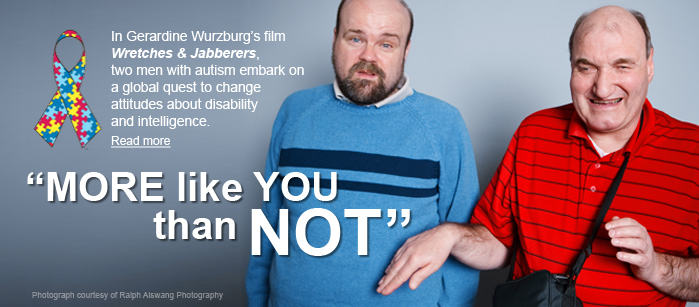
Wretches and Jaberers
There's a moment in the film where Larry expresses how painful it is when people thinks he's stupid because he can't talk. I related so hard to this moment, not because people think I'm stupid. The opposite, I'm normally perceived as being above-average. It took me awhile to figure out what I had in common with Larry in this moment.

Then it occurred to me – the key thread is being misunderstood.

I know myself really well. I know my capabilities and feelings and outlooks. Yet often NTs think they know these better than me. They make assumptions about my motives, and then they argue with me, trying to convince me their outside perceptions are more real than my own experience.

All autists are deeply misunderstood. NTs often think we're stupid, or out of control, or crazy, or drama, or unfeeling, or unempathetic, or dangerous. They think we're emotionally unintelligent. We are painted in broad strokes with wide brushes that assume intentions and ascribe meanings which aren't true.

It's even harder, for those of us who are skilled in the use of language, when what normally works for us suddenly stops working. We sometimes can't find words, or the words we use are suddenly incomprehensible to NTs because of their assumptions or because autistic thought patterns are so different and difficult to communicate across the divide. Other skills, like sensory processing or executive function and abruptly fail, and we blow through expectations set by past behavior.

For this and many other reasons, I've known instinctively, since I was a small child, that I could expect to be misunderstood on a regular basis.

To see Elsa fleeing her own kingdom really struck a chord. She tried so hard to be like everyone else and to avoid hurting anyone, and yet she still failed and had her motives misascribed. This is something many autists can relate to.

The misunderstanding is even more acute because Elsa looks normal. Her "disability" (diversability) is invisible, so when it suddenly appears, it is all the more shocking and horrible and more difficult to understand. Aspie behavior is much the same. Because no one can see a reason for strange behavior, NTs can hurtfully ascribe motives that make sense to them, but not to us.

"You just need to try harder..."
Helpful advice, but only a little
It's easy to see why someone in a wheelchair isn't running in a marathon, but when a well-dressed, intelligent, and verbal aspie with sensory processing disfunction fails to reciprocate a friendly greeting, it must be out of rudeness or meanness or a lack of empathy, not out of severe social anxiety, or an inability to assemble the words into meaning, or the inability to instinctively understand what the appropriate response is.

Likewise, when Elsa's power first escapes in public, she is accused of being a sorceress, a monster. The people are not only afraid of her, some of them hate her and want her dead.

This reflects the quick switch of being admired by everyone, then abruptly alienating them, and not knowing why. That's the life of an aspie who passes as neurotypical, builds up expectations, then shocks everyone when we reach a limit and breakdown, or fail at some seemingly simple task (like shaking someone's hand). People don't realize the capricious nature of Aspergers, that sometimes those little things are impossible for us, even if it was possible just a minute ago.

Just like it became impossible for Elsa to contain her powers.

Though Elsa is a secondary character, she upstages Anna, the protagonist, who may also be a relatable character for aspie viewers. She is clumsy, socially awkward, blunt, practical, lonely, and unorthodox. She also expresses an impulsiveness and devil-may-care attitude which is not only endearing, but common to the Asperger's experience.

I related very strongly to Anna's confusion and pain when Elsa shuts her out the way my sister did me. Elsa's reasons for the rejection seemed to be good, but it caused more harm than it prevented. As in their case, my own relationship with my sister seems to be improving the more time we spend talking to one another, not less.
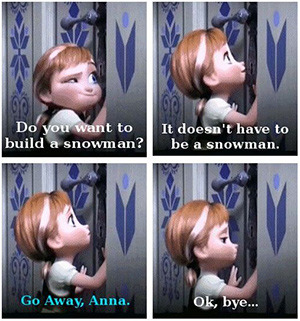

My sister's reasons for shutting me out are rooted partially in long-running misunderstandings about my behavior vs. her interpretation of my behavior. Once I told her I am as aspie, she could understand me more. (No everyone reacts this way, however. I have heard that revealing an Asperger's diagnosis sometimes causes increased misunderstanding in families.)

My sister's reasons are also partially rooted in religion, which leads me to the last mirror that Frozen held up to my life.

When I chose to leave the religion of my birth, I felt a mix of conflicting emotions. I still do. On the one hand, I can celebrate my freedom from expectations and rules which never quite fit me, as Elsa does. There is much joy to be had in that. My new beliefs and new way of living is very me. I've lived this way for thirteen years, and the more time that passes, the more I know this path is totally right for me, and I won't let anyone take it from me.

Yet like all good stories, there are tradeoffs and conflicts. This isn't a Mary Sue story, and the price I paid is steep. I left most of my family behind. I left my cultural homeland behind. I could no longer fit in there, so I exited. By isolating myself from them (and that isolation is a two-way street), they can no longer hurt me, and likewise, I no longer hurt them by being myself in their presence. But my leaving had unknowable destructive effects back home. My family misses me, and though their desire for me to fit their mold is unrealistic, it is also real.

Though we now live in very different worlds, we are still family. This story arc has not ended for me yet. I'm still the Elsa dancing in her ice palace, singing "Let It Go", trying to forget the people I left behind, trying hard to pretend they're better off without me as I am better off without them.

Our issues seem insurmountable, but maybe they aren't. The trolls sing a song about fixer-uppers which is about marriage and romance, but it also addresses blood-family. "Everyone’s a bit of a fixer-upper, that’s what it’s all about! Father! Sister! Brother! We need each other to raise us up and round us out." 

Getting to the point of acceptance is the hardest part. Unconditional love isn't loving in spite of differences; it's loving because of the differences. Unconditional love has no room inside it for wishing the other person were different. We can wish they'd treat us better, and set boundaries towards that end, but when we want them to act a certain way so we can pretend they are a fantasy version of themselves? That is very selfish indeed. That's alot of strings attached, enough to turn our loved-one into a puppet.
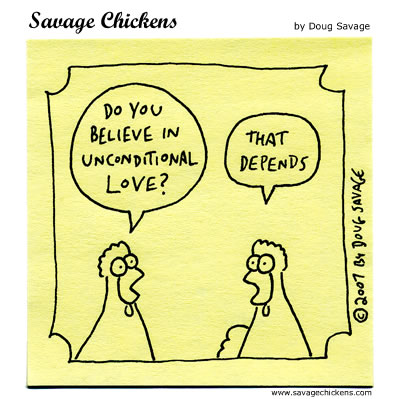
I love you...
I just don't approve of your choice to be a chicken.
The way I choose to live is a very spiritual path for me, uplifting, deep. Like Elsa, I feel ostracized for being who I am. In "Let It Go", when she sings the words, "No right or wrong, no rules for me", it's because those rules don't fit her the same way fit the others. She's decided "the perfect girl is gone" because she has a new standard of perfection all her own. This feeling is reflected in the lyrics of the radio version by Demi Lovato, "Up here in the cold thin air I finally can breathe; I know I left a life behind but I'm too relieved to grieve".

Having gone through that, it really is a weight thrown off. 

It's sad that by creating her own standard and cutting those strings, Elsa has to isolate herself: "Standing frozen in the life I've chosen, you won't find me, the past is so behind me, buried in the snow."

Elsa does eventually find acceptance among her people, but the movie fails to explain how this happens. The implication is that it magically happens once she comes to accept herself. In real life, it's kind of that simple, but not really. The reality is that some people will accept you. Others will reject you even more. Still others will reject you at first, and then slowly decide that love is more important–and more effective–than trying to form everyone else into a standard of false perfection.

In my case, whether talking about autism or religion, self-acceptance is my priority. If I have to reject myself to be accepted by others, their love isn't worth it. I would rather live my life in the best way I know how, and let them come around to me, if they want. In many ways, this is my "kingdom of ice-olation", but it's a price I am willing to pay.

Labels: , , , , , , , , , , , , , , , , , , ,

Sunday, December 25, 2011

Peace on Earth, Good Will To Men

I've had a lot of mixed feelings about Christmas over the years.  As a kid, I felt alternately excited and guilty.  Excited: obvious.  Guilty because my parents went overboard when buying me gifts, and I never seemed to have enough money to buy them anything they really wanted, and I was bad at buying gifts anyway.

When I was a teen, the excitement gave way to guilt and fear.  Fear that I wouldn't be excited enough or grateful enough or happy enough that I'd forget to buy gifts, which I usually did.  I secretly hid a lot of depression and social anxiety as a teen, and Christmas really brought that out.  At holiday family gatherings I was often at the brunt of most of the teasing.  There were peaceful and loving moments during this time as well, but I tend to forget those since pain is much louder than joy.

In my early twenties, as a single mom, I had a couple of really great Christmases.  I was on my own, in my own place, making my own choices.  I found a lot of spirituality and peace during this time.  I was still Mormon, and my boy really small.  Everything was very magical at this time in my life, and somehow I tapped into the "True Meaning of Christmas".  I remember listening to a lot of music, like Mannheim Steamroller and a Mormon production called The Forgotten Carols (both of which I would still recommend to this day).  A Fresh Aire Christmas had a lot of choir music that is really beautiful, like Veni Veni, Emmanuel.

When I lost religion, I became very cynical around Christmas.  Its blatant commercialism became clear to me, which rang chimes with my feelings of guilt and fear as a child.  I had mixed feelings about the idea that only a baby god child could bring peace to the earth... a peace which never seemed to come, in spite of the promises of angels on high.

My son had to suffer this attitude from me through most of his childhood.  I also saw Christmas as a burden: just one more thing to do in my busy life and more money that had to be spent when money was tight.  I still hate putting up Christmas decorations, and have left this task to him.

This year, I've had a recurring theme to my Christmas season, one I've chosen to embrace.  Peace.  One simple word with so many meanings.  Over the month, a refrain has gone through my mind: "Peace on earth good will to men" sung to the melody written by Handel.  Of all the messages one can get from the Bible, this is one we should embrace.

Yet this is not the central theme of American Christian culture.  Even though Christianity has permeated nearly everything we do, even those of us who are agnostic and atheist, we somehow cannot shake our desire for violence.  Strength is to be admired.  Gentleness is to be laughed at.  Stars and hearts and puppies are for "little girls" and people who play or fight poorly are like little girls. (Didn't Jesus say we should be like little children?)  Hippies are flippy-wristed weaklings who are just waiting to be victimized.  Pacifists and vegans are to be mocked.  Anyone who wishes to conserve the dwindling resources of this planet are idiots who just want to take away everyone's toys.  Those who raise protesting voices against third-world slavery are ignorant, and this is how it must be.

There's this fear that if we give peace an inch, it might take over, and we might end up loving people we'd really rather not love.

I know these feelings because I struggle with them myself.  I feel cognitive dissonance, because culture has programmed me to think these things.  To feel these things.

But why?  What's so wrong with peace?  Is it a lofty ideal?  Yes.  Is it unrealistic?  Maybe.  But why does it need to be vilified?  Why should adherents to peace be mocked?  What is so dangerous about a message of peace that it must be marginalized?

There isn't a major religion on earth that doesn't at least pay lip service to the concept of peace.  Any religion that can't claim to be peaceful is rejected by a majority of potential converts (even if those converts are being converted at the point of a sword).  Yet the prevailing meme, in the form of ideas and feelings, is toughness, strength, bullying, and war.  Concepts of compromise and diplomacy are "weak" and "fluffy" and "unrealistic".  But maybe these ideas are unrealistic because any who are espouse them are ridiculed.

In our readiness to "speak softly and carry a big stick", we forget the speak softly part.  Should we as individuals and a society be ready to defend ourselves?  Absolutely.  But instead of being a last resort, it tends to be the first.  If our culture embraced peace as much as we claim we do, if we really sought peace, we would have more of it.  We would challenge our leaders for every war they wished to fight.  We would make them offer the same level of proof we require of prosecutors in a court of law.  They would be required to prove, beyond a shadow of a doubt, that the war is absolutely necessary to defend our country.

Maybe instead of sending men off to die, we might have to go without a few resources.  Some prices might go up.  What price of oil or cheap goods is high enough that it pays for the lives of soldiers who may come back alive and unmaimed, but who will be scarred forever?  If we go to war, it should be for one reason: That another country has initiated force against us, or our military allies, first.

This season, I have looked within, and seen the side of me that rejects peace.  I have faced it, and found that in spite of its power, it is still silly.  Peace is more rational than violence.  Peace is smarter than war.  It is not touchy-feely to believe in peace: it is logical.

May we all have gentle hearts in this coming year.  God has been unable to bring us peace, so let's bring it to ourselves.

I have compiled a list of Christmas songs about peace, which I will link in the next post.  Merry Christmas to all, and to all a good night.

Labels: , , , ,

Thursday, November 17, 2011

I Am the Crazy Uncle

The bond that links your true family is not one of blood, but of respect and joy in each other's life. Rarely do members of one family grow up under the same roof. - Richard Bach

I feel like I have become the Crazy Uncle of my family.

The timing is about right. My Crazy Uncle passed away about seven years ago, around the time I moved to Seattle, and about that time it was starting to be clear to most of my family that I wasn't Mormon anymore, and wasn't ever going to be again. My strange family has always tended toward estrangement. We were always too busy with our own activities, or caught taking sides in a who-hurt-whose-feelings war. But after that, whatever distance was already there just grew and grew.

My Crazy Uncle was weird because he took myth too far, with his conspiracy theories and demons and conspiracy theories about demons. He would call my mom every few months to talk her into buying gold or silver, or to invest in garnet mines or whatever scheme he'd gotten into his head. Because the economy was about to collapse, any minute, he'd say. Edgar Casey was right, he'd say. Mt. Rainier is going to blow up so you guys need to move to where it's safer, in Ohio. He'd had a vision, he'd say, and plead with my mom to take this action or that.

And now and then, she'd even be convinced by him, just a little. I remember the time we bought silver at $4.25 an ounce, and waited for it to shoot up in price like he said it would. We waited for the world to end so it would be worth something. But there it stayed at $4.25 an ounce for years.

I grew up in a system of thought that was waiting for the world to end anyway,
and that was all right, as long as it was in the context of scripture, and you didn't go around selling your house or making any other rash decisions. You were supposed to wait for the Prophet to tell you to make a rash decision. We waited for the call to leave our house and move to Missouri. And we always had one year of food storage… two if when we were extra-righteous. That was within the realm of sanity, but my Uncle took it a step too far, and thus he was the Crazy Uncle.

I am weird because I take reason too far. I don't believe in demons at all (although they are possible). I don't believe in God at all, or scripture. My minimum level of proof is set pretty high. I'm willing to believe a few supernatural things now and then, if they actually happen to me, but those are my special moments in life, and I take my own meaning from them. I share those experiences only rarely, and don't expect anyone else to believe me, and I only take them half-seriously at best. My Crazy Uncle and I are quite a bit different.

And yet I felt a kinship with him when he died. He lived 3000 miles away. I rarely talked to him over my lifetime, and frankly, I was scared of him. As he lay dying of cancer and my mom drove to visit him, I wondered if I was wrong to fear him. I feared his insanity (he was diagnosed schizophrenic). I feared the booby traps he was rumored to have set up in his room, my grandparent's attic. But more than that, I feared his demons and magic spells. Because those were just as real to a Mormon kid in the 1980s as schizophrenia. More real.

But as a thirty-year-old ex-Mormon living in my own apartment in Seattle, the only one of my huge family to ever leave the church (except for my Uncle who was a convert anyway), I started to feel some kind of kinship with my Crazy Uncle. At the time, I took a little pride in being the "black sheep", and in a way, realized I did fill his shoes. I wasn't crazy, but I'd shirked the traditions of my family, gone away to live a wild life in the big city. I experimented with life and beliefs, explored other religions. I read books on paganism and dabbled in tarot, because these things no longer scared me. They were myths perhaps, or marginalized non-Christian activities even if they were real. Totally harmless.

And in that, I finally "got" my uncle.

But I was still a little afraid of him.

I thought of writing a letter to him then. I don't think I ever wrote it, and if I did, I know I didn't send it. Inside I was still a little kid, and he the scary, smoking, coffee-drinking, multiple-time divorcee, occult-believing, demon-hearing old man that might set off a bomb if I dared enter his room. He would send evil spirits after anyone who got on his wrong side, so I was always supposed to speak very nicely to him.

My childhood fears got the better of me, and I did not write him a letter.

And now he is gone.

And I feel the cold-shoulder from my family.

It could just be the same level of distance that has always been there, this weirdly insular vibe of people too busy, people with lots of defenses, added to the 280 miles that separate us. It could be that usually I still feel like the little kid, the youngest sister, the teased and picked on nerd. Everyone else feels taller than me, more interesting, more talented, and more powerful. That is the place where I often fit in my imagination, even though I'm thirty-seven and have three kids of my own.

It could be my own powerful defenses are still raised up high. After all, I did spend years hating my family. And even more years feeling like I didn't belong. I probably hated them because I felt I didn't belong.

I don't reach out to them often myself.

But when I do? The line seems dead.

And it's sad, because my family is actually very cool. I should belong in my family. My nieces and nephews are all very smart. Somehow, in spite of the personal and emotional distance, even though I only saw them once or twice a year as they grew up, I have a lot in common with so many of them. Internet, computers, geek culture, science, art, creativity and senses of humor. I am old now, and have a lot to share about what it was like growing up geek in a time when geek wasn't cool. I know the roots of the memes they love so well. I see them from time to time, on Facebook or Twitter, sending links of this or that, getting into shows I've always loved or will love, creating and building really cool things.

But in spite of what we have in common, I sometimes forget there is one important thing we don't have in common. It is too strong a detractor.

I seem normal enough to myself. I'm in Seattle, living the life I've always dreamed, happy with an awesome family of my own, with normal problems and normal interests… Out here, it's not too unusual to be agnostic. And it's only a little unusual to be openly bisexual. And most people around here are not too disturbed about the polyamory thing. They could never imagine living that way themselves, but they're okay with it.

Around here, you can disagree on just about anything, and still be friends with someone.  Because they are more likely to see what you do have in common.  They see past the odd lifestyle.  Those things aren't my identity more than my love of sci-fi and fantasy, my excitement when I hear about some new science breakthrough or at the launch of a new gadget or video game.  Even people I know who are straight, Christian, and part of traditional families know that my chosen lifestyle is only a small part of who I am.  It confuses me to see them like and accept me, to joke with me and share common interests with me, when my own family will hardly give me the time of day.

And then I remember what it was like to be a Mormon. I imagine my 18-year-old Mormon self looking at me here in the future. And now even being agnostic is cause for alarm. The tea I'm enjoying right now, the occasional cigarette, or the cocktail I have at the restaurant. Those things set me apart enough.

Then as I peel away the layers, looking deeper, I see the half-hearted paganism. Very creepy. (There could be evil spirits in my house right now just because of that.) I see the girlfriend and the boyfriend, and now I am off the edge. Crazy.  Hedonistic.  Immoral.  Sex-crazed.

The differences my Mormon-self sees are greater than the things in common, monsters that reel up and block my view of the real human being who stands behind them.

And suddenly the cold shoulders and the distance and the uninvite from family Thanksgivings makes a lot of sense.

But no less sad. Because all of these things are who I am. I made these choices because they are a part of me, my psyche, a part of my spirituality, my destined path. To act otherwise would be to deny myself, to pretend and put on a show for the sake of others. And since honesty and integrity and openness are my highest values, I can make no other choice.  I love my new family, too, and we have normal family problems, school, work, finances, arguments, chores, choosing between right and wrong.  Just like everyone else in the world.

It's lonely, being the only one in my family to not be Mormon.

That is not true. There is one more now. One of my nieces left, a few years after me.

I tried to reach out to her once.

See, no one understands what it's like to be ex-Mormon. Non-Mormons don't understand — they were never Mormon. Mormon-hating mainstream Christians don't understand, because they could have told you all along Mormons didn't worship the true Christ. And Mormons most of all don't understand, because how could someone know what they know, and then stop believing?

There was a time in my life, when I'd send wall-of-text pages-long emails to ex-Mormons I thought would understand me. It was my way of saying, "We're alike! I get you! You're not alone! I'm not alone! OMG Let's be friends please please please!" Sometimes that actually worked, and I'd get a great wall-of-text email back. But regretfully, more often than not, I just scared people off.

But I hadn't learned that lesson yet, and of all the people who could understand my unique experience in life, I had hoped it would be my niece — someone who understood not only what it was to be ex-Mormon, but also someone from my unique family.

Nevertheless, the wall-of-text email I sent her went unanswered. A missed connection, a possible friend in my family, and I scared her off with my pages-long email rant. It's something I deeply regret, because she has as many interests in common with me as any of my real-world Seattle friends. 

I do have a couple of nephews, almost-brothers because I grew up with them. I should still be close to them. One has been accepting of my choices, but still distant. No wonder. I've lost track of how many daughters he has, and he's a nurse. Very busy. The other nephew has been less accepting of my choices, and is just as busy with his own huge family and job.

My parents have been wonderful. After the initial troubles, they can't see enough of me, and I have to beat them off with a stick. My mother's weakness is her love. She loves every member of her family a little too much. And my dad is the same, only he tries his best not to show it.

But they're my parents, and that's their job to love me.  Their daughter could never be their Crazy Uncle.

I could reach out to them, my extended family of origin, my brother and my sister, nieces and nephews, and nephews who are like my brothers. And I do, now and then, in timid little ways on Facebook and Twitter. I'll respond to a tweet or say happy birthday on Facebook. My sister and brother or one of my nephews will argue with some of my political Facebook posts now and then. And it's nice. I like to think that they're reaching out, saying that they care in their weird little ways. The same way I reach out and say I care in my weird little ways. Who can fault them for acting just like me?

I have a new family now, and my own Thanksgiving.  We will fill the house with candles and food and music and joy and two-dozen people, just like any normal family would.  I have more love and life than anyone could ever ask for. But I don't have my genetic family. Was it worth it? Was it worth giving up my family as the price of losing my religion?

Yes, absolutely. I'd rather have a good relationship with myself, be true to myself and my new family who loves me for who I am, than have a family of origin I have to pretend around, just so my facade can be loved instead of the True Me.

But that doesn't take the sting out of it. And it doesn't make me feel any less like I must be the Crazy Uncle.

Labels: , , ,