Friday, February 6, 2015

Career Crossroads

Instead of working on Emerald City Iron like I was supposed to, I've spent the last month soul-searching. That's a rose-colored way to say "being existentially depressed wondering about the purpose of life and being totally unable to get any work done." I'm sure either sounds glamorous, but I assure you, it's pretty much not. Though now that I'm putting it this way, and looking back, it does seem a bit more dramatic and interesting than it really was. But maybe that's how lived stories are. They aren't really all that fun until you reach the end and know that everything is going to work out. 

For now anyway.

I suppose I imagined I'd coming out the other side all psyched up to finally finish Emerald City Iron a couple of months late. Instead, I've learned that perhaps I will never finish ECI.

TL;DR: I'm taking an extended hiatus from writing novels so I can focus on nonfiction books, short fiction, and nonfiction blog posts.

I'm going to steer my ship away from writing novels for awhile. And in writer-time, awhile means years. 

Instead, I'd like to write another nonfiction book, more nonfiction blog posts (particularly about autism and social justice), and continue to write and publish short stories.

There are lots of pros and cons to this choice. The most painful part has to do with all the novels I had planned. And worse, those poor novels I've already written that are impatiently waiting for edits. And worse, worse, worse, the five or six people who have let me know very plainly that they are sick and tired of waiting for the sequel to Emerald City Dreamer, and if I don't finish it, they're threatening to never read it. Which is fine, because I won't let them. Bwaha. Or something. At any rate, it ensaddens me to let down my loyal readers.

It's also sad that I've got these great moments in ECI and Emerald City Hunter that no one will get to see. (A cow-car chase... How fun is THAT??) This is a major drawback to the decision, but also one of the drawbacks to novelling overall – incredibly delayed gratification – that I'll get to more in a bit. 

Those are the cons. The pros far outweigh them. (Protip: That's how you know it's a good decision.)

I firstly must acknowledge my limitations and work with them, not against them. One of my greatest limitations is extremely high inefficiency when switching tasks. Like, oh, say switching from writing and promoting a 150,000 word nonfiction book about the phycology of Mormonism to editing a 70,000 word novel about trauma recovery and hunting fairies. When it comes to autism and switching gears, that's a the steampunk of all gearshifts. 

In other words, it takes way too much time and angst for me to jump between topics and skillsets like that. Especially on big projects grappling with big topics. It also duplicates my work when it comes to promotion and making contacts in each field. Selling urban fantasy is exactly the same as selling recovery books to ex-religionists... Only I have to do it twice in two different communities with twice the number of emails, tweets, blog posts, and potential travel.

If I didn't have the brain I have, I might be able to navigate that level of executive function. But then I also wouldn't be able to write the things I write. Even Supernerd has her crypto-night. (Inability to resist awkward puns is yet another weakness of mine.)

So it comes down to deciding what is most important. What do I want most to accomplish?

I have lots and lots of things to say. Overall, that's my greatest goal. How can I say them, and how can I say them to the greatest number of interested people?

The answer seems to be nonfiction and short fiction.

The novels market is way too flooded to get noticed. And while I can write a novel draft very quickly (two-time NaNoWriMo champion), and I can edit prose very quickly, editing a complex novel-length narrative seems to take ages. It's the bits of plot and character development and nuance that has to remain just right over 60,000-130,000 words that fouls me up. I can do it; it just takes too long.

Meanwhile, I have all these fiction ideas that want to be released into the wild. I have worlds to build (That's my favorite part.) I have characters and settings and fun to create. And I want to do it over and over again. I can do all that much more quickly through short fiction. The dozen short stories I've published, or come close to publishing, in the last five years have given me a much greater sense of satisfaction than the three novel drafts that no one has read because it takes so damn long to get them out the door. And then once I do, still no one reads them, because there are 3.3 million novels on Amazon.

If I could be more prolific, my novels would rise to the top. But it takes lots of novels. And as I've pointed out, I'm Slowly Slowpants McWriter. I know I can write a good novel, but it takes more than that to be successful as a novelist.. And I don't have what it takes. At least not right now, not at this place in my life.

I'm not going to turn my back on all fiction. I've laid the groundwork to gain fans and friends in the SFF world. I love the SFF community. I'm not going to turn my back on it.

That's what short fiction is for. Most writers have day jobs and write short stories in their spare time. That's more or less what I'm planning to do. I will continue to pursue publication in pro-rate markets. And without the novels to make me constantly feel like I'm working on the wrong thing, I'm hoping to be able to relax and have more fun with it.

For the majority of my time, for the de facto "day job," I'd like to write couple of nonfiction books. I'm pretty excited about the idea of "thought liberating clichès." What is the opposite of mind control? How can people, with intention, open their minds? What does a firm yet flexible foundation look like? It will be based on the cognitive structures I created for myself after leaving Mormonism, so it's the logical follow up to Recovering Agency, but it would appeal to a larger audience: ex-religionists in recovery, freethinkers and atheists, and anyone brought up in this society where people are usually "trained" and not "educated."
Then, in all the spare time that I'm sure I will have, I plan to continue writing blog posts on topics I'm interested in. Here on lunalindsey.com I will continue to blog about autism and all the random things. And I can submit more guest posts about religion and culture on atheism and freethinker blogs, as well as at RecoveringAgency.com.

So far, nonfiction has been more rewarding than the novel. More people tend to read my nonfiction. I receive regular compliments for Recovering Agency and for my blog posts. Not just "great prose!" kind of compliments either. It's feedback like, "You managed to put words to what I was thinking!" and "You improved my life."

Basically, my nonfiction is helping people. I'm changing hearts and minds, I'm giving people new ways to look at the world. And I'm persuasive.

It's very fulfilling.

I'm still slow at writing and editing longer nonfiction. Recovering Agency took 15 months from start to finish. But in many ways it's easier. Everyday I know what I'm supposed to work on. Nonfiction outlines are straightforward. I'm never in doubt about whether this or that change will ruin any plots or be a trope or be cheesy. I don't have to remember all the actions of a whole cast of characters to know whether a scene change will destroy continuity. It's all laid out for me: this chapter is about shame. What do I know about shame? Just answer that question along with references to the research. Done. Next chapter.

Then there's the money. Recovering Agency isn't doing well enough to pay my bills. But it's doing quite well. It's doing well enough that I've made a business account from which I can now pay my work-related expenses, including travel. It's doing well enough that with a couple more like that, I could be financially independent. I am currently being supported by my wonderful life partners, but I don't want to be a burden forever. They still seem happy to pay my way in the world, but there's an emotional cost, for me, to be in this position.

I've also considered speaking. Again, if I'm focused on novels, there are gear-shifting issues.

Last year, I submitted a couple of papers to conventions and didn't get accepted. But this year, I'd like to spend more effort trying to speak at places like Sunstone Symposium and the Exmormon Conference. If I'm writing a book about the cognitive structures of free thought, I'll be much more capable of hopping to writing a proposal for a liberal Mormon academic conference. That task is almost unfathomable if I'm working on a novel about fairies in Seattle.

Moreover, it's difficult to justify all the time and effort speaking to exmormons when I'm supposed to be trying to be a novelist. But if I'm a nonfiction writer? The efforts all go hand in hand towards related goals.

Efficient.

But of course I still love to do sci-fi cons. I'd never give that up. But that's way more easy to justify. I already go to cons for fun. Now I'm just doing it as a panelist. Even more fun! Sure, I won't have any novels to sell, but who cares? I've still got short story readers to reach. Novels would be nice, but not required.

Lastly, I'm playing to the strengths of my brain. Anyone who knows me personally (or even who follows me on Twitter) knows that once I get started on a topic I'm interested in, I can't shut up. Some writers have word count goals. I don't bother with them, because I know nearly every day I can't help but write 500 or 1,000 words. It's just that.. sometimes those 1,000 words are in an email or on Facebook or in a journal entry.

This will allow me to ask myself, as I'm typing that 800 word Facebook reply on some topic I'm passionate about – I can pause and ask, "Wouldn't this be better on the blog?" In the past the answer was always, "Yes, but I'm not supposed to be blogging right now. I'm supposed to be working on the novel." I'm hoping in the future, the answer will be, "Yes. I will finish writing this comment and then spend another two hours turning this nice draft into a real piece with a beginning and end so I can stick it on my blog or submit it as a guest article someplace." If my focus is nonfiction, then it's all in a good day's work.

Overall, nonfiction books is where it's at. A career pivot. Not terrible major in most ways, but pretty huge in a couple of ways. If you're one of the three people excited to read Emerald City Iron, I am deeply, deeply ensaddened.

Input? Thoughts? Please leave them in the comments below!

Labels: , , , , , , , , , , , , ,

Monday, February 24, 2014

Reflected in Ice: An Aspergers Review of Frozen

The following movie review contains mild spoilers. I try to tread lightly, but can't avoid addressing a few in-movie moments or thematic elements.


There are two measures of good art.

The first is anything that can make me feel strongly. The other is that which holds up a mirror to the viewers, in which, each sees herself.

Frozen accomplished both of these goals with resounding success.

Secret Wish - Tami Vaughn
I had this printed on a mousepad I used for years.
Good mirrors are composed of metaphors and character traits and plot in the right combination of vague and specific to reflect a broad range of life situations and personalities. Many types of people see themselves in Frozen: girls who are raised to be perfect, sisters who struggle in their relationships, women who are deceived by those they trust, those who have secrets, neurodiverse people, anyone who is misunderstood, and anyone who is rejected for all the wrong reasons. And like the second trial in The NeverEnding Story, a mirror which reveals the viewers "true self", Frozen's mirror can reflect the ugly parts of some people, like the blogger, "Well-Behaved Mormon Woman", who calls Frozen part of the "gay agenda to normalize homosexuality" and who says it's terrible we're letting kids get the message that rebellion is better than obedience.

Can you hold it down, please?
I'm trying to make history over here.
Whatever, lady. I have an entirely different view when I look at myself in art.


Frozen reflected many visions for me. Most strongly, it portrayed my autism in a very accurate way. It also reflected my relationship with my sister, and my struggles to leave the religious culture of my birth (incidentally, Mormonism), and my struggles relating to my family members who still belong to that culture. I will cover my thoughts on all these points.

Social equality activists argue for more representation of minorities in fiction. There are many good reasons to do this, but for any creator, the biggest reason should be "to make better art". When the same old characters are dancing to the same old plots choreographed with the same old tropes and the same old twists, only the same old segment of society is allowed to see themselves reflected in art. And even that segment is only allowed to get the same messages they always have about themselves. The mirror is cracked and the reflective backing is faded. It ceases to be useful even for the intended audience.

What's fun is a funhouse with only one twisted mirror?


Frozen is the first movie I can remember that explores the relationship between two sisters. I'm sure there are other examples, but they are few and far between. Often, to find them, you have to leave the mainstream film scene, into the art houses and foreign films.

Because of this dearth, Frozen had it easy. Its subject and plot is low hanging fruit. Disney made the only mainstream movie about sisters in recent history, so of course anyone who is a sister and has a sister is going to see herself in it. Finally, someone is showing her herself.

Because women are so rarely represented in movies, outside certain highly limiting tropes, we latch on to anything we're given. And it benefits us all greatly. Frozen allowed my sister and I to have a conversation we were unable to have before, because we lacked any kind of context to have it. Frozen helped her and I understand one another more.

Any filmmaker following in Frozen's footsteps will face a steeper challenge. The next attempt will require a little more thought and nuance in order to be good art and not simply derivative.

This is a good thing. I hope many attempts will be made to best Frozen's "sisters" mirror. And while we're at it, let's take a look at other female-female relationships. Mother-daughter? (Brave got us started there.) Business partners? Partners in crime? Buddies? (More Thelma and Loiuse, please.)

And God forbid.. Perhaps we could see female-female romantic partners? In spite of the success of the big gay agenda, I currently only have one small part of one song that describes what it feels like to be snuggled up with my lovely girlfriend. That ought to give well-behaved blogger up there a real example of homosexuality portrayed in the media.

Anyway, there's plenty more low-hanging-good-art fruit for the picking. Half the movie-viewing audience are women who really want, crave, and need more mirrors.

Now, I'm not implying Frozen's creators were amateurs and that it only succeeded because they entered unexplored territory. They tread some other ground which is extremely well-trod and managed to find a fresh mirror there, too.

The "be your own unique self no matter what people say" theme has been done to death. It's part of American culture, and we love it every single time. Where this theme gets stale is, again, where we endlessly see the same take on it. The underdog nonconformists who win in the end, they all start to blur together after awhile, until we forget that this is the theme of pretty much every single movie, ever. We don't even notice it anymore. The individualist rebel has become the new conformity, the ideal that we all strive for equally, to the point where we shun anyone who fails.

Repeat after me...
For Frozen to pull this old trick out of the bag, dust it off, and make it seem like they were the first to ever think of it, is a pretty tremendous feat. A mirror is pointless if we keep seeing the same image. It's the one that reveals a different side, or that pimple hiding under the chin, is the one that wins the "Good Art" award from me.

The song "Let It Go" is good art for the same reasons. It speaks to these common themes and others, of social rejection, of turning ostracization into chosen isolation, of the damage caused by suppressing feelings, of finding self-acceptance, and of having uncontrollable emotions or an inner power which is misunderstood.

This scene made me cry the first time I saw it. Which leads us to autism.

Others have written about this topic. But I shall write more about it. Because when you meet one person with autism, you've only met that one person with autism, so there's no one definitive autistic perspective.

[Mild spoilers incoming!]

Elsa is born with her power, and she is taught to hate and suppress it. She learns from her well-meaning parents that she is dangerous and likely to hurt others, especially her sister Anna, who she loves. She has to hide away in her locked room, stuff her feelings, and resist using her powers because of these inaccurate beliefs about herself.

Her powers are a double-edged sword. They started as a force for good, which she used to make her sister happy and strengthen their sisterly bonds. But after one mistake, her talent turns into a dark and ugly thing, not because of Elsa herself, but because of how the people around her view it.

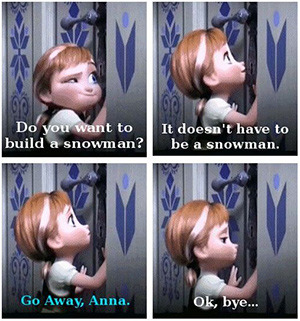
Ironically, it isn't her magic that hurts Anna. It's Elsa's self-imposed isolation because she believes herself to be dangerous. All Anna wants is the same love they once shared. The door that separates them wounds more sharply than the ice which was easily healed.

In a perfect case study of unintended consequences, Elsa's suppression of her power is what keeps her from controlling it. It all comes out sideways at the worst time, and she ends up in mutually-agreed upon exile, but with disastrous results for both her and her people. Again, it isn't her powers that are dangerous, it is how she and everyone else is handling them.

Olga Bogdishina's book, "Communication Issues in Autism and Asperger's Syndrome", talks about the ways autists process sensory information differently from neurotypicals (NTs). Among other issues, autists deal with being either hypo- or hyper-sensitive to stimuli. "Their senses seem to be too acute…or not working at all…"

Excellent book.
So read it.
Every autistic individual has a mashup of different conditions under which their senses are either ramped up or remote and blocked off. For some, sounds will always be too loud (auditory hypersensitivity) but they have no idea what they're feeling (alexithymia). For others, they do fine with sound... until they get overstimulated. Then they can hear a pin drop on the other side of the house.

Emotions should be counted among the "five" senses. Emotions are a sense, giving us information about our internal reactions to outside events, and are subject to hypo- or hyper- sensitivity effects. For autists, emotions can be remote and incomprehensible, or very loud like a blaring siren. While I've had periods in my life where I was more hyposensitive to my feelings (my teen years), these days, I tend to be more hypersensitive. I usually know what I'm feeling, and why, and even what I need to do to change those feelings. The downside is that strong emotions are very, very strong. Overwhelmingly so. Uncontrollably so.

And that's where meltdowns come in. 

Add to the complication, I was raised in a passive-aggressive environment, where showing certain emotions was never allowed. I quickly learned that crying would invoke an angry response, or accusations, or that I could hurt the people I loved. I became very good at repressing my tears if anyone else was around. When I became an adult, I had to teach myself to cry. It's a lesson I've never fully learned, and I have lots of triggers and shaky boundaries around that. All stuff I continue to work on.

When I feel cornered and triggered, I can meltdown. My emotions become so overwhelming that they shut down my thinking brain, with symptoms very similar to panic attack. I feel anxiety like fire, in my whole body, even my skin. I can't breathe, I can't think straight, I can't act in the best ways to protect myself. Everything becomes all-or-nothing. I may lash out and say hurtful things.

I'd put something funny here but it isn't really funny.
Cue Elsa. Here she has this double-edged power. She can build magnificent complicated fractal-based buildings using only her mental powers, but when she loses control, she shoots icicles from her hands.

Elsa's big triggers are related to emotions. When her parents die, her room turns frosty. And just like me, she becomes most dangerous during conflicts. She always risks hurting someone when she feels powerful things. And most of all, no one understands her. She's hurting and afraid, but everyone thinks she's a monster.

Her powers are just like my overwhelming emotions. As a child, I dealt with them by never feeling anything. As an adult, I still try to stuff them sometimes, but it totally backfires, especially when it reminds me of being a helpless child and I get triggered.

Power over ice is the best metaphor here. Aspies are often thought of as being emotionally cold, yet like Elsa's power, our emotions are often very active and passionate. Emotional repression is like trying to freeze feelings. And when I get upset, words come more difficult to me, as if my thoughts are freezing up. When the panic sets it, it's hard to breath, like my chest is frozen with fear.

It's not an icebeam, no that's all Jonny Snow!
(And Elsa the Snow Queen)
Anna tries to reason with Elsa, so together they can solve the endless winter problem. I related to Anna here, as well. My solutions are so simple, yet sometimes so hard to convey.

This is when Elsa whirls around in frustration, erecting a defensive ice barrier all around herself. Unknowingly, she hits Ana in the heart with an icy ray.

How often have I whirled about in my own pain and frustration said something that wounded someone I love? The closer to meltdown I am, the worse it is. I'm not trying to hurt anyone, though people accuse me of doing so. I'm as surprised as Elsa is, when she hears Ana's little cry of pain.

The metaphor continues through Anna's reaction. She seems fine for awhile. She knows she's got a problem, but she runs around for awhile and even has a comedic musical number with the trolls, before the ice starts to take over and incapacitates her. That's how painful words work. We stand up and shake them off and move along in life, but if the words were painful enough, they cause traumas that are hidden but still slowly freezing us to death.

Elsa finds her answer, and it's the answer I found. By stuffing her emotions, by trying to deny who she really is, by allowing social shame to consume her, she becomes explosive. It's only when she "lets it go" and accepts who she is in spite of what others tell her, that her talent becomes a controllable force for good. A unique power no one else has.

The message here, for anyone with autism or Aspergers, is to be true to your autistic self. NTs are going to set up alot of incomprehensible social standards for you to follow, but maybe you don't have to. At least not all of them, not all the time. Maybe there are ways around them, or maybe you can just do what you're going to do anyway, without shame. Maybe some of those social standards are lame and need to be questioned and rejected.

Art by FabUUlousGear.
Because you can get this as a mousepad.
By accepting and being open about all facets of your personality, you learn to control your powers. You can avoid those pesky painful meltdowns altogether, and forgive yourself when you can't. You can create your own environment, a palace on a hill, free from overstimulation and ridiculous social rules. And when you get really good at that, maybe you can come down off the hill and be a leader for others.

Or not, and that's okay, too.

One of the emotional elements of Frozen, for me, was Elsa's entire story arc. I had a rotten 2013. I was diagnosed in April. Conflicts between me and Roland were increasing in intensity and frequency. For many reasons, my anxiety continued to increase, until it pained me every single day. I was melting down every couple of weeks, every month at a minimum. I had multiple scary suicidal moments which recurred for months.

My diagnosis was helpful, but it also spun me into turmoil. I had my own self-rejection/self-acceptance narrative arc. I had to learn about my traits, my powers, and my limits, and then learn to articulate them to others.

As I watched Elsa struggle on screen, trying on various options to deal with her power/curse, I watched myself. I felt her pain and confusion. I understood her loneliness. But I also triumphed with her. I danced with her as she sang of how she no longer cared what anyone else thought, she no longer wanted to hide her true self, she would no longer try to be the perfect girl everyone expected her to be.

It's making me tear up as I write about it.

By the end of the year, I'd found my balance, an equilibrium, of how to live with autism and accept myself. The hardest part was learning how to be around others. Living in an ice castle is one thing, but I have family. I learned to set boundaries to keep other people from hurting me, which also resulted in me hurting them less. Like Elsa, I am now able to step out on the stage, confident, knowing I am loved.

That's not to say I won't continue to struggle. Every story arc repeats itself. On screen, it's just a sliver, a slice, of the cyclic life-themes we continue to deal with. Frozen gives us a common language to think about it and discuss it.

The story also reflects isolation, of being around others and yet effectively alone because true communication is impossible. This is the story of autism.

When I first started researching autism, I wondered what non-verbal autists could possibly have in common with me and other aspies. Yet I still had this deeply empathetic response to any non-verbal autist I read about or saw on video.

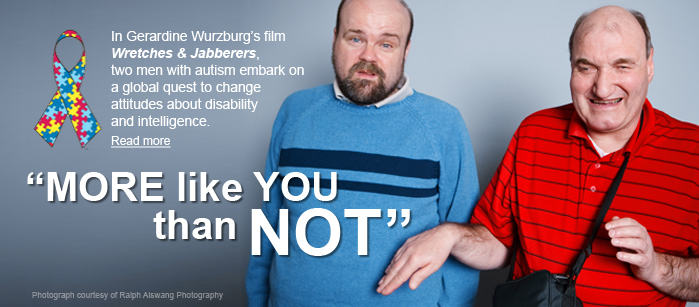
In the documentary Wretches & Jabberers, two men with classical autism travel the world to meet other autists and advocates. I found myself almost in tears through the whole film. Even though their experience of life is, in so many ways, very different from mine, I felt some common, mysterious tie.

Wretches and Jaberers
There's a moment in the film where Larry expresses how painful it is when people thinks he's stupid because he can't talk. I related so hard to this moment, not because people think I'm stupid. The opposite, I'm normally perceived as being above-average. It took me awhile to figure out what I had in common with Larry in this moment.

Then it occurred to me – the key thread is being misunderstood.

I know myself really well. I know my capabilities and feelings and outlooks. Yet often NTs think they know these better than me. They make assumptions about my motives, and then they argue with me, trying to convince me their outside perceptions are more real than my own experience.

All autists are deeply misunderstood. NTs often think we're stupid, or out of control, or crazy, or drama, or unfeeling, or unempathetic, or dangerous. They think we're emotionally unintelligent. We are painted in broad strokes with wide brushes that assume intentions and ascribe meanings which aren't true.

It's even harder, for those of us who are skilled in the use of language, when what normally works for us suddenly stops working. We sometimes can't find words, or the words we use are suddenly incomprehensible to NTs because of their assumptions or because autistic thought patterns are so different and difficult to communicate across the divide. Other skills, like sensory processing or executive function and abruptly fail, and we blow through expectations set by past behavior.

For this and many other reasons, I've known instinctively, since I was a small child, that I could expect to be misunderstood on a regular basis.

To see Elsa fleeing her own kingdom really struck a chord. She tried so hard to be like everyone else and to avoid hurting anyone, and yet she still failed and had her motives misascribed. This is something many autists can relate to.

The misunderstanding is even more acute because Elsa looks normal. Her "disability" (diversability) is invisible, so when it suddenly appears, it is all the more shocking and horrible and more difficult to understand. Aspie behavior is much the same. Because no one can see a reason for strange behavior, NTs can hurtfully ascribe motives that make sense to them, but not to us.

"You just need to try harder..."
Helpful advice, but only a little
It's easy to see why someone in a wheelchair isn't running in a marathon, but when a well-dressed, intelligent, and verbal aspie with sensory processing disfunction fails to reciprocate a friendly greeting, it must be out of rudeness or meanness or a lack of empathy, not out of severe social anxiety, or an inability to assemble the words into meaning, or the inability to instinctively understand what the appropriate response is.

Likewise, when Elsa's power first escapes in public, she is accused of being a sorceress, a monster. The people are not only afraid of her, some of them hate her and want her dead.

This reflects the quick switch of being admired by everyone, then abruptly alienating them, and not knowing why. That's the life of an aspie who passes as neurotypical, builds up expectations, then shocks everyone when we reach a limit and breakdown, or fail at some seemingly simple task (like shaking someone's hand). People don't realize the capricious nature of Aspergers, that sometimes those little things are impossible for us, even if it was possible just a minute ago.

Just like it became impossible for Elsa to contain her powers.

Though Elsa is a secondary character, she upstages Anna, the protagonist, who may also be a relatable character for aspie viewers. She is clumsy, socially awkward, blunt, practical, lonely, and unorthodox. She also expresses an impulsiveness and devil-may-care attitude which is not only endearing, but common to the Asperger's experience.

I related very strongly to Anna's confusion and pain when Elsa shuts her out the way my sister did me. Elsa's reasons for the rejection seemed to be good, but it caused more harm than it prevented. As in their case, my own relationship with my sister seems to be improving the more time we spend talking to one another, not less.


My sister's reasons for shutting me out are rooted partially in long-running misunderstandings about my behavior vs. her interpretation of my behavior. Once I told her I am as aspie, she could understand me more. (No everyone reacts this way, however. I have heard that revealing an Asperger's diagnosis sometimes causes increased misunderstanding in families.)

My sister's reasons are also partially rooted in religion, which leads me to the last mirror that Frozen held up to my life.

When I chose to leave the religion of my birth, I felt a mix of conflicting emotions. I still do. On the one hand, I can celebrate my freedom from expectations and rules which never quite fit me, as Elsa does. There is much joy to be had in that. My new beliefs and new way of living is very me. I've lived this way for thirteen years, and the more time that passes, the more I know this path is totally right for me, and I won't let anyone take it from me.

Yet like all good stories, there are tradeoffs and conflicts. This isn't a Mary Sue story, and the price I paid is steep. I left most of my family behind. I left my cultural homeland behind. I could no longer fit in there, so I exited. By isolating myself from them (and that isolation is a two-way street), they can no longer hurt me, and likewise, I no longer hurt them by being myself in their presence. But my leaving had unknowable destructive effects back home. My family misses me, and though their desire for me to fit their mold is unrealistic, it is also real.

Though we now live in very different worlds, we are still family. This story arc has not ended for me yet. I'm still the Elsa dancing in her ice palace, singing "Let It Go", trying to forget the people I left behind, trying hard to pretend they're better off without me as I am better off without them.

Our issues seem insurmountable, but maybe they aren't. The trolls sing a song about fixer-uppers which is about marriage and romance, but it also addresses blood-family. "Everyone’s a bit of a fixer-upper, that’s what it’s all about! Father! Sister! Brother! We need each other to raise us up and round us out." 

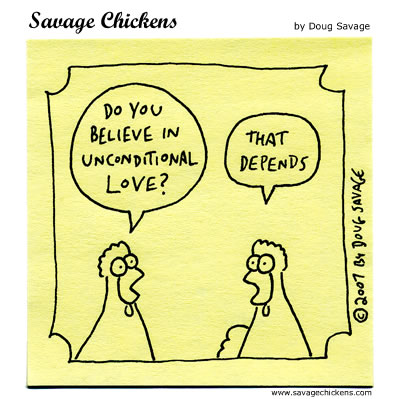
Getting to the point of acceptance is the hardest part. Unconditional love isn't loving in spite of differences; it's loving because of the differences. Unconditional love has no room inside it for wishing the other person were different. We can wish they'd treat us better, and set boundaries towards that end, but when we want them to act a certain way so we can pretend they are a fantasy version of themselves? That is very selfish indeed. That's alot of strings attached, enough to turn our loved-one into a puppet.

I love you...
I just don't approve of your choice to be a chicken.
The way I choose to live is a very spiritual path for me, uplifting, deep. Like Elsa, I feel ostracized for being who I am. In "Let It Go", when she sings the words, "No right or wrong, no rules for me", it's because those rules don't fit her the same way fit the others. She's decided "the perfect girl is gone" because she has a new standard of perfection all her own. This feeling is reflected in the lyrics of the radio version by Demi Lovato, "Up here in the cold thin air I finally can breathe; I know I left a life behind but I'm too relieved to grieve".

Having gone through that, it really is a weight thrown off. 

It's sad that by creating her own standard and cutting those strings, Elsa has to isolate herself: "Standing frozen in the life I've chosen, you won't find me, the past is so behind me, buried in the snow."

Elsa does eventually find acceptance among her people, but the movie fails to explain how this happens. The implication is that it magically happens once she comes to accept herself. In real life, it's kind of that simple, but not really. The reality is that some people will accept you. Others will reject you even more. Still others will reject you at first, and then slowly decide that love is more important–and more effective–than trying to form everyone else into a standard of false perfection.

In my case, whether talking about autism or religion, self-acceptance is my priority. If I have to reject myself to be accepted by others, their love isn't worth it. I would rather live my life in the best way I know how, and let them come around to me, if they want. In many ways, this is my "kingdom of ice-olation", but it's a price I am willing to pay.

Labels: , , , , , , , , , , , , , , , , , , ,

Monday, July 22, 2013

Mind Control 101: The Basics

Remember this? Youre still doing it wrong.
Keep trying, buddy.
We have explored what thought reform is not in Mind Control 101: Myths of Brainwashing. But what is it? What force can shut down people's minds and get them to do things they otherwise would never consent to?

Cult Conversion Walkthrough (Storytime!)

No one is immune from mind control. And contrariwise, mind control doesn't always work. It takes the right combination of factors; specifically trust, common ideals, and receptivity.

Cults are a good place to study mind control because the changes they effect on people's lives are extremely obvious.

Pretend for a moment you are having a difficult time in your life: a recent tragedy or major transition. Maybe you've just gone through divorce, lost a loved one, you've moved to a new town, or have recently been fired. You're feeling alone, scared, depressed, ashamed, or desperate.

One day you encounter someone who is nice to you. Either it's a friend or associate, or even a complete stranger. Maybe it is someone handing out pamphlets, or speaking to a crowd. Who ever it is, he has kind eyes, and you feel a little better when you're around him. He also seems to share your values. Maybe he wants to help the poor, or he talks about the power of love, or God, or protecting animals. Imagine your greatest value, and he also shares that value with a level of passion you admire.

He invites you to a meeting or a party. Once there, you find a room full of people who say nice things to you, lifting your spirits. They are involved in a cause you wholeheartedly endorse. They take care of the sick or collect food for the poor, or educate kids about capitalism, or share the message of God to the world.

Being around these people makes you feel good. You feel as if you belong. You quickly forget your personal problems and begin spending more time with this group, working towards making the world a better place.

They have won your trust.

Now you are fairly receptive to what the leader may tell you. He will use this time to win more of your trust and make you more receptive. If you've had niggling doubts about your new friends or their beliefs, they are easily explained away.

Slowly, you are introduced to new ideas you may not have accepted at first. Over time, more is required of you. More money, more time, more sacrifices. Your behavior is slowly restricted. Maybe you are required to dress a special way, eat or not eat certain foods, show up at a certain number of meetings, be so busy you don't get proper sleep or nutrition.

Now the grip tightens. The leader teaches you doctrines to instill phobias about the outside world. You learn that your group has many enemies to fear. Those enemies are not to be listened to because you will be unable to resist when they try to lead you away from the love of the group. You are given thought-terminating cliches, phrases or words that help you easily dismiss criticism. You are elite, one of the chosen to help save the world from political error, or one of the blessed of God. Your very language is altered, as your words become "loaded". This prevents you from properly thinking about certain concepts, and from properly communicating with people outside the group. You have become dependent upon the group for your emotional well-being, and you are possibly even physically or financially dependent. You are isolated, if not physically, then mentally, because there are many sources of information you are taught to distrust.

When you think about the group and its teachings, you are filled with a sense of euphoria. Thinking about outsiders or criticisms makes you feel anger or confusion. The thought of leaving the group or "switching sides" makes you feel guilty, ashamed, or afraid. If something is not going as promised, you blame yourself, not the group. There are no gray areas left in your world view -- things are either good or evil, left or right, pure or tainted, full of life or death.

You now automatically reject any criticism, no matter how valid it is. You reject any fact that goes contrary to your beliefs, because your beliefs have become more important than reality. Certain words are now triggers that cause you to reject specific ideas before you even have a chance to hear them out.

You feel yourself to be perfectly rational, far more enlightened or intelligent than those with opposing views. Yet instead, your brain has been crippled from the mind viruses you voluntarily made part of you.

What Just Happened?

Here is the process:


Jim Jones was a really nice guy... till he lead 900 people to death by Koolaid
Jim Jones seemed like a really nice guy...
till he lead 900 people to voluntarily drink cyanide-laced Koolaid.
1. Win Trust

Sometimes people just seem really trustworthy because they are kind, charismatic, or because everyone else also trusts and loves them.

2. Appeal to ideals, goals, beliefs

You probably feel very passionate about your beliefs, so it's easy to involve you on this level. It's also another way to win trust.

3. Create a state of emotions and receptivity

Once your defenses are down, there are many techniques for turning off your critical mind and putting you in an emotional state. There you are more willing to believe anything. Emotions may include fear, anger, idealistic euphoria, camaraderie, love, or any other strong feeling.

4. Slowly introduce new ideas and restrictions on thoughts and/or behavior

These are ideas or restrictions that dehumanize opponents, instill fears of the enemy, introduce thought-terminating cliches, create loaded words, give you feelings of elitism or of being special, and so on. This is the point at which you become tangled in the lie and become a perpetuator of that lie using the same techniques used against you.

It's How We're Wired

You don't have to be a full member of a suicide cult to be manipulated. Mind control techniques are used every day: in the news, in commercials, in political speeches, on billboards, on the radio, in forwarded emails, and in conversations. Even abusive relationships practice the same manipulative methods.

We are always being asked to trust someone who wants to tell us who to fear, when to shut down our brains, who's side to never respect, which facts are skewed and which are true. We are asked to immediately reject everything we disagree with and accept everything we agree with without question.

There used to be a lot more bowing and scraping. Those prone to backtalk were usually beheaded.
There used to be a lot more bowing and scraping.
Those prone to backtalk were usually beheaded.
This process seems to be the rule rather than the exception. Our society now values free-thought, intellectual honesty, and persuasion through facts and reason, but this has not always been so. For most of history, mankind has blindly followed authority. Arguably, civilization might not have survived this far without these traits. Rebellious, contrarian individuals in those cultures didn't survive long. Our minds seem prone to accept deceptive persuasive processes that bypass critical thinking. The tendency towards free thought was literally bred out of us.

It's hard work to employ honest persuasion. We have to risk the discomfort of cognitive dissonance, which seems ever present in the harsh light of honesty. Our very brain chemicals make us unhappy when we critically question cherished beliefs.

Conversely, coercive persuasion is a much more comfortable process, but it always involves deception. Typically such persuaders believe the lies they tell. Followers of these distortions are just repeating the program, including mind control methods, they have been taught.

Who Can I Trust?

Ironically, you are actually more likely to be brainwashed by those you least expect to be capable. These will be people you fully trust, people with similar values and goals as you, someone who is on your side.

You cannot be brainwashed by someone you distrust, unless you are physically held hostage by them. This means if you hate liberals, you can't be brainwashed by liberals. If you hate Republicans, you can't be brainwashed by Republicans. If you're God-fearing, you can never be brainwashed by atheists.

Think about that for a moment. The groups you might suspect most capable of mystically infecting your mind with deceit are actually the most incapable. Those you believe to be benevolent are those most capable of deceiving you, if they so choose.

There are members of every camp, every ideology, every school of thought who have used the powers of deceptive thought reform. Out there, somewhere, is a controlling group or belief system that is likely to appeal to you, that has the power to hook you and reel you in. It's even possible, likely in fact, that it's already happened to you to one degree or another.

When we're born, we are about as helpless and dependent as we ever will be. We start out being programmed by our parents. In most ways, this is a good thing, because this is how we learn basic survival, how to behave in society, and how we gain culture and language. We learn useful values and principles. But we also come to blindly accept many untruths and thought patterns that keep us from critically thinking or asking questions when maybe we should.

I know its true. I saw it on TV.
I know it's true. I saw it on TV.
We also become susceptible when the world itself becomes terrifying. There are many things to fear: War, terrorism, disease, crime, violence, immorality, anarchy, socialism, racism, tyranny, oppression, and so on. Many will stand on podiums or behind TV screens and amplify those fears, and then promise to ease them if we but trust. This isn't much different from when a cult targets someone who has had a recent loss in their lives.

I have been brainwashed about some things. I still am, to some degree, even though I am aware of these techniques and do everything I can to spot them. But when someone is "on my side", saying things I already tend to agree with, I'm just a little susceptible. And so are you.

Ultimately, you can only trust yourself. That is why questioning and critical thinking are so important. If you can become comfortable with cognitive dissonance and ok with being wrong, your mind becomes agile. If you learn good research techniques, you make yourself the ultimate authority. If you teach yourself rational habits and learn about the difference between good logic and fallacy, you can give yourself a built-in bullshit detector. If you study mind control techniques, you shield yourself with awareness to disarm the lies. Trust yourself and become the guardian of your own mind.

In future Mind Control 101 posts, I will explore each of the known mind control techniques in detail, describing exactly how they work to entrap us. I will also explore cognitive theories that explain why and how our brains cling so desperately to what we already believe, easily rejecting conflicting data.

Hopefully, armed with this knowledge, you can be that much more immune to mind control. Because no one else can do it for you.

THIS POST IS PART OF A SERIES
Mind Control 101: The Myths of Brainwashing
Mind Control 101: The Cogs of Dissonance

Labels: , , , , , ,

Wednesday, May 15, 2013

Mind Control 101: Myths of Brainwashing

Mind catrol - ur doing it rong akshully

I've studied a lot about mind control over the years. My interest piqued shortly after I left a rigorous and restrictive religion (Mormonism). I wanted to better understand how I had willingly allowed myself to be controlled, all the while believing and protesting loudly that I was free.
These methods are deceptive and unethical, tricking the mind rather than persuading through honesty and reason. Knowing this, I now have a very unique perspective on American politics. I can see these techniques used all the time, by politicians, media, and regular people.

This is not owing to a vast conspiracy. It doesn't take an evil mastermind to notice certain approaches work better to persuade. These methods have always worked and will always continue to work, and so they perpetuate through society. Some who study memetics might even say these approaches are living things that self-replicate and spread though human minds.

This post begins a series called "Mind Control 101", which precedes its non-evil step-twin, "Logical Fallacies 101".

Please do not use this as a How To! I address this topic not with the intent that you try to take over the world. I instead wish to make you better able to defend yourself when your mind comes under assault. I think of it as a defense against the dark arts course.

Let's begin with the myths. The entire subject of brainwashing is "loaded". Loading Language is itself a mind control technique that limits thought by giving you preconceived and highly incorrect notions. I'll start "deprogramming" you by showing where your existing understanding of the topic is far from reality.

When I say these words, "Thought Control" or "Brainwashing", you no doubt envision a wild-haired hypnotist swinging a silver watch, while a stern doctor injects your arm with a strange serum. In the background, hooded figures chant, and soon your eyes begin to glaze over. All the while you are helpless to resist because you are strapped to a chair.

This is all complete fantasy. Here's the great secret: while being brainwashed, you feel in complete control of yourself. You are cooperating. A much more accurate term is "coercive persuasion", because you are persuaded to want the same thing the manipulator wants, to believe as he wants you to believe.

Those who have been thusly persuaded never know they have been brainwashed. Conversely if you're sure you've been brainwashed, you probably haven't been.

So let's dispel some myths, shall we?

Thought reform does not require physical restraint.

Scientists used to think this, back in the 1950s, when American POWs returned from Korea singing the praises of their captors. But coercive persuasion in our free society requires a little more finesse. No force is required. All it takes is listening to someone who is talking. It also requires that you trust them and like them, at least a little bit. If they do their job right, you will go willingly.

This picture is totally photoshopped.

It does not involve hypnotic disks.

Hypnosis is a broad word that means any varying state of consciousness other than the one you're probably experiencing now. Various levels of hypnosis, trance, and meditation are sometimes used by cult groups, but this is never, ever a requirement.

No drugs, truth serums, elixirs, or magical incantations are used in brainwashing.

Other than a few 60's cults that were using drugs anyway, I've never come across any thought reform involving chemicals. Nor does it have anything to do with Satan. No demonic possession, summoning of evil spirits, or worshiping pagan gods is required. Brainwashing is not about the content of the doctrine, but about the methods used to make you believe it, and never want to leave it.

Brainwashed people are not glassy-eyed, drooling zombies.

Most actually appear quite normal. In fact, I would venture to say everyone ends up brainwashed to one degree or another, at some point in their lives. Our brains seem wired to accept manipulation and deception. It seems logical that humankind would have better survived those very dangerous first 100,000 years of pre-history by following a leader without question. Thought control merely capitalizes on those built-in survival skills we are all born with.

There is absolutely no way to know that you've been brainwashed.

That's exactly the point. If you knew you were being controlled, you wouldn't like it very much, and you wouldn't stand for it. The manipulated fully believe they are making their own choices, that they are completely free to act in any way they choose.

A good deal of brainwashing involves setting up trigger thoughts, little tricks and traps that help you deflect any incoming facts, beliefs, thoughts, or feelings that would make you suddenly stop believing the lies you've been duped into. Part of this series is going to be identifying those traps, so you can avoid them in the first place.

(I could say "...and so you can escape if you're already brainwashed." But you see, if I were to accuse you of being controlled, you would immediately become defensive and protest, thinking, "There is no possible way!" That is exactly what I'm talking about.)

There is no "one size fits all" method of mind control.

To paraphrase Abraham Lincoln, you can control some of the people all of the time, or all the people some of the time, but you can't control all the people all the time. Manipulators throw out a line with some bait to see what bites. Sometimes it's you, but usually you will laugh at their crazy ideas. Everyone is ripe for being manipulated at some point in their lives. Someone has something to say that will appeal specifically to you. You will always be able to see how other people are being brainwashed, but you won't necessarily notice when it's happening to you, because you will like it.

There are a lot of mind control tricks, but not all are required.

There isn't a checklist that says, "Must meet all 50 requirements to be considered mind control". To control, you only need to do what works.

Brainwashing is not total.

It is possible to be partly brainwashed. You can be brainwashed about certain topics but not others. You can be brainwashed to the point of doing or believing almost everything the leader wants, but not quite. Victims of mind control can eventually be freed.


This image is actually pretty accurate.  NOT!
A completely staged, totally unrealistic depiction of a typical brainwasher.
(Note the evil eyebrows.)
Brainwashers are not creepy, bizarre, crazy, mean-spirited men who ooze evil and darkness from every pore.

Images of cackling, sneering, British-accent-wielding villains were created for the drama of movie fiction, not to reflect reality.

If you're going to be good at manipulation, you've got to be likable. To persuade, you must be charismatic. To convince, you must be, well... convincing. I listened to old recordings of Jim Jones taped just before the infamous Jonestown kool-aid mass-suicides and he sounded sincere, kind, loving, and wise.

Furthermore, controlling groups or ideologies work best when believers are taught to use brainwashing techniques themselves. That's right. In almost every case, the controlled end up controlling.

No one is immune from mind control.

Not even me, not even after all I've learned about it. I can build up defenses, but even then I will be susceptible to it at some point.

Conclusion

Now you know what mind control is not, which gives you an advantage over most people. In the next post I will, in the most basic of terms, describe what it is. Later on, I will delve into the details each technique so you can learn to recognize these methods in the wild.

NEXT: Mind Control 101: The Basics

THIS POST IS PART OF A SERIES
Mind Control 101: The Basics
Mind Control 101: The Cogs of Dissonance

Labels: , , , , ,