Monday, October 14, 2013

Splines Theory: A Spoons Metaphor for Autism

An incident occurred last week where my child unexpectedly needed a ride to school in the middle of my writing session. And it ruined my whole day. Why?

I knew it had to do with Aspergers, but I wanted to know more. Puzzling over this question, I went in search for the perfect metaphor to describe the experience.

I love the spoons metaphor for invisible disabilities. It describes a portion of my world, and it goes something like this: Every morning, most typical people wake up with infinite spoons. They don't even think of spoons as a resource because they almost never run out. They can easily choose to do this or that without risking much other than time consumption. Sure, they get tired by the end of a full day, but generally they have enough spoons to do all the normal things. It's a gift they take for granted.

Those with chronic pain or serious illness or certain types of mental illness, like depression, only get twelve or twenty spoons a day. Each activity, even small things like getting dressed or making breakfast, takes a spoon. Careful choices must be made about how the spoons are spent; otherwise, they will be gone before the day is through. Or worse. A bad spoon-management choice might leave them without spoons for several days.

There is no spoon. It's just a theory.
Which states aren't enough spoons.
The word "spoon" is actually quite weird, when you think about it.
Why is it called a spoon?
Oh, that's why.
It's still weird.
I'm already out of spoons. I wonder why?
Oh look, a butterfly!
For the origin of Spoon Theory, and why spoons and not some other eating utinsil, see Christine Miserandino's account on her blog, But You Don't Look Sick.

I relate to this analogy somewhat, but it fails to describe the intricate resource-management I must do as an aspie. I wake up with a random number of spoons. Why? Why do I mysteriously get a bunch of new spoons at unpredictable times? The process of getting ready for a new task seems to cost me "spoons", but that model doesn't reflect the intricacies of the gathering process itself. What about the frustration I feel when I fail to gather or get interrupted? How do I describe the sense that a dozen little things need doing before I can start a big thing, each costing a fractional "spoon"?

Spoon Theory didn't fit the all data for my experience, so I went in search of a Grand Unified Theory of Resources or Law of Conservation of Aspergers Energy that I could use to think about and describe my universe.

I found a few articles on inertia that help describe some aspects of life with Aspergers, like:

Inertia is a term I'd used years ago, long before my diagnosis. The idea is just like the law of motion. An object at rest tends to remain at rest, and an object in motion with a certain trajectory will tend to remain in motion, headed that direction, at that speed, until stopped or bumped off course by an outside force.

Inertia Theory perfectly describes my hyperfocus, or lack thereof, but it failed to describe outside forces I must apply to get up to speed. Or my frustration at outside-outside forces that stop me.

Last night, after doing a little light reading from Olga Bogdashina's book, "Communication Issues in Autism and Asperger Syndrome," eureka! I found it. The perfect metaphor, "Reticulating splines..."

I'm a huge gamer, and in the 90s I loved old school Maxis games. You know, SimCity, SimEarth, SimAnt. Back then, games took forever to load, especially on my old 386. While games loaded or maps generated, many companies showed useful information, like "Decompressing graphics files...", "Loading sounds..."

Maxis wanted to be funny, so their load screens repeated random nonsensical phrases that sounded Really Important™. Some of them flashed by so quickly you couldn't read them. One remained on the screen the longest, while a voice read it aloud: "Reticulating splines..."

Reticulating Splines...
Seems legit.
Maxis has carried on this fine tradition for decades, and while games now load lickity-split, they ensure you have just enough time to see "Reticulating splines..." flash past. For tradition's sake. Other software drops this phrase in as an Easter egg, and everyone who knows the joke gives a chuckle.

Separately, "Reticulating" and "Spline" are real words, but put together they make no sense. Until now.

What does this have to do with Asperger's?

The single greatest resource hog during my day is what some call "shifting gears", or moving from one task to another. Skilled teachers of autistic kids know to give a child ample warning of an upcoming task and to explain the purpose of moving on. Anyone who's worked with autistic kids knows the reason for taking this extra step. It's to avoid meltdowns.

Even the gear metaphor is problematic, because it takes no energy or time or frustration or boredom to shift a real gear. It's just BAM, you're in first and now you're in second. And you're still driving, not suddenly riding an elephant. It totally fails to describe the struggle of wrapping up one task and beginning a new one. For a neurotypical, it's as simple as shifting a gear. For someone on the spectrum, it's something else.

I knew from the get-go that my search for the perfect metaphor would center around this question: "Why does it take so long for me to get started?" The answer is wrapped up in other autistic tendencies: hyperfocus, special interests, distractibility, and "getting stuck".

Bogdashina describes how the autistic brain processes sensory information differently than neurotypical brains. NTs tend to take in sensory data all at once, summarizing, and comfortably filling in gaps with assumptions. As a result, NTs leave alot of things out, and in return for this compression, they get a speed boost.

According to Bogdashina, autists on the severe end of the spectrum cannot sense objects as part of a whole. A face breaks up into "mouth", "nose", "eye", "eye". A person then is "hand", "arm", "ear", "face", "hair". A room is instead a "wall", "wall", "table leg", "table top", "plate", "chair", "floor". Sounds and other senses take on the same fragmentation, and it's difficult for the autist to lump them all together into "mother" or "dining room".

My experience is not so extreme. I can see a person, a face, a room, a coffee shop, as a "whole thing", though sometimes details jump out at me like the eyes on a cartoon character, causing distraction (but it's also a superpower of observation).

Yet there is an aspect of sensory fragmentation I can relate to, and that's in memory storage and in my understandings of concepts.

Take a concept. For instance, one of my special interests, cults and mind control. I can can perceive the concept as a whole, but not without all its parts. Mind control is a network in my brain of all the thousands of things I've read about over the years, and my own experiences, and my views on how it appears in religion, politics, public schools, and the media. Everything I've ever linked to mind control is in there in this massive file, stored by words, principles, feelings, and synesthetic colors. The topic of "mind control" is not complete without all those bits.

Right now, I'm knee-deep in mind control, because that's the writing project I'm working on. If I were to switch to another project, say editing Emerald City Iron, which is a novel about fairies, I'd be knee-deep in fairies, with mind control long forgotten. I need room in my brain to unpack all the details about fairies and my characters and writing fiction. I'd no longer have room for the topic "mind control" and the task "non-fiction writing". The files would have to be stored away.

In order to really understand fairies and fiction editing again, I'd need to get back into that space, open up the whole file with all the parts. And doing that requires a resource which is nothing like a spoon or inertia. It's more like opening a big game on my old, slow 386. Hence:

Reticulating splines. . .<hourglass>

Screenshot of my brain reticulating splines.
Yes, this artist managed to capture it.
Credit: Jon Storm
It makes sense that a complex topic or project, like mind control or fairies, would take a long time to shift into. That would be difficult for anyone. But what is harder to describe is how the little things, things NTs take for granted, can be just as difficult to shift into.

Reticulate means to "make a net or network of". A spline is a number of things, including: "a. Any of a series of projections on a shaft that fit into slots on a corresponding shaft, enabling both to rotate together. b. The groove or slot for such a projection."

When I switch tasks, I am making a network of all the projections and grooves and slots and shafts and strips of metal and curve-drawing tools and geometrical maths used to draw up the task. I am loading and linking together all the details in my brain that are connected to the project at hand. And that's going to take time, whether that project is making a phone call, disciplining the dog, or writing a novel.

It doesn't just take time. It takes a bunch of energy and processing resources. It isn't fun at all. My brain has to work really, really hard. So when something interrupts me, and demands I dump the loaded program to load up a new program, I get very frustrated. When I've got lots of annoying little errands to do outside the scope of my main project, I lose splines and spoons. The more do this in a day, the more frustration builds.

For instance, if I need to make a phone call about a bill, I need to gather the phone number, collect all the data about the bill, and get into the frame of mind to make the call. For me, that requires gathering lots of little pieces, and on my hardware, it's slow loading. On NT hardware, it might flash by, "Reticulating splines!" so fast you can't even see it. Yet because I have more splines, they take longer to reticulate.

This is why, when I made and took twenty phonecalls a day as part of my tech support job, talking on the phone was relatively easy. It didn't take a lot of spoons, because it wasn't reticulating many splines. The "talk on the phone solving technical problems" program was all loaded up. It stayed in memory for years.

These days, using the phone requires all kinds of splines. And when I need to reticulate that many splines, it ends up costing spoons.

Likewise when I ran Sapioscape, an online retail business, I ran to the post office every day, shipping 3-5 boxes at a time. I was efficient, and it was even a pretty fun. Sometimes I still miss those days.

Now, when I need to ship just one box? I procrastinate forever and the task seems impossible. Because I have to reticulate every single spline related to packaging a shipping and item. It's a rather complex task for me, because my memory has stored each step as a separate thing that I have to recompile.

Same goes for home improvement tasks. I loved remodeling my house. I couldn't wait to get home and build bedrooms in the basement, retrofit foundations for earthquakes. and landscape the yard. Now? Hanging a picture seems impossible. Because I have to remember where I keep the nails and how to use a hammer.

Computers can run multiple programs in background, and so can I, which is fortunate. I can keep one or two complex tasks, and several small items partially loaded into memory. So at the end of the day, I can reticulate splines on some smaller tasks and recreational activities (which also require splines), and switch back to the big project again the next day.

It's not entirely free of cost. I can't just Alt-Tab. A few splines get lost and have to be regenerated again in the morning. If I do too many side-tasks or have too many interruptions or too much time passes, loading up the main project begins to cost more and more.

Part of my spline-management system involves ridding myself of potential interruptions before I can start on my real work for the day. So I invest alot of initial spoons and splines into dealing with small tasks. I try to make sure Prince Ryuk of Pomerania (the dog) is happy. I feed myself and make tea. I deal with email and twitter. I cycle through my ritual of lighting candles and taking meds and turning on music. I let kids and other events interrupt me during this time, and work as fast as I can to get through this routine so I can get to my real work. Sometimes even then my brain isn't into gear, and maybe by that time, I'm hungry again or out of tea. I stare at the blank page a few moments, and I'm back to checking twitter or fiddling with things on my desk.

Somedays, I can reticulate my splines within an hour, and I have an amazingly productive writing day. Other days, it takes many hours. With each passing moment, the frustration builds. I fear I won't be productive, that I'm wasting time, that my book will never be written. It's just like waiting for your favorite game to load on an old, slow 386. You're eager to get started, but those damn splines are still reticulating.

This is why my child needing a ride to school ruined my productivity for the day. It had taken me about three hours to prep for writing. (I was coming off a full week non-productivity due to other life tasks that needed attention, so I required additional spline reticulation.) The door slid open just fifteen minutes after I had finally gotten started putting words to page. I was the only one who could drive said child to school.

I thought I'd be able to get her there and home without issue. But no. I lost all the splines on the drive back. And I got angry. I had an anger-meltdown in the car. I screamed at the top of my lungs and smacked the steering wheel. I knew the day was wasted.

I wasn't angry at anyone in particular. Things happen. I was angry at the situation. And a little bit at myself for being this way.

I also knew that Spoon Theory wasn't going to be enough to describe what just happened.

I still have spoons. I have a limited number of social spoons, overstimulation spoons, working hard for too long spoons. There are some splines-to-spoon exchange rates -- reticulating splines can cost spoons, and if I don't get enough sleep, for example, I don't have enough spoons to reticulate many splines at all.

It's just that running out of spoons doesn't lead me to meltdown. Running out of splines can.

There is an upside to having a brain like mine. Once all those splines get reticulate, I have thousands of connected details available to me. That's not to say I have a photographic memory and can actually remember those details perfectly. But I know the parts that lead to the sum, and can look up things up from there. (Thank Google!) If one of the parts changes, I can make adjustments to the entire topic. If a new fact comes in that contradicts the old parts, I can take a look at the parts of the whole structure to quickly see where adjustments need to be made. I think of new ideas quickly because I kept all the bits stored away, not just the unalterable concept as a mushy whole.

It just means it takes a bit longer to load. Even the "easy" stuff like getting dressed or shopping for groceries or talking to humans. All these splines must be reticulated.

To summarize the three complex forces of Asperger's, I've come up with the Three Laws of Thermodynamic Autistic Motion, also known as "Spins, Spoons, and Splines".
  1. Inertial Mechanics, or "The Law of Spins": An autist in motion will remain in motion until acted upon by an outside force, like a barking dog or the need to pee.
  2. The Law of Conservation of Energy, or "Entropy of Spoons": Spoons can neither be created nor destroyed, only washed and placed back in the silverware drawer. It always takes more spoons to wash the spoons than there are total spoons, leading to entropy, and the eventual heat death of the universe and everyone in it.
  3. The Law of Reticulation of Splines: The load time of splines is directly proportional to the number of splines in storage times the distance (in time) since the splines were last loaded times the number of interrupts by other spline-reticulating processes. As implied by the Second Law of Autism, spline reticulation requires energy in the form of spoons, splines, spins, and anger management classes. Moore's Law does not apply.

What do you think about this model? If you're autistic, or know someone who is, does it seem to fit?

Labels: , , , , , , , , , , , , , , ,

Monday, September 17, 2012

Ultimate Fantasy Escapism: Choose Your Race, Choose Your Class.

You're starting a new game. It may be a table-top RPG, or the latest MMORPG. You create a character.

Your very first choice: Race. You can be a human, elf, dwarf, halfling, orc, lizardman, or cat-person. Some games even offer different kinds of elves (light vs. dark elves), and in still others you can be mixed-race -- say half-elf.

Your choice isn't just cosmetic. Your race will provide you with a starter personality and an ethnic background you can expand upon. Based on your race, your character will be given inborn advantages and disadvanges: differences in intelligence, strength, dexterity, charm, health, and ability to buy and sell at a discount.

Next you choose gender, which usually provides no difference in gameplay, other than how cute the ass is you will be staring at for the next eighty hours.

Then you choose your class. Do you want to be a fighter, or thief? Monk or mage? Archer or knight? Will you rule your foes with magic or might? Your birthright is yours for the choosing.

Of course we know fantasy is escapism. The real question is: What are we escaping from? The doldrums of life, certainly. Who wouldn't want the chance, through hard work and many hours of rolling dice and clicking mice, to eventually become a king? Or a powerful mage? (Alongside thousands of our peers.) It's the perfect blend of aristocracy and meritocracy: A world ruled by invincible hereditary dominance, with all the upward mobility of modern society.

But is there something deeper we're escaping from? It has bothered me somewhat, as David Brin has put it well, that fantasy glorifies a non-existent golden age. A medieval time when benevolent kings and mages (aka religious priests) kept the kingdom in a perpetual state of peace so the happy farmers could live out their simple pastoral lives, never having to worry about rush hour, corporate mergers, and Manager Rob.

That is, until Evil McOverlord comes along to stir up the joyous peasant's otherwise idyllic lives. This is the time when that one special peasant takes the chance every peasant has, to climb the serfdom ladder and, by luck of destiny and/or secret birthright, exercise his right to become a king or mage himself. Through his well-rewarded efforts, the countryside can go back to blissfully herding sheep.

If only...

So what is it that attracts us to that specific time? Why the middle ages? Why not the Enlightenment, when the class system began to change and people began to demand freedom and equality? What is it about the values of one of the lowest points of Western Civilization, sandwiched between the glory of the Roman Empire and the Enlightenment, that attracts millions of fans?

Could it be those worlds are acting as a surrogate for something we all crave? Could the clues to this craving be in the very words we use to describe our first choices in character creation -- "race" and "class"?

Violence is another nasty little element we idolize in our entertainment. When we look at history, we realize why the past wasn't so idyllic. Violence has been a part of regular human experience of nearly every individual on earth until very recently. Men were sent to war not once a generation, but once a year, with cattle raids and such happening more frequently. Even in peacetime, dinner came from the pasture or the forest and it was something you had to kill and dress with your own hands. No one had to wonder if blood had a smell, because it was more than just a smudge of red pixels on your computer screen -- blood was simply a part of life.

Violence is written in our genes. Now that we are more civilized, we have a historical privilege we all take for granted. We rarely commit or are victims of violence. Fiction is our outlet. We give life to imaginary phantoms, only so we can take it away with the slash of a sword. We can watch death, read about it, and even act it out, in a way that hurts no one.

Likewise, tribalism is writ in our genes. Racism, classism, religious hate. There was a time when the majority of our ancestors believed there were tangible physical, moral, and spiritual differences between peoples of other races, cultures, and castes. People outside the familiar group were not human, they were "other". And those groups were generally very small, limited to families, tribes, small kingdoms, or local religions. Killing someone outside your group came easily and without regret. Like violence itself, these were survival tools in a world where letting go of limited resources or undefended territories could mean your death.

Here in the United States in 2012, we have new values to live by. These values are luxuries we enjoy in a world with abundant resources, and in part, we have abundant resources because of these values.

Among them:
  • All humans are created equal. 
  • All humans have the same capacity for achievement, regardless of gender, race, or class. 
  • The playing field should be level so that hard work can lead to success. 
  • We all deserve equal reward for equal effort.
  • Those at the top who do not contribute should fall to make room for those who do contribute.
Not everyone holds these values. (Just go read the comments section on news articles and YouTube.) But they are our cultural standard. It is what we strive for.

We take for granted that even mere decades ago, majorities held opposite values. During those medieval times, races were considered fundamentally superior and inferior. Members of the upper class were divinely chosen by birth. Knowledge was reserved for those privileged enough to join the clergy. Enslaving others, be it through ownership or serfdom, was considered noble. Forcibly robbing whole nations of their cultures was thought to be an act of moral goodness.

As our society slowly outgrows our base instincts, we have replaced real hate with playful outlets. We've built political groups, religious factions, sports teams, and subcultures, and most of the time, tribalism is harmless. More or less.

Racism and classism still very much exist, even in "civilized" America, just as violence still exists. People still die because of their race, and upper classes still believe themselves better and use power to maintain position. We are always poised on the brink of some terrible mob-mentality disaster.

At heart, we are still tribal. "Us vs. Them" is wired in the very nature of the human spirit. It is manipulated by politicians and religious leaders to keep us committing guilt-free acts of violence, large and small, real and metaphorical, against other human beings.

The important thing is that our society now strives to overcome it. Our fiction reflects this: The "underdog" movie is ever popular. The little guy works hard, and in spite of the odds, in spite of the intolerance and hate directed at him, he rises to the top. This is our culture's idea of a happy ending.

Yet our culture makes violent films as well. An outlet. A way to pretend.

Unlike violence, depictions of justified hate can actually reinforce real hate. How can we feel the satisfaction of superiority, without it being at another's expense? How can we foster a sense of equality while at the same time, satisfy our intolerant urges?

We log in, we choose our race, we choose our gender, and we choose our class.

Oh, we may not realize it. We don't set out to play at racism anymore than we set out to commit play-violence. All we know is that it's fun to fight goblins and orcs and lizardmen. Everyone knows goblins are ugly and genetically inferior. They aren't human. We can kill them with glee, secure in the knowledge that they don't deserve to live. Secure in our knowledge that no one in the real world is hurt by our hate.

It's taken for granted that elves hate dwarves, and everyone justifyably hates goblins, and there's nothing wrong with that; no harm done. Dwarves can go on cracking elf jokes and having a good time, at no one's expense. 

(That's not to say fantasy is entirely free from real-world parallels to existing cultures who are harmed by stereotypes. I frequently see culture appropriation that goes a little too far. Likewise, violence in media is not completely free from influencing violence in real life.)

We have the privilege to play at being underprivileged. If we decide we don't like life as an Asura Thief, because the Asura are too short and everyone thinks we look like children and we're big nerds, and we find out the life of a thief really stinks, we can start again, as a giant Norn guardian with a big sword, who doesn't have to take orders from anybody.

A new life and new destiny is just a re-roll away.

Most of the time, fantasy fiction is completely unaware of its own themes. Sometimes, much to my delight, a game or novel becomes aware, and uses uses fantasy intolerance to hold a mirror up to our society.

Dragon Age springs to mind. In this fantasy world, elves are considered inferior to all other races and have been segregated into "Alienages". The game explores themes of racism and segregation. Most non-elves accept this reality. Some don't think it's fair. The elves themselves react sometimes passively, sometimes actively, and some have formed into groups to change things, sometimes using violent means. Your own character gets to make choices, and those choices have real consequences.

We play this game through our own culture's eyes. Unlike the dehumanized goblins of other games, where the world is bettered by the hated-group's demise, the elves have personalities. They are humanized. We know the elves' suffering is unjust.

Even when we commit genocidal acts against the elves, we know they are the "evil" choices, and we make them with a sick kind of glee, (just like when the game gives us violent and sadistic choices), because we are not allowed to feel that way in real life. Unlike our ancestors, we know these choices are wrong. And you get to see exactly how those choices play out.

Even when we're playing at being evil, we see how the virtual elves are hurt.

This can't be said of real-world hatred. Those who wrap themselves up in racism or religious hatred or other forms of tribalism, do not see their enemies as human. They see them as "the other". They feel no more moral crisis at the deaths of black people, or Mulsims, than I feel getting an achievement for slaughtering my 1,000th green-skinned goblin.

Fantasy gives us pretend racism and classism, and when we're done, we can return to our privileged and moral lives. I choose to see it for what it is, and rest easy knowing that, just as I wouldn't wield a sword against a real human being, I also wouldn't really want to live in a world where inequality, injustice, intolerance, and genocide are glorified.

Games provide an acceptable outlet for make-believe hate. And the more people who redirect their hatred away from real human beings, towards virtual races, the better.

Labels: , , , , , , , , , , ,

Friday, August 31, 2012

Bathroom Bacon PAX (photo)

PAX Prime, 2010, Seattle, WA
It's blurry.  It says "See the bacon.  Catch the bacon."

Labels: , , , , ,

Friday, August 10, 2012

PAX Beholder (photo)

PAX Prime, 2008, Seattle, WA
When your head is in the mouth of the Beholder.

Labels: , , , ,

Monday, June 4, 2012

Gender Politics on Game Night: "Apples to Apples" vs "Blokus"

I love games.  I love games of every type: LARP, PC, console, board, card, RPG, strategy, and puzzle games.  I like games that are difficult, that make me think.  And I love games where I can sit back and relax and do something mindless for hours.  I love meaningless social games where everyone wins.  And hardcore competitive games where the loud shout of "Headshot!" booms bass from my speakers in a crowded room of a LAN party.

I'm really good at many games, and pretty good at most games.  I used to avoid games I totally suck at, but lately I can play them without caring too much about winning.

For many years, off and on, I've hosted game nights where random friends show up bearing games and snacks.  A card or board game is selected by democratic process, and fun is had by all.

A few years ago, I attended a large game night with twenty or thirty attendees in a large house.  Some of the people I knew pretty well, and others were new to me.  We had enough people for two or three simultaneous games.  At some point, Apples to Apples was starting up in the living room, and Blokus was coming out the dining room.

In case you're not familiar, let me describe these games.  Apples to Apples is a party game that large groups can play.  The rules and strategy are very simple.

A very girly card played during a very girly game.

The judge draws a card.  In this example, he reads, "Touchy-Feely! Affectionate; Tactile, Huggy!"  Players then select from their hands cards they think the judge will find most touchy-feely...  They throw them into the pile upside down, and the judge reads off all the red cards in a dramatic or amusing fashion, explaining the rejects before settling on the winner.  In my case, here I would choose "spiders", because I freaking love adorable cuddly spiders.

In this example, "Risky", I'd choose "Cocaine"... because when I use a wood chipper, I know exactly who I'm putting in there and why.
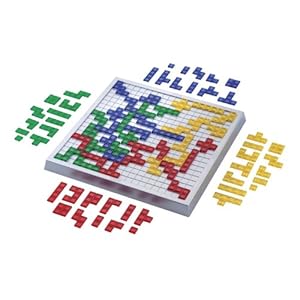
Blokus is a very different game.  There are a fixed number of players, up to four, and four works best.  You are given a pile of brightly colored geometric shapes and a series of specific rules on how to place them on the board.  Your goal is to lay down as many of the pieces as possible while blocking your opponents' ability to do the same.  It is a highly competitive game requiring feats of logic.
The only 8-bit board game.
These two games could not be any more different from each other.  And I love both equally.  Depending on who I'm playing with, I'm usually more likely to win Blokus than Apples to Apples... and as I said, everyone wins Apples to Apples.

So we're at this party, where an Apples to Apples game is forming.  I'm standing in the dining room with two other guys, and we're trying to talk another guy into being the fourth player in Blokus.  One of the guys, someone I've not met before, says something like, "It's better than that girl-game they've got going in there."

Errrrt.  Time to bust out my newly-formed infant inner-feminist.

There was a time when I'd let this comment slide.  After all, who wants to be the rude angry bra-burner, when he's perfectly innocent just ignorant and we're all just trying to have a little fun?  The fear bubbles up -- how am I going to put this complicated concept into words he'll understand?

I turned on him and opened my mouth in spite of my fears.  I said, "What?"

He repeats what he'd said, then makes some excuse.  "You know, it's a girl-game.  What's wrong with that?"

"And I suppose Blokus is a boy's game?"

He nods, a little sheepishly, but only a little.  "It's no big deal," he says.  "You know what I mean."

"It is a big deal," I say.  Then I explain to him, exactly and persuasively, what I mean.  I ask him, "Do you work in the IT field?"  Most guys at these Seattle game nights are.  He nods.

At this point in my life, I had worked in IT for ten years.  Ask any woman who has worked in IT for long.  I had experienced what most of us have:
  • A former boss spent most of our conversations staring at my breasts.
  • I'd been denied promotions, only to have outside male-hires fill those positions.
  • When answering the tech line on the phone, I'd heard the words, "I'm sorry, I was trying to reach tech support... can you transfer me?" more than once.
  • I'd had persuasive arguments for decisions ignored until my male underlings said the same things to the same people, and then the decisions were made.
  • I was repeatedly honored for being an awesome "webmistress", then a "guru", then a "rockstar", yet continually made 40% of the market average for my position. 
  • If you had any kind of computer problem, I could solve it, but had a hard time convincing a lot of men that my opinions were worth anything.
  • I went years thinking I was the only women this ever happened to.
I also had won almost every Blokus game I'd played up to that point.

So I say to him, "Most likely you are or will be in a position to hire."

He nods.

"And you think that women are good at social word-association touchy-feeling games, and uninterested in logic games.  Which means you may generally think women are bad at logic."

At this point he says something about thinking not all women were bad at logic.  Obviously some women are good at logic.

"That's a problem," I said.  "Because the IT field requires logic as a primary skill.  Someday, you will interview two applicants of equal experience and skills.  One will be a woman, and the other a man.  And the woman will have to somehow prove to you that she logical enough to get the job.  The man won't.  That is why it's a big deal."

He looked abashed.  He looked convinced.  We went on to play Blokus, and I won.  I pwned three guys in a competitive game of logic and strategy, and I hope at least one will someday interview a woman and remember that night.  And that she will get the job.  And that she will be treated well at that job, and that her opinion will matter, and that she will have equal opportunities for advancement.

This personal story is important on this week when a sexual harassment lawsuit is beginning in Silicon Valley.  Liberal geeks on the West Coast, in the IT field, consider themselves open minded, advanced, pushing the envelope not just in the tech fields, but in culture and social interaction as well.  The geek men in Seattle have long hair and wear kilts and T-Shirts with swear words and they are sex-positive and tolerant and they're well-read on advanced concepts of political theory and history and .. well, they're aware, and they're smart.

Geeks should know better.  Yet according to employment statistics, they don't.  According to that one guy, at that one game night, they don't.  Women are less likely to enter the computer field, less likely to climb the ladder to management and executive levels, less likely to make as much as men in the same positions, and more likely to leave the computer field for a new career.  (I did.)

There are a lot of reasons for these stats, and I'm willing to acknowledge there are many factors, including pregnancy, women's difficulty with knowing how to negotiate, and women's tendency to try to be "nice".

Yet I cannot overstate how men's attitudes towards women play a direct role in keeping women discouraged.  I was strongly motivated in my career, not only to make more money, but to influence my company.  No matter where I worked, I always wanted to help my company succeed.  I wanted to make operations more efficient, I wanted to make our systems run as smoothly as possible.  I wanted our products to be better.  And I invested a lot of thought and energy at each company towards these goals.  I didn't see myself as any different than my male co-workers.  But they did.

Being shot down repeatedly is demoralizing enough.  To know that at least some of those times I was dismissed because of my gender is intolerable.  At one company, early in my career, I'd been shot down so many times, I remember finally giving in and giving up.  (Especially when they kept hiring men for the IT Manager role that I was basically doing, without the title or pay.)  I decided to stop rocking the boat and just settle into the shoes they wanted me to fill... just fix the computers and make everything run, without a budget or the authority to make decisions that no one was making.  I literally kept the network together with duct tape.

What they needed:  A smart, driven person to make decisions and keep the network running.
What they had:  A smart, driven person to make decisions and keep the network running who happened to be female.

The Silicon Valley lawsuit story combines with another new story.  Global labor statistics reveal the jobs most difficult to fill.  Even with unemployment at 8.2%, STEM (Science, Technology, Engineering, Math) jobs continue to go unfilled at crippling rates, especially in hard-logic roles like Infosec and Network Architecture (two fields which were options on my career path).  Of the top five hardest positions to fill, STEM fields make up four of them, including IT jobs.  49% of companies in the US have difficulty filling jobs.

These numbers will have a huge impact on our country's role as a technology innovator.  It will have a huge impact on our GDP.

Is it just a coincidence that fewer women are entering these fields during the same period that these fields are starving for employees?  Women make up half of our population -- shouldn't we be represented 50/50 in STEM jobs at IT firms?  And shouldn't women help run these companies?  I worked for five tech companies in my career, and with one exception where a small consulting firm was started and owned by a woman, the only women in C-level positions were in HR and Marketing.

Gender stereotypes might be funny to joke about at parties.  They might not seem like a "big deal".  It's all good.  It's just game night.  But real women are being hired and fired based on that stereotype.  Women who could contribute.  Women who might help your bottom line.  Women who probably would take your company to the next level against your competitors, if only you'd listen to them, if only you'd give them credit, and if only you'd pay them what they're worth.  Women who could help keep this economy afloat if society would only stop barring and discouraging them from positions that are desperately needed.

One thing I can say for sure.  This woman will gladly challenge you to a game of Blokus, because there's a strong chance I'll win.

Labels: , , , , , , ,

Tuesday, May 15, 2012

What's So Wrong with Being the Healer?

Today an interesting conversation came up in my Twitter feed.  It echoed a conversation I had with one of my daughters yesterday, about the role of gender and the celebration of fighting over more peaceful activities.  With my daughter, we discussed girl cartoons vs boy cartoons.

Specifically, Jem, who uses science and technology to create music, vs. the Transformers, who use science and technology to cause devastating explosions.  Even though my daughter is female, she thought the girl-shows were lame.  Shooting things was much, much better.

The Twitter conversation was about gaming, specifically related to today's release of Diablo III.
Oestrus is a woman.  For those who might not automatically guess, this statement is potentially controversial in a gender-politics kind of way.  Why?  Because stereotypically, women are healers in games.  Moreover, this reflects real life, in which women are healers, nurturers, and in general, sissies.  (The word "sissy" was invented to describe what weak little girls women can be.  Men can be unflatteringly accused of being in this state.)

One could easily imagine a man mocking a female gamer by making the above statement in a highpiched voice.  "And then my girlfriend was all like, 'Are there healer thingies?  Can I follow you around and heal all the things?  PLEASE?' and I was all line, no ho, get back in the kitchen!" (Cue bass laughter.)

I didn't see the original post first.  I saw the reaction:
This is an understandable response.  i.e. stop acting the stereotype, because you're going to prove what men have been saying about us all along!

This kind of thinking makes a few assumptions that bother me.  It assumes that being a healer is undesirable.

There are simulations of living things flying around on the screen and the healer is not helping them to die.  You're just going around making injured people feel better, and that is not very respectable.

There is a kernel of fundamental sexism rooted in this assumption, so deeply, that most people, even women, miss it.  It is such a basic part of our mental reality that we take it for granted.  The male paradigm of what is important, and what is not, is so accepted as truth that we will not question it.

The question should be: What's so bad about healing?

We assume it's weak.  We assume it is not very hard.  We assume it requires no skill.  We assume it doesn't help anyone win the game.

Yet none of this is true.  In most serious MMORPGs, there are basically three roles (sometimes broken into sub-roles):
  • Tank: Takes damage and keeps mobs (monsters) from attacking other players.
  • DPS: Deals massive damage.  Can be ranged or melee.
  • Healer.  Heals people and buffs them (makes them stronger).
Anyone who has seriously played an MMORPG actually knows, deep down inside, that healing is essential.  It is a difficult skill to master.  A poor healer will cause a party to wipe far more often than a poor damage class or tanking class.  The tank's primary job, actually, is to keep the healer alive.

A good healer can often make up for poor performance on the part of any other class.  Our team is not doing enough damage?  That's okay.  I will keep you alive long enough to kill it.  It just means the fight takes longer, but we will live through it.

A healer in PvP (Player vs. Player, considered some of the most hardcore gaming on MMOs) is golden.  A team with good healers will beat a team with no healers or bad healers any day.

I rarely play a healer.  I rarely feel up to muster.  I know that the tank (who usually leads parties) will chew my hide if I fail as a healer.  Healers get yelled at.  Healers hold the life of the party in their hands.

My lovely girlfriend?  She is happy to take on this enormous responsibility, and I respect her for that.  And she is good at it.  And every time there are open calls for raid parties or in PvP queues, she is first in line.  All healers are.  Because there aren't enough of them to go around.

Maybe there aren't enough of them because the role is downplayed.  Because it's sissy.  That's a character only girls play.  Or the larger picture: The role of healing in our entire society is downplayed.  Who cares about healing when we can build stuff, or better yet, kill things?

So a lot of men don't want to play healers.  And a lot of women trying very hard not to seem like women don't want to play healers.  (I didn't want to give this video airplay by linking, but it is appropriate.)  What we end up with is a shortage of healers.  It should be obvious to everyone how necessary they are, when a party can't even do a raid without them.

Another gaming analogy went around today.  John Scalzi wrote about how being a white male is like playing an MMO on easy, while everyone else has to play on hard.  Games simulate life, and so it only makes sense to bring the metaphors back to reality.  What can we learn about real life from looking at how healers are perceived?

Think about our healing classes in real life: Teachers, nurses, mothers, day care providers, HR managers, psychologists, massage therapists, social workers.

Unless you're lying to yourself, or an alien, your idea of these careers evokes a reaction in you: One Big Giant "Meh!"  Who wants to do any of these things?  Compared to rocket scientist or police officer or lawyer or airline pilot, no one does.  They are weak roles, anyone can do them.  They are boring, at best necessary evils - the kids must be taught, and someone has to clean up after sick people.  Only janitors show up lower on the totem pole, in terms of respected careers.

(Doctors are an exception, a respected healing class.  Perhaps that is because it is still not a female-dominated career.  Many of the above listed careers more respected back when they were male-dominated.)

Is the problem that women act in nurturing ways?  Take nurturing jobs?  Are we too eager to be healers?

Or is the problem that we accept the sexist undervaluing of these roles?

Rearing children is amazingly cool.  It is difficult.  It requires skill, and it helps society win the game.

Psychology is awesome.  It fixes people's brains.  It makes people happy.  It is difficult.  It takes a lot of skill, and helps society win.

Social workers help lift people up, keep people going through hard times.  It is difficult.  It helps society win.

Admin assistants (aka secretaries) are awesome.  Like healers in MMOs, they juggle a thousand different things, run all over the place, get it all done in time, and get yelled at if they let anyone fall down.  It is difficult.  They help a company win.

We could "stop acting the stereotype", but that won't lift the oppression.  If we are reacting against the gender roles by stepping into male shoes, we validate the existence of those roles.  We continue to perpetuate them and allow them to oppress us.

If women are avoiding acting the stereotype so we can be "free" of oppression, then we're no more free than we were barefoot and pregnant.  Sure, it will lift oppression for women who would rather work in male-dominated fields (as I once did in IT, and arguably, still do as a writer).  It will help women who want to be successful tanks and damage-dealers.  And that's great.

But it won't help those people, both women and men, who want to be healers.

What we need to do is not question the stereotype, but question the value placed on the stereotype.  What's so wrong with choosing to be a mother, if that choice is available to you?  What is so wrong with being a nurse or an HR manager?  What is wrong with being a healer?

Women should be able to play whatever character we want.

This goes past gender politics.  This goes to the bedrock of some of the ills of society.  This world is in need of good healers.  Humanity needs more people (men and women) competently doing very difficult and valuable jobs.  If we respected the results of good healing as much or more than we respect skillful damage-dealing, perhaps we'd have fewer lawsuits and wars, and more happy, healthy, functional people.

Gaming shows us it's possible to heal and be competitive.  It is possible to heal and help everyone else win.  It is possible to cooperate and win in a competitive way.  Let's learn from that.

We've been programmed to dis peaceniks (hippies and sissies, the lot of them), just as we laugh at healers.  In the long run, shifting our values could make for a better society, one in which it is valuable to heal and be healed.

If you are a healer, you are awesome.

Labels: , , , , , , , ,

Monday, August 29, 2011

Don't Throw the Booth Babe Out With The PAX Water - My Take on the Dickwolves Controversy

Trigger Warning: Dickwolves Ahead

A lot of people I know and follow on Twitter have talked about boycotting PAX over the dickwolves controversy.  Recaps abound all over the internet, but here's a timeline and a summary from my point of view:

PAX is a very large gaming con run by the guys who write the webcomic Penny Arcade.  Last year, they wrote a strip (see "dickwolves" link above) making fun of quests in MMORPGs.  Typically these quests go like this:  Save five slaves.  Leave the other fifteen to rot.  Move on to next quest while more slaves spawn in behind you.  The joke is that games don't make sense, and in fact encourage our fictional-selves to be jerks.

The controversy is over the use of rape in the joke.  The (male) slave declares that he is going to be raped to sleep every night by dickwolves, but not even this persuades the heartless hero, who has other quests to complete.

Most of the controversy arose months after I read this strip (and LOLed).  Gabe and Tycho issued a funny apology where, in spite of the humor, they make it clear they do not condone rape.  Later they pulled their dickwolves merchandise, but not the comic.  Again, that first link is the quickest way for you to get up to speed here.

Gabe and Tycho have actually received death threats over this, so yeah, it's a pretty big deal.

Nevertheless, I happily attended PAX Prime 2011.  The subject came up in Twitter several times over the year, and each time, I tried to describe in 140 characters or less why a boycott is the worst possible reaction (second to making death threats).  But Twitter is a poor place to make effective arguments about sensitive and complex topics such as these, hence a post.

I've been attending cons since 1995, and of them all, PAX is the most female-friendly.  I want to support that.  More, I want to continue to influence con culture by being a strong woman with strong opinions.  That's how culture improves.  Each of us makes our little waves in the best way we can, trying to persuade.  We don't take our toys and go home.  That doesn't persuade anyone.  As con culture improves, we need to continue to participate fully.  Now is not the time to abandon the community just because we're all now more aware of what has always gone on.

Fact: Geek culture is hostile towards women.  It always has been.  It won't always will be.  This past year there have been a lot of other controversies, which in my opinion, are far more worthy of outrage.  Like actual harassment at Apachecon against a speaker and board member.  After that a lot of women came out of the woodwork to tell their own stories, and I realized I have a few of my own that I could look at in a new light.  Instead of feeling shame, which was my original reaction, I realized I could feel empowered and set boundaries and push back.

If you're a woman who attends cons, you've probably already been harassed, whether you knew it or not.  Someone has touched you without consent, or oggled you when oggling wasn't invited, or catcalled you, or made an offensive remark about your gender.  It's happened to me plenty of times.  You just take it, as part of being a gamer who happens to be female.

But it shouldn't have to be something we "just take", which is why the Con Anti-Harassment Project was formed.  Their goal is to get every con to enforce a strict anti-harassment policy.  PAX does this, and has done it every year I've attended (since at least 2007).  This isn't exactly a standard policy, and some actively resist, which is why CAHP works so hard.

That said, in a culture like this, real rape happens at cons all over the world.  It doesn't take a web comic by the founders to create a culture wherein rape will happen.  What helps prevent it are things like awareness and strict policies against the steps leading up to rape... like harassment.  Which PAX has done.

But I'm getting ahead of myself.  The dickwolves joke was offensive for two reasons.  1. It's triggering.  2. Rape jokes encourage rape culture, and the dickwolves strip is one of those jokes.

For the first point, that's true.  The word "rape" and references to it are indeed triggering.  Let me get scientific for a moment: Victims of trauma often suffer from Post-Traumatic Stress Disorder (PTSD).  "Triggers" are words, sights, sounds, or smells that bring back the memory of the trauma or cause the trauma-survivor to feel afraid when they otherwise wouldn't have anything to fear.

I understand this and sympathize with people for whom rape is a trigger-word.  I have my own PTSD symptoms for childhood events that I don't even fully remember.  It's been a long journey for me to overcome some of those triggers so I can enjoy a full life.

I can't really argue with someone who boycotts PAX because they don't feel safe there.  You're not statistically any more likely to be hurt at PAX than anywhere else, but triggers are triggers, and you have to deal with it in your own way.  I have a panic response when anyone grabs my thigh (even safe people I love and trust), and will completely lose control if I feel cornered in an emotional situation, even by safe people I love and trust.  That doesn't mean either thing is actually unsafe, but I draw clear lines on both counts: Don't grab my legs, and don't corner me in emotional situations.

Likewise for anyone who avoids PAX for the same reason.  By all means, avoid PAX and I truly wish you the best of luck on your journey.

The use of trigger-words in popular culture is a trickier subject.  Should Penny Arcade have avoided the use of "rape" because it triggers some people?  I don't think so.  I have belonged to survivor and recovery communities where trigger-words were either banned or required trigger warnings.  Survivors join those communities to experience a safe environment, so those are the rules.

But in culture at large?  No.  We have to talk about these issues, in all kinds of ways -- in serious or funny or irreverent or solemn ways.  My horror novella, Make Willing the Prey, is full of potentially triggering material.  Is it any more redeemable because it's scary and serious?  Because I make it clear that Rape Is Bad?

Why is rape in fiction any "better" than rape in humor, if the humor continues to imply that rape is bad?  The joke didn't even make light of rape.  The rape content was there to exaggerate the slave's predicament, to make you sympathize with him, so you would question your own behavior in video games.

It's hard to see myself as any different from Tycho and Gabe, when my novella also capitalizes on the horror of rape.  But no one is talking about banning the topic of rape from novels and novellas - oh wait, people are.  It's hard for me to see the difference here.

Which leads me to point #2: Rape culture.

Yes, rape culture is a very real thing.  There are plenty of rape jokes which make light of rape, wherein the message is "rape is good, women are bad".  They are a lot like racist jokes, which dehumanize non-whites and make light of lynchings and other violence.  Both make violent acts seem justified.  If you want to see some examples of real rape jokes, here you go.  Warning: TRIGGERS and OMG I didn't even read very far because that is just how offensive they are.

(As a totally side tangent, Jezebel has a thought-provoking article on "Are Rape Jokes Ever Funny".)

The thing is, as women we can react to these things in a lot of ways.  I think the fact that Penny Arcade is now in Wikipedia as an example of a joke promoting Rape Culture is really bad for making the point.  It's a terrible example of how jokes promote rape culture.  It's become a straw man.  People who don't understand are not going to be enlightened by this example, and if fact will have their notions reinforced: that feminists are reactionary, overly-emotional whiners who complain over nothing.  In other words, it fails to be persuasive.  And isn't that what we want?  To persuade?

Here is a much better reaction to counter rape culture.  Duke Nukem Forever was just released, and it disgustingly promotes rape culture.  Thankfully the game also sucked in a lot of other ways, so almost no one played it.  But women are in a double-bind about complaining about this sort of content, because doing so promotes lots of negative stereotypes that undermine our argument.  It was solved brilliantly in this video:  Women React to Duke Nukem Forever

So I don't think the dickwolves joke promoted rape culture in any way.

That being said, even if it does somehow promote rape culture, the good that PAX does far outshines the bad.  Not to equivocate, but again, geek culture sucks for women.  It always has.  We don't live in the perfect utopia where all geeks are enlightened, socially conscious members of polite society.

I've always felt PAX has come the closest to that ideal vision.  Here are some examples:
1. PAX has an anti-harassment policy.  See above.  And there are Enforcers (security) everywhere to report to.  And I saw a number female Enforcers, if you are more comfortable reporting to one.

2. PAX has more panels on women's issues than I've ever seen at a con.  This year, I went to one called "Fat, Ugly, or Slutty: Exposing Harassment in Online Gaming", put on by the staff of FatUglyOrSlutty.com.  All the seats were filled, and now a very large ball room of gamers know more about this topic.  Many were undoubtedly persuaded that online harassment of women is bad.  On the way out, I overheard a girl explaining to her male friends how gender-based harassment is different from trash-talking an opponent.  She otherwise might not have gotten that opportunity.

3. PAX does not allow booth babes.  By booth babe here, we mean a scantily-clad woman hired specifically to market games when she doesn't know anything about games, designed to lure sex-starved male gamers into the booth.

PAX culture has not tolerated them even before the ban.  In fact, at my first PAX in 2007, I recall a mini-controversy over the only scantily-clad woman on the floor: A pirate in a corset.  Some people thought she was a hired booth babe, and there were negative murmurs, until she came onto the forums and chewed everyone out.  Yes, she was a real gamer girl, and yes she really liked to dress that way, and yes she actually played and loved the pirate game she was promoting.  That's what PAX gamers want.  Even the guys.

That year I spoke to several people that year who were upset at booth-babe-types passing out party invites.  I'm sure that party was well-attended by a few creeps who go for that, but prevailing attitudes were about how disgusting it was.  That sort of marketing doesn't fly at PAX.  It never has.  This year, almost all pamphleteer women I saw were wearing t-shirts.

4. PAX gives women a chance to speak out against scanty armor.  This year a game called Firefall was being hugely promoted with the most ridiculous scanty armor I've ever seen, because it's on a powered mech suit.  There is never any reason to expose your belly button in a mech suit!  The women's bathroom had a picture of one of these suits with the face cut out so we women could laugh at how stupid the character designers are and how clueless their marketing team is.

The idea of scanty armor is hilarious to many PAX attendees, and again, it's about culture.  If lots of people are mocking the sexist armor design, those in favor of jerking off to it at night just might overhear.  If the booth-babes trend shows any evidence, this kind of subtle influence is important to making the changes we want to see.

5. PAX culture provides a petri dish where all sorts of enlightened conversations happen.  In 2009, the big controversy was over EA's promotion of a game at Comic Con, wherein guys were encouraged to commit "acts of lust" against the booth babes, for which they'd win a prize that bordered on prostitution.  Lots of people were talking about it, and no one in a positive way.  I've had lots of these types of discussions at PAX.  Not so many at other cons.

PAX does not transform into a hostile environment just because of one web strip.  Let's compare it to, say Defcon, where something happened that I'm a little afraid to talk about in a public forum where everyone knows my name.  I've thought of emailing Defcon directly with a complaint, but haven't yet because that's how intimidating this is.

I didn't see this myself, but Roland did.  Guys were walking around the hallways with a sign reading "Shots for Tits".  This in and of itself is not too unexpected.  After all, we're talking Defcon here, which prides itself on irreverence and rebel behavior, where even the elevator computers are fair game.  I rolled my eyes at Roland... whatever.  It happens.  It's a con, and the guys want to see tits.  Lighten up.

But here's the scary part: Goons were participating.  Goons fill the role PAX Enforcers do.  They're security.  They're the ones you might normally go to for help.

One girl took the bait, and started to lift her shirt.  She was immediately surrounded by guys.  Completely.  Some of them were Goons.

I'm sexually liberated and all.  I've flashed at cons before, for a lot less than a shot.  But when con security participates in an activity like this, it makes me feel unsafe.  It institutionalizes the behavior, sanctions it.  When real authority asks you to show your tits, it stops being consensual. How are they supposed to take complaints of harassment or reports of rape seriously, if they're the ones holding the signs?

That's what I have to compare PAX to.  And that's why I'm going to keep on going to PAX.  Because geek culture is getting better.  Guys are starting to wise up.  And PAX is a shining example of what we want.

We've come this far.  Let's not throw it all out.

Update 1/3/2012: I've just learned of an organization called Men Can Stop Rape.  If you are still angry at Penny Arcade and PAX over the Dickwolves controversy, maybe spend some of that steam supporting a positive organization which takes positive actions to change rape culture, to remove ignorance from men who don't believe it exists, and to encourage good men to protect the women around them.  Send them some money, speak out in favor of them as often as you speak out against PAX, or even better, volunteer.  Yelling at people will not change their minds, so if you really want to prevent rape, do something positive.

Labels: , , , , , ,